
Opinion
Africa’s Longest Highway Could Reshape a Continent – If It Survives the Journey

By Mark-Anthony Johnson
When Egyptian deputy transport minister Hossam El-Din Mustafa announced in November 2025 that roughly 80 percent of the Cairo-Cape Town Highway had been completed, the news barely registered beyond the region’s infrastructure circles. It should have reverberated far wider.
If it delivers on its promise, this 10,228-kilometer (6,355-mile) corridor – stretching from the Nile Delta to the southern tip of the African continent – could become the most consequential piece of infrastructure built on African soil in a generation.
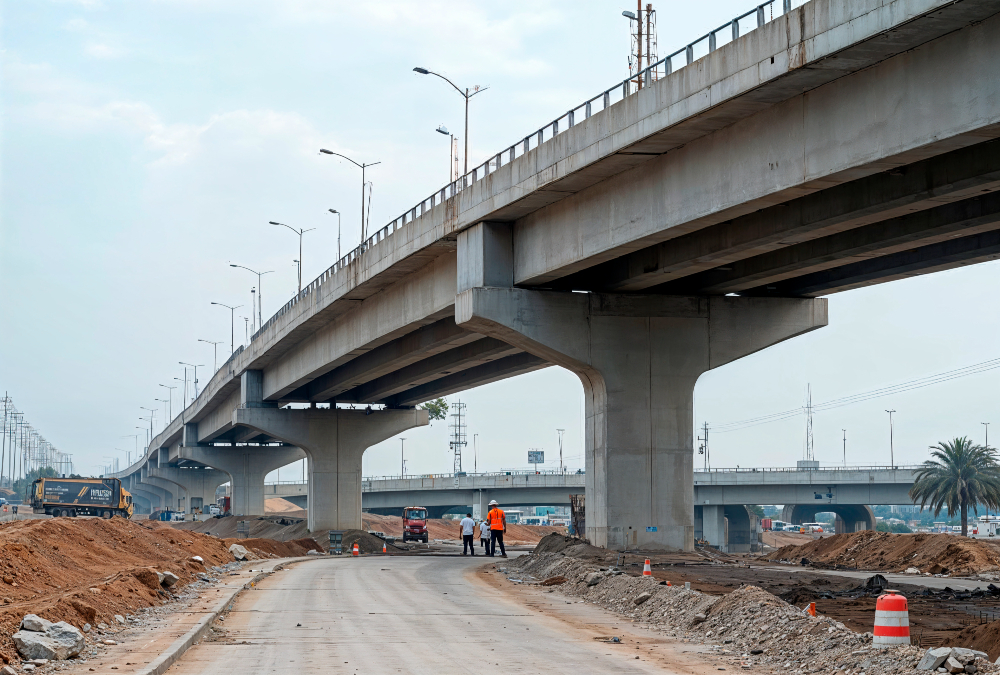
The highway, known as the CCTH, threads through ten countries: Egypt, Sudan, Ethiopia, Kenya, Tanzania, Zambia, Zimbabwe, Botswana, and South Africa. Egypt has already completed its 1,155-kilometer (718-mile) section, including specialized concrete lanes engineered for heavy freight traffic, terminating at the Argeen border crossing into Sudan.
The full corridor is projected to open by 2027. When it does, the drive from Cairo to Cape Town – a journey that today requires navigating a patchwork of crumbling roads, redundant border crossings, and improvised detours – could theoretically be completed in five days.
A Corridor Built on Economic Ambition
That figure alone is striking. Africa currently loses an estimated US$100 billion annually to poor intra-continental connectivity.
The CCTH, in theory, begins to address that wound directly. Egypt has set an ambitious target of growing its annual exports to African markets to US$30 billion within three to five years of the highway’s completion, a figure that would represent a dramatic acceleration of southward trade flows.
Reduced logistics costs, faster delivery times, and more predictable supply chains would benefit not just Egyptian exporters but every economy along the route.
Cairo is also thinking beyond the main corridor. A complementary US$500 million road is being developed to link the Red Sea coast to Chad via Libya – a 1,720-kilometer (1,069-mile) route designed to give landlocked Chad access to Egyptian ports such as Safaga.
It is an illustration of how the CCTH is being conceived not merely as a single road, but as the spine of a broader regional logistics network.
The Conflict Zones That Could Derail Everything
And yet, the highway’s completion date is almost certainly the least complicated part of this story. The route passes through some of the most politically fragile and conflict-affected territory on the planet.
Sudan, which the highway must traverse for a substantial stretch, has been engulfed in a devastating civil war since April 2023, with fighting between the Sudanese Armed Forces and the Rapid Support Forces reducing entire cities to rubble and displacing millions. There is no credible timeline for when Sudan’s section of the highway will be safe for commercial transit, let alone for the kind of sustained high-volume freight movement the project envisions.
The Horn of Africa presents further complications, with persistent instability in parts of Ethiopia adding additional uncertainty to the corridor’s operational viability.
Asphalt Is the Easy Part
Physical gaps and security bottlenecks are, in many respects, the more tractable problems. Pavement can be laid when conditions allow.
The deeper challenge is what infrastructure specialists sometimes call the “soft” layer: the customs procedures, regulatory frameworks, visa policies, and digital logistics platforms that determine whether a road actually functions as a trade corridor or merely as an expensive strip of asphalt.
A truck driver crossing from Zambia into Zimbabwe, or from Ethiopia into Kenya, can face delays measured not in hours but in days, thanks to redundant documentation requirements, inconsistent border agency procedures, and outright corruption. No amount of well-engineered concrete resolves those frictions on its own.
The African Continental Free Trade Area (AfCFTA), which entered into force in 2021, provides at least a partial framework for addressing these barriers. But implementation has been uneven, and the political will required to harmonize customs and trade policy across ten sovereign nations – each with its own fiscal interests and bureaucratic inertia – should not be underestimated.
Regional integration in Africa has a long history of ambitious declarations and halting follow-through.
A Vision Worth Defending – With Eyes Wide Open
None of this is an argument against the CCTH. On the contrary, the project represents precisely the kind of long-horizon, continent-scale thinking that African development has often lacked.
The economic logic is sound, the engineering is proceeding ahead of most expectations, and the symbolism of a continuous road linking Cairo to Cape Town carries genuine weight at a moment when African leaders are increasingly asserting the continent’s capacity to shape its own future.
But infrastructure optimism has a poor track record when it outruns political realism. The CCTH will not transform African connectivity simply by existing.
It will do so only if the governments along its route treat the highway not as a ribbon-cutting opportunity, but as an ongoing institutional commitment – one that demands sustained investment in border management, regulatory coordination, and security stabilization long after the last kilometer of road is paved.
The road may be 80 percent built. The harder work is only just beginning.
Mark-Anthony Johnson is the founder and CEO of JIC Holdings, a global asset and investment management firm founded in 2009. With over 30 years of experience and strong ties to Africa, his investments span mining, infrastructure, power, shipping, commodities, agriculture, and fisheries. He is currently focused on developing farms across Africa, aiming to position the continent as the world’s breadbasket.
