
Opinion
Africa’s Infrastructure Myth: The Roads Are Already There


By John Kourkoutas
Western companies are losing billions waiting for African roads to look European – while competitors profit on the infrastructure that already exists.
The narrative persists with remarkable durability: Africa has no infrastructure. It’s repeated in boardrooms, development conferences, and investment reports with the certainty of received wisdom.
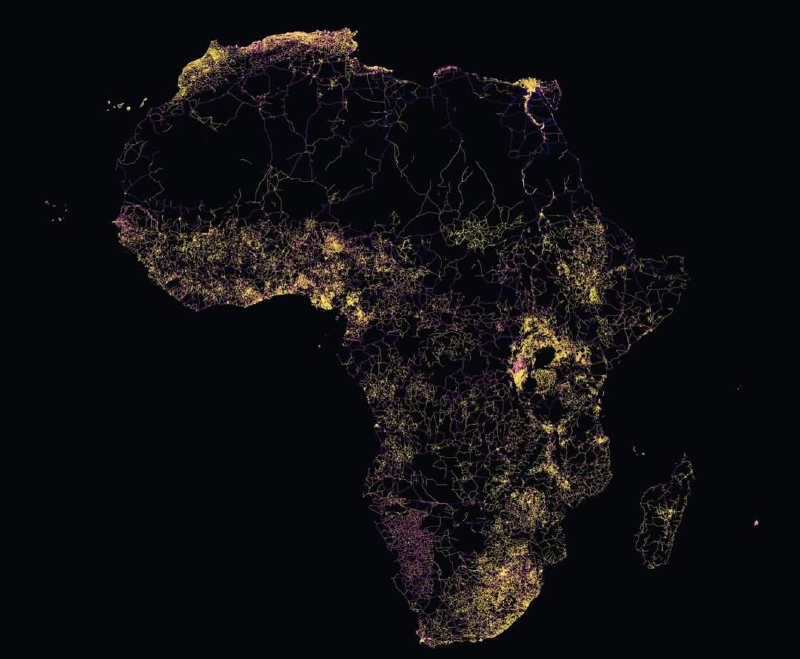
Yet this assertion crumbles under the most basic scrutiny – a glance at any contemporary road network map of the continent.
Those yellow lines crisscrossing the map? Those are roads. And they are everywhere.
The Infrastructure That Dare Not Speak Its Name
North Africa’s road density rivals Europe’s. South Africa’s network connects cities and regions with German-like efficiency.
Nigeria boasts higher road density than Scandinavia. The East African corridor links ports to landlocked nations in an unbroken chain.
West Africa’s coastal route runs continuously from Mauritania to Nigeria. Even the supposedly impenetrable barriers – the Sahara, the Congo Basin, the Sahel – are traversed by functioning road networks.
These roads exist. They are mapped, maintained, and most importantly, used every single day to move goods, people, and services across a continent generating over US$2 trillion in annual GDP.
The European Highway Fallacy
The reflexive objection reveals the underlying assumption: “But they are not paved European highways!” Precisely.
And therein lies the fundamental misunderstanding that costs Western companies billions in lost opportunities.
African logistics doesn’t require German autobahns to function effectively. Infrastructure isn’t an abstract ideal measured against European or North American standards – it’s a functional system measured by three practical criteria: Does it move goods? Does it connect markets? Does it work?
When Lagos requires a multi-lane highway for its exploding urban population, Lagos builds one. When rural Tanzania needs a dirt road adequate for local traffic patterns, that road serves its purpose admirably.
Infrastructure sophistication must match actual demand, not theoretical perfection.
The Competitive Advantage of Adaptation
European and American firms routinely lose lucrative African contracts because they are waiting for “infrastructure maturity” – a euphemism meaning they expect African nations to invest billions rebuilding perfectly functional roads to match their operational comfort levels. This is strategic paralysis masquerading as prudence.
Meanwhile, Chinese logistics companies, Turkish freight operators, and Indian trading firms are moving goods profitably on these exact same roads. They have adapted their vehicle fleets, adjusted their logistics models, and optimized their supply chains for existing conditions rather than hypothetical ones.
What Western companies perceive as an “infrastructure gap” has become their competitors’ decisive advantage.
The calculation is stark: while Western firms conduct feasibility studies and await infrastructure upgrades, nimble competitors are capturing market share, building relationships, and establishing dominance in the world’s fastest-growing consumer markets.
Misdiagnosing the Problem
The persistent claim that Africa lacks infrastructure reflects a deeper failure of imagination and commitment. When companies declare they cannot operate without European-standard roads, they are not identifying an African problem – they are confessing their own inability or unwillingness to adapt.
This matters because Africa’s infrastructure is rapidly evolving. The African Development Bank reports over US$130 billion in annual infrastructure investment across the continent.
New highways, bridges, and ports are transforming regional connectivity. But this development is happening on African terms, driven by African priorities, and optimized for African contexts.
Companies that recognize and work with existing infrastructure today will be positioned to benefit from tomorrow’s upgrades. Those waiting for Africa to become Europe will find themselves permanently outmaneuvered by more agile competitors who never needed to wait.
The Yellow Lines Don’t Lie
The evidence is literally mapped. The roads exist. Trucks traverse them daily. Economies function on them. The only question is whether Western businesses will acknowledge this reality and adapt their strategies accordingly, or continue losing ground while insisting the infrastructure they need isn’t there.
The yellow lines on the map represent more than roads – they represent opportunity, connectivity, and the infrastructure foundation of a US$3 trillion economy projected to double by 2030. Those lines are already there.
The question facing businesses isn’t whether Africa has infrastructure. The question is whether you are ready to use it.
John Kourkoutas is business development expert that specializes in helping companies, export teams, and business leaders succeed in Africa’s dynamic and emerging markets.
