
Opinion
Africa’s Greatest Resource Is Not Underground – It Is in Its People

By Lance Chisue
The continent’s true competitive advantage lies in its people – and the leaders who invest in them know it.
For generations, the story of Africa’s economic potential has been told in terms of what lies beneath its soil: gold, diamonds, cobalt, oil, lithium, copper. The continent holds an extraordinary share of the world’s natural wealth.
And yet, resource abundance has rarely translated into broad-based prosperity. History, repeated across every continent, offers a sobering lesson – raw materials alone do not build great economies. People do.
Africa’s most consequential strategic asset in the twenty-first century is not buried in any mine. It is walking to school, launching a startup, learning to code, and coming of age in the fastest-urbanizing region on earth.
More than 60 percent of Africa’s population is under the age of 25, with a median age hovering around 19. By 2050, the continent’s population could reach 2.5 billion – and its working-age cohort will be the largest single driver of global labor supply.
This is not a demographic footnote. It is a structural shift with the power to reshape the world economy.
Economists call it the demographic dividend: the accelerated growth that becomes possible when a rising workforce outpaces dependents, savings rates climb, and productivity surges. East Asia harnessed this dynamic to spectacular effect in the latter half of the twentieth century.
Africa now stands at a similar inflection point. By 2030, the continent could account for 40 percent of the world’s young people, with its 15-to-35 cohort already numbering around 530 million and growing.
But a dividend is not guaranteed. It must be earned.
The Skills Gap That Cannot Be Ignored
The challenges are real and should not be minimized. Youth unemployment across much of Africa remains stubbornly high, with NEET rates – young people not in employment, education, or training – hovering around 23 percent in many countries.
Literacy among youth in sub-Saharan Africa stands at approximately 77 to 80 percent, a figure that lags considerably behind global benchmarks. And perhaps most corrosively, a pervasive skills mismatch leaves graduates academically credentialed but practically underprepared for the jobs that exist – or that need to be created.
Nelson Mandela understood the stakes with characteristic clarity: “Education is the most powerful weapon which you can use to change the world.” That conviction has never been more economically precise.
Quality education, with a strong emphasis on STEM disciplines, vocational and technical training (TVET), digital literacy, and sustained investment in public health, is what converts demographic potential into measurable productivity. Human capital – educated, healthy, connected, and mobile – is emerging as Africa’s most investable and competitively distinctive resource in an era when the rest of the world is aging rapidly.
Progress is already visible. School enrollment rates are rising across the continent.
Digital hubs are proliferating in Nairobi, Lagos, Accra, and Kigali. Youth-led entrepreneurship is producing companies that are solving distinctly African problems in distinctly African ways – often leapfrogging the infrastructure constraints that would have stymied earlier generations.
The continent’s future, in short, is not defined by extraction. It is being built in innovation labs, classrooms, and co-working spaces.
Accelerating that momentum, however, demands urgent structural reform: bridging the gap between classroom learning and labor market demand, expanding access to affordable internet, and creating the regulatory conditions in which young enterprises can survive their first years and scale.
Powering the Transformation: Africa’s Off-Grid Solar Surge
No investment in human capital can reach its full potential in the dark. Which makes the second great transformation underway across Africa inseparable from the first.
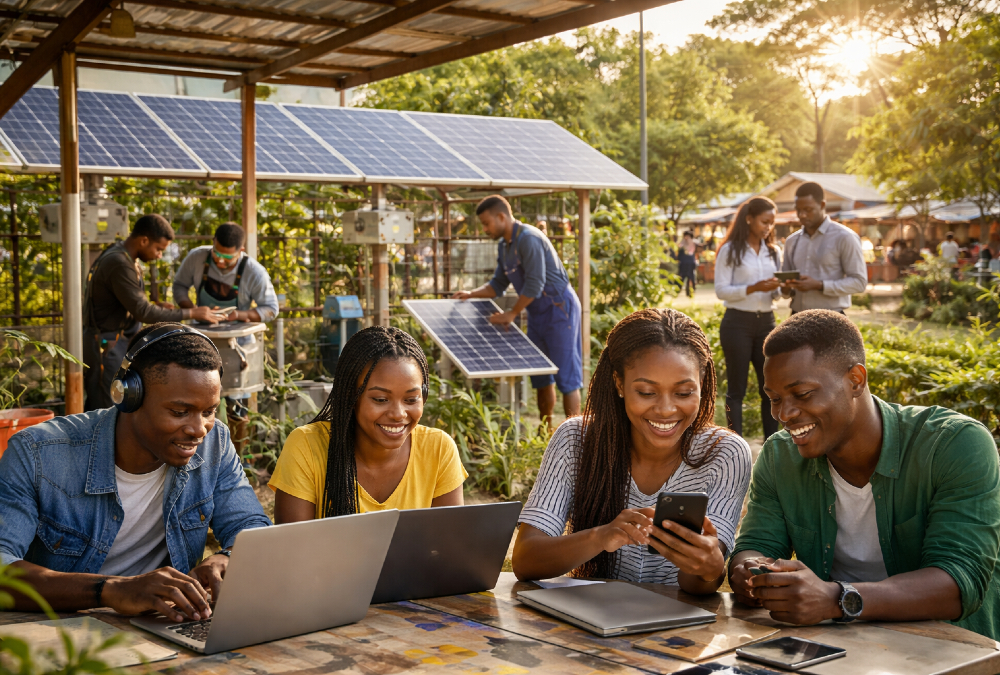
Solar energy has never been cheaper, and decentralized power is scaling faster than almost any infrastructure technology in the continent’s history. Across rural and peri-urban Africa, mini-grids, micro-grids, and flexible mesh-grid systems are delivering electricity to communities that have never had it – not as a temporary fix, but as permanent, reliable infrastructure.
The economics have shifted decisively. What once required massive centralized investment can now be deployed modularly, financed incrementally, and maintained locally.
The concept driving the most transformative outcomes is what practitioners call the Productive Use of Energy, or PUE – electricity that does not merely illuminate homes but directly generates income.
Farmers use solar-powered irrigation to water fields through dry seasons and cold-chain refrigeration to keep harvests marketable far longer than before. Small businesses run grain mills, welding equipment, and refrigerated display cases that were simply inaccessible without reliable power.
Communities process crops closer to where they are grown, charge the mobile devices that connect them to markets and financial services, and dramatically reduce their dependence on expensive, polluting diesel generators.
The cumulative effect is a virtuous cycle: energy access enables productivity, productivity generates income, income creates demand, and demand attracts further investment. Africa is now among the fastest-growing renewable energy markets in the world, and the social returns – in food security, job creation, and economic resilience – are compounding alongside the financial ones.
None of this happens by accident. The off-grid energy surge is thriving because of deliberate collaboration among developers, policymakers, investors, and the communities they serve.
Smart regulation that recognizes the legitimacy of decentralized solutions, blended finance instruments that reduce risk for private capital, and community engagement models that align incentives from the outset – these are the elements that distinguish successful deployments from stalled ones.
The Case for Strategic Investment
Taken together, Africa’s human capital opportunity and its renewable energy transformation are not separate stories. They are the same story told from two angles.
Educated, skilled young people need the power to run the devices, businesses, and institutions that their education prepares them for. Communities with reliable electricity have stronger incentives to keep children in school, attract qualified teachers, and sustain the health clinics that keep workforces productive.
The investors, development institutions, and policymakers who grasp this interconnection – and who act on it with the urgency the moment demands – will find themselves on the right side of one of the most consequential economic transformations of the century.
The continent’s mines will continue to matter. But the minds – trained, connected, and energized – will matter more. The charge, as they say, is on.
Lance Chisue is the Founder and CMO of Sales Connect Africa, a Pretoria-based firm specializing in helping manufacturers enter and grow in Southern African markets. He leverages sales expertise and strategic visibility to connect products with buyers, supporting manufacturers in navigating complex regional market dynamics and distribution channels. Lance is dedicated to empowering manufacturers to succeed by bridging gaps between products and customers in emerging African markets
