
Opinion
Africa’s Food Movement Crisis: A Continent That Grows Plenty, But Moves Too Slowly
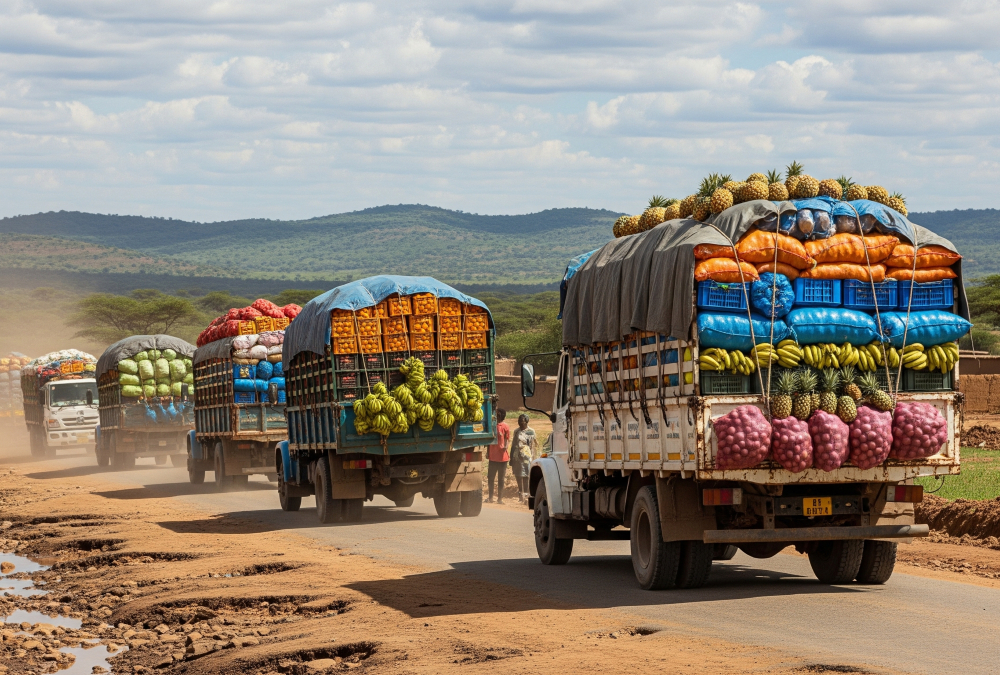

By Dishant Shah
Africa feeds the world – and yet, it struggles to feed itself efficiently.
Consider this: the average journey of food across the African continent spans 4,000 kilometers (2,490 miles) and takes 23 days to reach consumers. That’s nearly four times longer than in Europe, where similar goods arrive in just six days.
For a continent blessed with 60 percent of the world’s uncultivated arable land, this delay isn’t a flaw – it’s a systemic failure.
The problem isn’t scarcity. It’s stagnation.
Africa produces enough food to nourish its 1.4 billion people. But too often, crops rot in fields, fish spoil before reaching markets, and staples vanish before they can be sold.
The culprit? A broken logistics chain that treats movement as an afterthought.
The Hidden Cost of Poor Infrastructure
The journey from farm to fork in Africa is a gauntlet of delays. Roads that are unpaved, poorly maintained, or simply abandoned mid-construction force trucks to crawl through potholes older than the drivers themselves.
Border crossings demand up to half a dozen bureaucratic stamps – each one adding hours, sometimes days, to transit times. Ports operate at less than half the global average efficiency, turning gateways into bottlenecks.
In logistics, time is money. In Africa, time is bureaucracy.
Take the route from Eldoret, Kenya, to Kampala, Uganda – a mere 350 kilometers (218 miles). A truck carrying maize can spend three to five days on this stretch.
Not due to distance, but because of weighbridges, inspections, and interminable queues at the Malaba border post. Contrast that with Europe, where a driver could cross three countries in the same window – without stopping once.
Meanwhile, tomatoes grown in northern Nigeria spoil before reaching Lagos. Fresh fish from Lake Victoria take longer to arrive in Nairobi than frozen salmon shipped from Norway. This isn’t just irony – it’s a crisis of connectivity.
The Human and Economic Toll
Post-harvest losses in Africa reach 30–40 percent of total production – not because farmers lack skill, but because supply chains lack strength. Every extra day in transit means spoiled food, lost income, and communities deprived of vital nutrition.
And the financial burden is staggering. Logistics costs in Africa consume up to 40 percent of the final price of goods, compared to just 10–15 percent in developed economies. This means a family in Dakar pays more for a bag of rice than a family in Paris – not because the rice is superior, but because it traveled a fractured, inefficient route.
This imbalance doesn’t just hurt consumers. It undermines local economies. Domestic producers, burdened by slow movement and high costs, cannot compete with imported goods – even when those goods have crossed oceans. The result? A paradox where Africa imports food it already grows, simply because moving it locally is harder than shipping it from abroad.
Unlocking Africa’s Potential
The opportunity for transformation is enormous. Studies suggest that if Africa could cut food transit time from 23 days to just 7 days, the impact would be profound:
- Farm incomes would rise significantly, lifting millions out of poverty.
- Food inflation would decline, making staples more affordable.
- Intra-African trade – currently just 15 percent of the continent’s total – could surge, fueling regional integration and economic resilience.
The African Continental Free Trade Area (AfCFTA) offers a bold vision: a unified market of 55 countries, reducing tariffs and harmonizing trade rules. But trade doesn’t flow on paper – it flows on roads, rails, and digital systems.
AfCFTA’s success hinges not on signatures, but on implementation. The real work lies in fixing border inefficiencies, digitizing customs processes, and ensuring that a truck driver spends time driving, not waiting.
The Way Forward
Africa does not have a food production problem. It has a food movement problem.
The continent doesn’t need to grow more – it needs to move smarter. Investments must shift from isolated infrastructure projects to integrated logistics ecosystems:
- Modernize regional transport corridors
- Automate border clearance with digital platforms
- Upgrade port efficiency through public-private partnerships
- Empower regional bodies to enforce cross-border standards
The question is no longer can Africa feed itself – but will it move what it already grows?
The answer will determine not just food security, but the future of African economies. Before chasing new crops or foreign imports, Africa must master the most basic act of trade: getting food from point A to point B – quickly, efficiently, and affordably.
Because in a continent rich with resources, the greatest untapped potential may not be in the soil – but in the speed of its supply chains.
Dishant Shah is a partner at Legion Exim, a company specializing in facilitating the export of high-quality engineering products directly sourced from manufacturers in India to Africa. His areas of expertise include new business development and business management.
