
Opinion
Africa’s Economic Powerhouses: The Top 15 Largest Economies in 2025

By Des H Rikhotso
As Africa navigates a decade of transformation, its economic landscape is evolving with remarkable speed and complexity. Driven by a confluence of demographic dynamism, digital innovation, natural resource wealth, and strategic reforms, the continent is increasingly asserting itself on the global stage.
In 2025, the rankings of Africa’s largest economies – measured by nominal gross domestic product (GDP) – reveal both enduring powerhouses and emerging contenders reshaping the narrative of African growth.
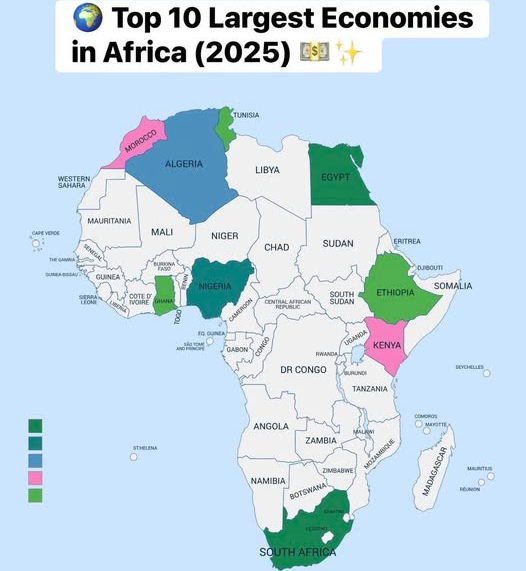
Here are the top 15 largest economies in Africa in 2025:
- Nigeria – US$472 billion
- Egypt – US$469 billion
- South Africa – US$405 billion
- Algeria – US$255 billion
- Ethiopia – US$205 billion
- Morocco – US$173 billion
- Kenya – US$141 billion
- Angola – US$136 billion
- Tanzania – US$101 billion
- Côte d’Ivoire (Ivory Coast) – US$86 billion
- Democratic Republic of the Congo – US$80 billion
- Ghana – US$78 billion
- Sudan – US$70 billion
- Cameroon – US$68 billion
- Uganda – US$62 billion
A Continent on the Move
Nigeria retains its position as Africa’s largest economy, buoyed by its vast population, growing fintech sector, and ongoing efforts to diversify beyond oil. Yet the gap with Egypt – long a regional heavyweight in finance, tourism, and energy – is narrowing. Egypt’s strategic investments in infrastructure, renewable energy, and digital governance have positioned it as a key node in global trade corridors linking Africa, Europe, and Asia.
South Africa, despite structural challenges and energy constraints, remains the continent’s most industrialized economy and a critical gateway for foreign direct investment. Meanwhile, Ethiopia and Côte d’Ivoire exemplify the potential of policy-driven growth: both have sustained high GDP expansion through agricultural modernization, export diversification, and public investment in transport and logistics.
Notably, resource-rich nations like Angola and the Democratic Republic of the Congo are leveraging their mineral endowments – not just oil and gas, but also cobalt, copper, and lithium – to attract green-tech investments aligned with the global energy transition.
The Engines of Growth
Africa’s economic momentum is underpinned by four key drivers:
- Demographics: With the world’s youngest population, Africa’s labor force is expanding rapidly, creating both opportunity and urgency for job creation.
- Digital Leapfrogging: From mobile money to AI startups, tech ecosystems in Lagos, Nairobi, Cairo, and Accra are redefining financial inclusion and entrepreneurship.
- Agricultural Transformation: Agribusiness is emerging as a multi-billion-dollar sector, with countries like Ghana, Kenya, and Tanzania investing in value addition and export competitiveness.
- Regional Integration: The African Continental Free Trade Area (AfCFTA) is gradually unlocking intra-African trade, reducing reliance on external markets and fostering industrial corridors.
Challenges Ahead
Despite this optimism, structural vulnerabilities persist. Currency volatility, debt distress (particularly in Sudan and Ghana), climate risks, and uneven governance continue to pose significant headwinds.
Sustainable growth will require not just macroeconomic stability, but deep institutional reforms, investment in human capital, and inclusive policies that translate GDP gains into broad-based prosperity.
Looking Forward
The 2025 rankings are more than a snapshot – they signal a continent in flux. While Nigeria, Egypt, and South Africa dominate in absolute size, the fastest-growing economies often lie further down the list.
Tanzania, Ivory Coast, and Uganda, for instance, are posting GDP growth rates well above the global average, suggesting that tomorrow’s leaders may come from today’s mid-tier economies.
As global investors recalibrate their strategies in a multipolar world, Africa’s economic diversity, strategic resources, and youthful dynamism make it impossible to ignore. The question is no longer if Africa will rise – but how it will shape its own trajectory in the 21st century.
Des H Rikhotso (PgDip-BA, MBL) is a seasoned C-suite Multi-Industry business executive with 25+ years of Business Leadership Experience across the South, East and Western Sub-Sahara Africa Region. Based in Kampala, Uganda he serves as East Africa Region Business Executive, driving Business Strategic Growth and Operational Excellence – contributing his Leadership Voice and Clarity to the Region. Des has held Business Leadership roles at BMW Group Africa, Volkswagen Group Africa, Peugeot Motors South Africa, Toyota/Lexus South Africa, Nissan Group of Africa, G.U.D Holdings (Africa Exports Operations Division) and The HDR Group of Companies. He holds Under-Graduate and Post-Graduate business degrees from the University of the Western Cape, Wits University (Wits Business School) and the University of South Africa.
