
Opinion
Africa’s Competitive Future Hinges on Integration, Not Just Infrastructure

By Danilo Desiderio
At the World Economic Forum in Davos, a provocative thesis emerged from the corridors of global finance: Africa’s 1.3 billion people represent potential, not power – at least not yet. The Executive Vice President for Global Trade Bank at Afreximbank delivered a stark assessment that should trouble policymakers across the continent.
Africa’s demographic advantage, long touted as an inevitable economic windfall, means little if the continent continues operating as 54 separate economies rather than one integrated market.
The comparison he drew was unflattering but necessary. China and India possess populations roughly equivalent to Africa’s, yet they compete globally with vastly superior economic coherence.
The difference is not demographic scale but institutional architecture. While African leaders routinely celebrate the continent’s population as a competitive asset, the reality is more sobering: size without integration delivers fragmentation, not market power.
The Coherence Gap
China’s economic unity stems from centralized state control and decades of enforced coordination. India’s integration rests on federal architecture, common legal frameworks, and shared regulatory standards.
Africa has neither. Instead, it operates as a union of sovereign states, each pursuing divergent development strategies shaped primarily by domestic political calculations rather than continental imperatives.
The African Union provides valuable coordination and agenda-setting, but it lacks the autonomous decision-making authority and enforcement mechanisms that would enable genuine continental coherence. Unlike its Asian counterparts, Africa must build integration through negotiated frameworks and shared incentives – a slower, more uncertain path that requires compensating for fundamental governance constraints.
The result? Africa remains demographically large yet economically fragmented, possessing theoretical scale that proves difficult to mobilize in practice.
Its trade flows reflect this dysfunction: African countries often find it easier to trade with Europe or Asia than with their immediate neighbors, a legacy of colonial-era infrastructure designed to extract resources rather than connect economies.
From Borders to Corridors
The solution, according to Afreximbank’s vision, requires a fundamental shift from border-centric thinking to corridor-based development. Rather than pursuing isolated national infrastructure projects, African states should jointly identify strategic investments with maximum impact on intra-African trade.
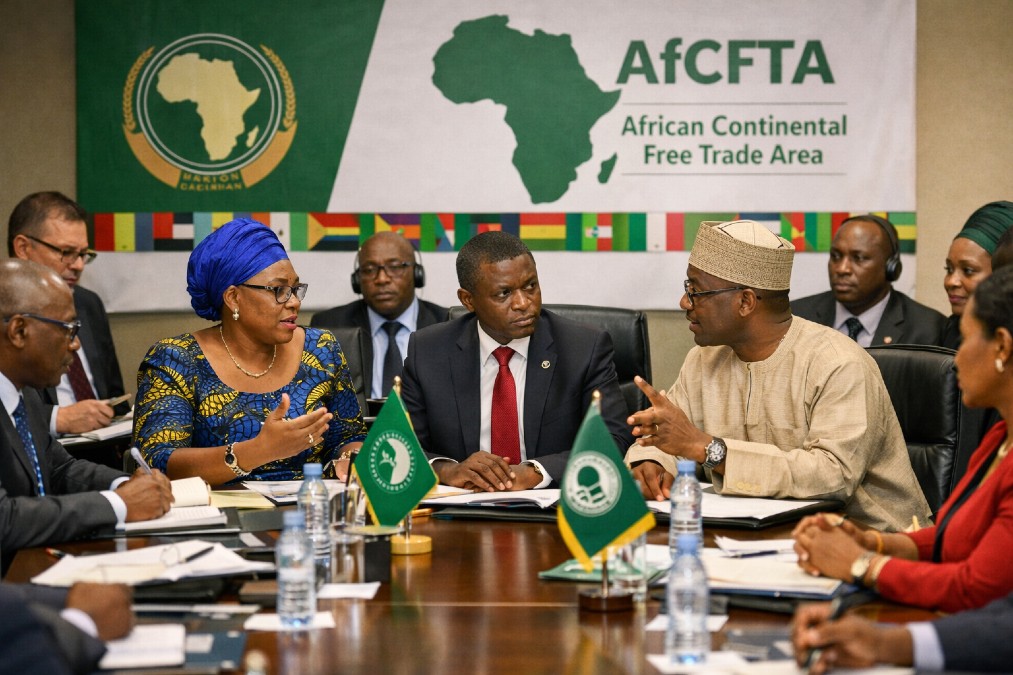
This is not mere conceptual posturing. The African Continental Free Trade Area (AfCFTA) Secretariat has already begun assessing priority trade corridors – including the Abidjan-Lagos, Northern, Central, North-South, and Central Africa routes – identifying bottlenecks and prioritizing interventions that align transport, logistics, and trade facilitation with continental integration objectives.
Afreximbank’s broader vision encompasses major ports, key airports, and navigable waterways as components of an integrated connectivity strategy. The goal is functional connectivity rather than comprehensive coverage: enabling goods to move efficiently across borders and eliminating the structural inefficiencies that currently force African trade to detour through extra-continental hubs.
The Political Economy of Integration
Yet infrastructure alone cannot overcome Africa’s integration challenge. Borders are not merely cartographic lines but revenue collection points where governments exercise regulatory control and domestic interests benefit from existing arrangements.
Without addressing these political and economic realities, trade corridors risk becoming technical fixes imposed on unchanged incentive structures that will continue distorting cross-border commerce.
Afreximbank emphasizes that corridors must anchor well-structured, multi-country projects actively promoting value addition within Africa. By connecting raw material suppliers, manufacturers, and consumers across borders, these initiatives can transform fragmented supply chains into integrated regional value chains.
Success, however, depends on clear governance, careful sequencing, and effective enforcement.
Critical questions remain unanswered: Who decides priorities when national interests diverge? How are costs and benefits equitably shared among participating countries?
How is compliance ensured when domestic political pressures conflict with continental commitments? Without robust coordination mechanisms and reliable dispute resolution frameworks, even the most ambitious corridor plans risk stalling during implementation.
Finance as Catalyst, Not Cure
Large, coordinated projects attract more sustainable investment than isolated initiatives. Institutions like Afreximbank can play catalytic roles by anchoring investments, deploying balance sheets to crowd in private capital, and creating vehicles enabling diaspora participation in long-term continental development.
But finance cannot overcome coordination failures alone. It must accompany regulatory harmonization, trade facilitation reforms, and institutional capacity-building along corridor routes themselves.
The underlying proposition is straightforward yet powerful: Africa cannot compete globally while remaining a patchwork of disconnected economies.
The Institutional Imperative
African integration ultimately requires more than roads, ports, or corridors. It demands sustained political commitment, credible institutions, and effective continental coordination mechanisms.
Current treaties establishing the African Union and Regional Economic Communities rely heavily on voluntary compliance and consensus, limiting institutional capacity for decisive action.
Granting these bodies autonomous authority in key economic areas – including the power to negotiate agreements and pursue integration objectives without individual state vetoes – alongside full financial autonomy, would require significant legal reforms and broad ratification by member countries. An immediate grant of full autonomy appears politically unrealistic.
A phased approach combining gradual authority delegation, clearly defined mandates, accountability mechanisms, and alignment with domestic incentives offers better prospects for success. Without empowering regional and continental institutions, even well-designed corridors and integration projects will reproduce existing inefficiencies at scale.
The Path Forward
Africa faces a fundamental choice. It can continue operating as 54 separate markets, celebrating demographic scale while accepting economic fragmentation.
Or it can pursue the difficult institutional reforms necessary to function as an integrated economic system capable of competing with China, India, and other global powers.
The corridor approach offers a pragmatic starting point – tangible projects delivering visible benefits that can build momentum for deeper integration. But corridors alone will not transform Africa’s competitive position.
Only sustained institutional reform, enabling effective cross-border coordination and enforcement, can convert demographic potential into genuine economic power.
The question is not whether Africa has the resources or population to compete globally. It has both in abundance.
The question is whether African leaders possess the political will to build the institutional architecture that would allow the continent to function as the integrated economy its population size suggests it should be. Until that question receives an affirmative answer, Africa’s competitive disadvantage will persist – not because of what it lacks, but because of what it has failed to organize.
Danilo Desiderio serves as the CEO of Desiderio Consultants Ltd in Nairobi, Kenya, specializing in African customs, trade, and transport policies. He is a customs and trade expert at the World Bank and a senior associate to the Horn Economic and Social Policy Institute (HESPI).
