
Opinion
Africa’s Coffee Paradox: From Bean to Brand, the Path to Global Value

By Jean Claude Niyomugabo
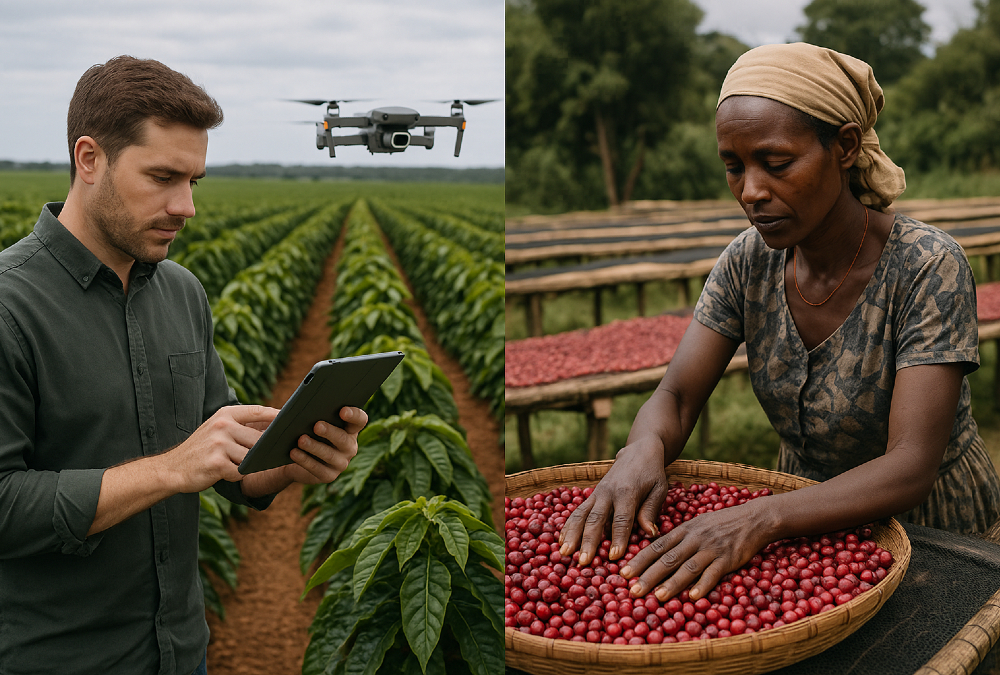
In the lush highlands of Brazil, a coffee farm operates like a precision-engineered symphony. Artificial intelligence scans each cherry for ripeness.
Cloud-connected dryers optimize moisture levels. Drones survey soil health, while automated roasters prepare premium beans for export – all under a single, vertically integrated brand sold in cafes from Berlin to Tokyo.
This is Company A: a model of modern agribusiness, capturing nearly every dollar from soil to cup.
Now, cross the Atlantic to Ethiopia – the birthplace of coffee – where Company B, a cooperative of hundreds of smallholder farmers, tends some of the world’s most sought-after beans. Yet their reality is starkly different.
Manual pulping machines bruise delicate cherries. Beans dry on woven mats under erratic sun and sudden rains.
By the time green coffee reaches global markets, much of its potential value has evaporated. The farmers earn pennies per cup; others reap the profits.
This contrast is not just a tale of two companies. It’s a reflection of a systemic imbalance in the global coffee economy.
Africa produces 12 percent of the world’s coffee – more than Vietnam, the second-largest producer. Yet, the continent captures less than 5 percent of the US$200 billion global coffee market.
Why? Because too much of Africa’s coffee is exported as raw green beans, stripped of the value added by roasting, branding, and retail – value that accrues elsewhere.
The root of the gap lies in underinvestment in technology and local value addition. While Brazilian farms leverage AI to predict harvests and optimize yields, many African producers still rely on decades-old infrastructure.
The result? Inconsistent quality, post-harvest losses, and diminished bargaining power.
But the solution isn’t about replacing tradition with technology – it’s about empowering tradition with innovation.
Modernizing the Foundation
The first step is upgrading processing infrastructure. Simple interventions can have transformative effects:
- Modern pulping machines reduce waste and preserve bean integrity.
- Solar-powered drying units ensure consistent quality, even during rainy seasons.
- Automated washing stations improve cleanliness and flavor profiles.
Shared processing hubs – owned and operated by cooperatives – can make these technologies accessible and affordable. These centers would not only boost efficiency but also establish uniform quality standards, essential for premium market access.
Adding Value at Home
Africa must stop exporting its potential. Instead of shipping green beans to Europe and Asia for roasting and branding, the continent should roast, package, and market its own coffee.
Imagine: “Ethiopian Heirloom Dark Roast” on shelves in New York. “Ugandan Single Origin Ground” in Seoul. “Rwandan Cold Brew Ready-to-Drink” in London – each carrying a proudly African brand.
Local value addition means more jobs, higher incomes, and greater resilience. When a farmer’s coffee is roasted in Addis Ababa instead of Amsterdam, the economic benefits stay local.
Harnessing Digital Innovation
Technology is no longer a luxury – it’s a necessity. Digital tools can revolutionize smallholder farming:
- AI-powered apps analyze satellite data to monitor crop health and predict yields.
- Mobile marketplaces connect farmers directly to international buyers, cutting out exploitative middlemen.
- Blockchain traceability allows consumers to scan a QR code and see the journey from farm to cup – boosting trust, transparency, and premium pricing.
With these tools, Company B wouldn’t just survive – it would thrive, commanding better prices and building direct relationships with global customers.
Quality Was Never the Issue
Let’s be clear: African coffee is already world-class. The problem isn’t the bean; it’s the broken value chain.
The difference between Company A and Company B isn’t agricultural talent – it’s technology, ownership, and control.
Africa doesn’t need charity in the coffee trade. It needs equity. It needs investment. It needs the chance to compete on a level playing field.
The Future Is Full-Chain Control
The next generation of African agribusiness won’t just grow coffee – they will own the entire story.
From seed to sip. From farm to brand.
With targeted investments in processing infrastructure, digital tools, and branding, Africa can capture its rightful share of the coffee economy. The blueprint exists.
The demand is global. The time to act is now.
The billion-dollar African coffee brands of tomorrow are already growing in the highlands today. All they need is the support to rise.
Jean Claude Niyomugabo is an entrepreneur and digital communication specialist with a strong passion for Africa’s development. He is dedicated to harnessing the power of social media to drive positive change and enhance livelihoods. With diverse interests and a strategic approach to digital engagement, he strives to create meaningful impact through innovation and connectivity.
