
Opinion
Africa now has 643 Tech Hubs – which play “pivotal role” for business

By Toby Shapshak
Even though Africa’s tech hubs have grown to a new record of 643 across the continent, some 25 percent of them only provide coworking spaces, presenting an opportunity for greater growth, according to a new survey.
The research by AfriLabs and Briter Bridges is some of the most detailed about the tech hub ecosystem, and explores how the hubs finance themselves, offer startups.
It found that 41 percent of these facilities are incubators, 24 percent are nnovation hubs, 14 percent are accelerators and 39 percent offer coworking space.
Nigeria has the most hubs per country, with 90, followed by South Africa’s 78, Egypt 56 and Kenya’s 50 in the 34 countries it covered. The report – called “Building a conducive setting for innovators to thrive” – found the majority of the surveyed hubs received less than US$100,000 in funding from various sources, while 62.2 percent of hubs have less than 10 paid employees.
Almost half of the existing hubs consist of non-profit organizations or donor-funded organisations, with 60 percent of all respondents receiving funding. Donors, corporate sponsors, philanthropic organisations, and NGOs are the most active funders.
Excluding donor funding, the report found 53.3 percent of hubs charge a membership fee and 62.2 percent receive funding for initiatives.
Earlier this year a GSMA report found 618 active tech hubs, a 40 percent leap of “incredible growth” over the 442 hubs counted last year. These hubs have provided “the backbone of Africa’s tech ecosystem,” it said.
In September the two most well-known tech hubs in Africa combined, with Lagos’s CcHub buying iHUB in Nairobi. CcHUB chief executive officer Bosun Tijani said this was to “create a robust platform that’s capable of attracting the best resources and partnerships to accelerate the application of technology and innovation for economic prosperity across Africa”.
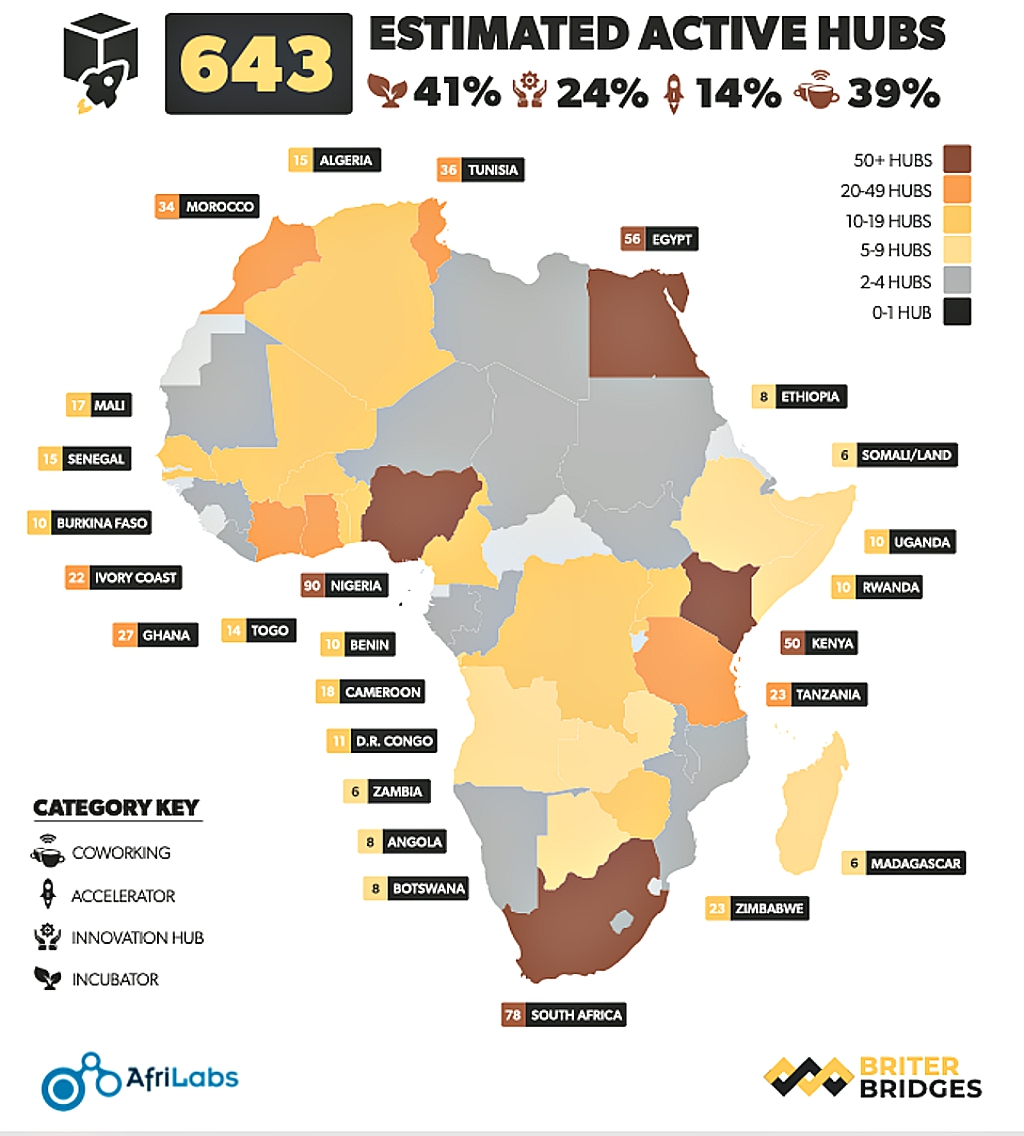
Africa has 643 active tech hubs, according to research from Briter Bridges and AfriLabs. IMAGE SOURCE/Briter Bridges
“Hubs represent a lot of potential in terms of facilitating growth and creating synergies across the entrepreneurial ecosystem, but just like the startups they support, they need a conducive environment to thrive,” Briter Bridges founder Dario Giuliani told me.
Two of the key constraints are the lack of adequate funding and stringent regulations, which he says could be addressed by “more visible and tangible support” from governments.
Temitope Isedowo, AfriLabs’ director of programmes, agrees. “I think governments mostly need to regulate less and make any regulation or policy intervention youth and stakeholders-led,” he told me.
Lisa With, co-head of research at Briter Bridges, also need support. “Hubs represent a lot of potential in terms of facilitating growth and creating synergies across the entrepreneurial ecosystem, but just like the startups they support – they need a conducive environment to thrive.”
Giuliani adds: “African economies are witnessing a fast rise in the degree of business activity,” with a special concentration in major cities such as Abidjan, Cairo, Dar es Salaam, Lagos and Nairobi. Several “secondary’” cities such as Alexandria, Douala, Ouagadougou and Mombasa are also showing signs of fast growth.
When it comes to startup funding, the report found 191 were funded by the surveyed hubs in 2018. “The fact that only 40 percent of the surveyed hubs offers funding to startups denotes the high diversity in the type of support that such organizations provide. Equity investment (30 percent) remains the most common type of funding although, as explained, hubs are often endowed with donor or sponsor money which is used for funding – often through competitions or at the end of an incubator or an accelerator programme.
“This type of cash injections are typically in the form of grants or non-equity (23 percent and 13 percent). Almost 25 percent of the funding is also in-kind and it is not uncommon to see mixed funding rounds including in-kind and equity investment. Finally, a small proportion includes debt financing (12 percent).”
Even the 25 percent of hubs who only offer coworking space is a huge advantage for many startups, adds Lisa With, co-head of research at Briter Bridges. “Fundamental to starting a new venture is having a reasonable, safe and inspiring setting to foster ideas. For many hubs, offering a working space that is based on collaboration and flexible terms of engagement is therefore also a logical starting point of support.
Toby Shapshak is the editor-in-chief and publisher of Stuff magazine; is a contributor to Forbes and writes a weekly column for the Financial Mail. He co-hosted a weekly TV show on CNBC Africa for the past 3 years. He writes and speaks about how innovation is better in Africa. His TED talk on how Africa is solving real problems has had over 1,4-million views; and he has been featured in the New York Times. More informstion about his work and publications are available at his website.
Forbes © Copyright 2019
