
Opinion
Africa: Large youth demographic is a dividend, not a time bomb – If we get the basics right
By Ghada Hammouda
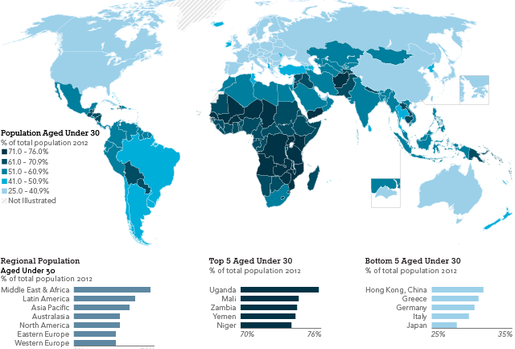
While advanced economies are facing the problem of an aging population, one of Africa’s most attractive assets both domestically and internationally is that it holds the world’s largest youth demographic. To those keeping close tabs on Africa, this burgeoning working age population serves as a stark reminder of the segment’s yield-able socio-economic power, should its full potential be harnessed at both government and private sector levels.
A major challenge for the region is creating enough jobs for the growing population. A recent World Bank report estimates that as many as 11 million young people in sub-Saharan Africa will be joining the job market every year for the next decade, and the risks associated with growing numbers of urban youth without meaningful employment are high. It is widely recognized that long-term economic growth can only be achieved through investment in a highly-skilled workforce.
From a macro point of view, leveraging Africa’s promising future requires a meeting of minds between governments and the private sector – where government policy encourages local actors to lead.
Buoyed by a growing power to dictate their own terms, African governments are increasingly implementing reforms in government policy and regulation with a collective objective that puts Africans first. In practical terms, what this can translate into on the labor market is local jobs for local people – a policy already well-established in the extractive sectors.
In theory, this strategy offers many positives. However, if a company chooses to weigh local identity over qualifications to fill a quota, these hires are unlikely to make significant contributions to the national purse.
In a recent report on the lack of employment among graduates in Africa, the British Council notes that there has been an increase in higher education in sub-Saharan Africa over the past decade. But at the same time, too few graduates acquire the skills they need to find work. Nowhere is this quality challenge more evident than the transition to the labor market. Graduate unemployment rates are high in many countries and employers across Africa complain of a lack of basic, technical and transferable skills. Given the pressures for expansion in many industries, absorption of graduates into the labor market will be a significant undertaking.
A lack of skills combined with limited access to quality education is a serious constraint for young people to contribute meaningfully to Africa’s economic growth.
PricewaterhouseCoopers’ recent 18th Annual Global CEO Survey revealed that business leaders are more concerned than ever about being able to find the right people to fill roles ahead of planned increased hires over the next year. Narrowing these data down to Africa specifically, alarmingly, 96 percent of CEOs are most concerned about the lack of skills available in-market, which echoes the trend of many multinationals preferring to “buy in” talent into their Africa-based operations.
The conversation positively changes, however, when African governments place requirements front and center for foreign investors to develop “local content”: to create jobs, open equity to local partners and invest in local supply chains – a model that has been proven conclusively in both Kenya and Egypt.
The national objective is clear: the transfer of knowledge and value to the local economy and to indigenous companies. The incentive for business should also be clear: businesses that can develop talent, procure inputs and market goods and services locally should be able to develop better operating margins and to protect long-term license to operate.
