
Opinion
Beyond Trade: Can Zero Tariff Really Ignite Africa’s Industrial Revolution?
Beijing has thrown open its markets to African exporters. Whether the continent finally industrializes will depend on choices made far from Chinese ports.

By Paul Frimpong
On May 1st, 2026, a quiet but consequential change took effect in the architecture of Africa–China trade: zero-tariff treatment across every eligible product line for qualifying African exports. Most of the commentary since has focused on the obvious metrics – trade volumes, export earnings, market access. Those numbers matter. But they also miss the more interesting question lurking underneath the policy.
For half a century, African governments have chased the same elusive goal: breaking the continent’s dependence on raw commodities and building real manufacturing capacity. Zero tariffs do not, by themselves, answer that challenge. What they do is something subtler and arguably more important – they create an opening. The real question is whether Africa treats this as a bigger door to the same old trade, or as the starting gun for something structurally different.
Put bluntly: is this just an invitation to export more, or a chance to finally produce differently?
What Zero Tariffs Actually Change – and What They Don’t
The mechanics are straightforward. Tariffs disappear on eligible goods moving from participating African countries into China, instantly making those goods more price-competitive in the world’s largest consumer market. For exporters, that means lower costs, easier entry, and potentially stronger demand.
What the policy cannot do is conjure factories out of thin air. Tariff elimination does not build skilled labor forces, install machinery, or create the institutions that turn raw materials into finished goods. It does not, on its own, move a country from shipping ore to shipping iPhones.
Zero tariffs, in other words, are an enabling policy – not a development strategy. They clear a path. They do not walk it for you.
From Raw Exports to Real Value: The Industrialization Test
Here is the uncomfortable possibility: this policy could simply make Africa more efficient at doing what it already does – exporting unprocessed commodities while importing the expensive, finished versions of those same goods. Cheaper access to China’s market is not automatically a step up the value chain; it could just as easily entrench the status quo at a larger scale.
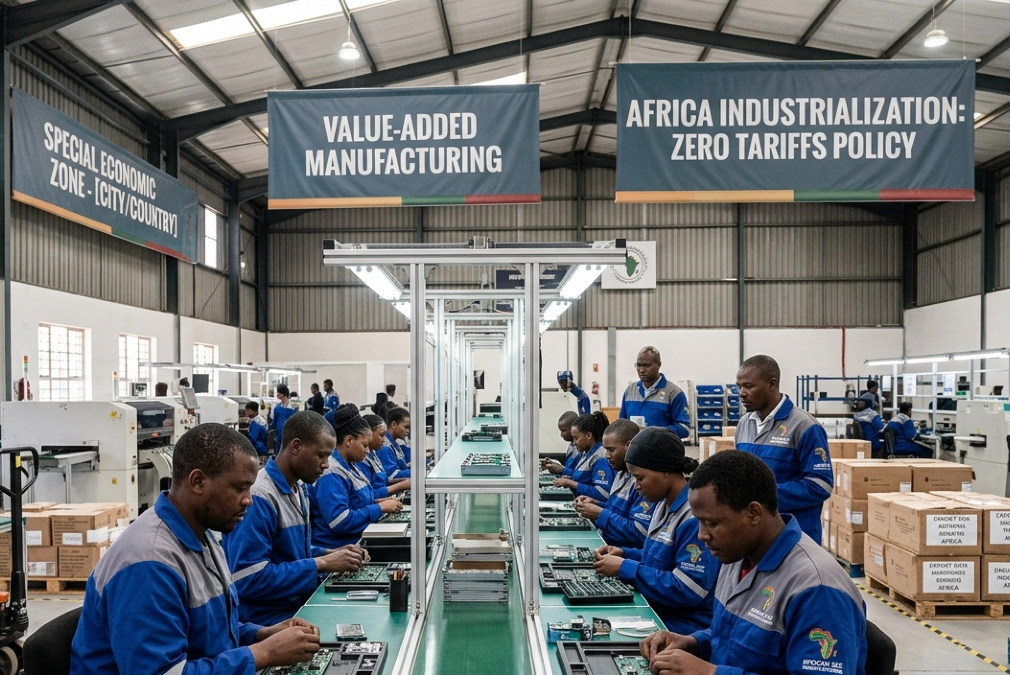
But it doesn’t have to. Instead of shipping raw cocoa beans, African producers could be exporting chocolate. Instead of raw cashews, roasted, packaged, branded cashews. The same logic applies across coffee, cotton, minerals, and a long list of agricultural goods currently leaving the continent in their least valuable form.
The objective should never have been exporting more. It should be exporting better. Value addition is where jobs get created, where skills compound, and where genuine industrial capability takes root.
So the real test of this policy isn’t how much Africa sells to China. It’s what Africa sells. Get that right, and zero tariffs become a meaningful stepping stone toward an industrial future the continent has chased for decades. Get it wrong, and they become a more efficient way of standing still.
Four Pathways to Turn Tariff Relief into Industrial Strategy
Zero tariffs cannot industrialize Africa unilaterally – but strategically leveraged, they can be the catalyst that tips several existing opportunities into motion.
Agro-processing and light manufacturing are the lowest-hanging fruit. Cocoa, cashews, coffee, textiles, leather, and processed foods already have proven export potential and stand to benefit immediately from easier access to Chinese buyers. Expanding processing capacity in these sectors creates jobs while simultaneously lifting export revenue.
Industrial clusters and Special Economic Zones offer a way to achieve scale that individual firms struggle to reach alone. Concentrating infrastructure, logistics, and business services inside designated industrial parks can turn scattered manufacturers into competitive, export-ready hubs serving both regional and global markets.
The African Continental Free Trade Area (AfCFTA) provides the missing regional dimension. By linking production across borders, African firms can build the scale needed to compete internationally – assembling regional value chains before finished goods ever reach a Chinese port.
Technology transfer and skills development remain the quiet, unglamorous prerequisite for everything else. Without access to modern equipment, technical know-how, and international quality standards, even well-positioned firms will struggle to climb the value chain.
None of this happens automatically. It has to be built, deliberately, around the opportunity zero tariffs have created.
African Governments Hold the Real Levers
Ultimately, the fate of this policy rests less with Beijing than with Accra, Abuja, Nairobi, and dozens of other capitals. Market access creates opportunity; only domestic policy converts opportunity into transformation.
Governments need to align industrial strategy with the sectors most likely to benefit – identifying where local processing and manufacturing can realistically scale, then backing that judgment with targeted tax incentives, accessible financing, and investment facilitation. Firms won’t move up the value chain on goodwill alone; they need a credible economic case to do so.
Infrastructure remains the unglamorous but unavoidable foundation. Reliable energy, functional transport networks, and efficient logistics determine whether a factory is competitive or merely aspirational. Institutions like Ghana’s Export Promotion Authority, along with similar trade and investment bodies across the continent, have a critical role connecting local producers to international buyers and quality standards.
Zero tariffs create the opportunity. Policy – or the absence of it – will decide whether that opportunity becomes anything more than a missed chance.
China’s Choice: Trading Partner or Industrial Partner
China’s role here extends well past granting market access. Chinese firms are already active across the continent in manufacturing, agro-processing, industrial parks, and infrastructure – the physical scaffolding of local production. The next phase of this relationship could deepen that involvement through joint ventures, integrated supply chains, and export-oriented manufacturing that genuinely helps African economies move up the value chain, rather than simply buying more raw material from them.
Industrial parks and special economic zones, in particular, could serve as testing grounds for technology transfer and skills development – turning China–Africa cooperation from a trading relationship into something closer to an industrial one.
The next chapter of this partnership shouldn’t just be about trading more. It should be about producing together.
Development Partners: Financing the Patient Work of Industrialization
Industrial transformation rarely pays off on a timeline that satisfies purely private capital. Long-term financing, risk-sharing mechanisms, and technical support – the kind development finance institutions specialize in – are often what stand between an idea and an operating factory.
The African Development Bank and similar institutions can de-risk investment in strategic sectors, drawing in private capital that would otherwise stay on the sidelines. Beyond financing, these partners can offer policy support, capacity building, and the kind of knowledge transfer that doesn’t show up on a balance sheet but matters enormously in practice.
Industrialization needs patient capital. It rarely arrives without coordinated effort.
From Trade Policy to Development Strategy
China’s zero-tariff policy is among the most significant market-access opportunities African exporters have been offered in years. But its real legacy won’t be measured in trade volumes or export receipts alone. It will be measured by whether it helped accelerate the structural transformation African economies have pursued, with mixed success, for generations.
Market access can spark incentives. Industrialization demands coordinated action: governments aligning policy with industrial ambition, businesses investing in value addition, China deepening productive partnerships rather than purely transactional ones, and development partners supplying the financing and technical scaffolding that scale requires.
The opportunity is genuine. Its success is not guaranteed. Converting tariff relief into manufacturing capacity, durable jobs, and real economic diversification will take deliberate choices – and sustained commitment – from everyone with a stake in the outcome.
Zero tariffs have opened a door. Whether Africa walks through it into an industrial future, or simply exports more of the same, will be decided by the choices made now.
Paul Frimpong is the Executive Director of the Africa-China Centre for Policy & Advisory (ACCPA). He is also a Development Economist and entrepreneur.
