
Opinion
Africa’s Digital Trade: Why Regional Blocs Hold the Key to Continental Integration
How the East African Community, ECOWAS, COMESA, and SADC are quietly building the regulatory scaffolding for the African Continental Free Trade Area’s digital future.
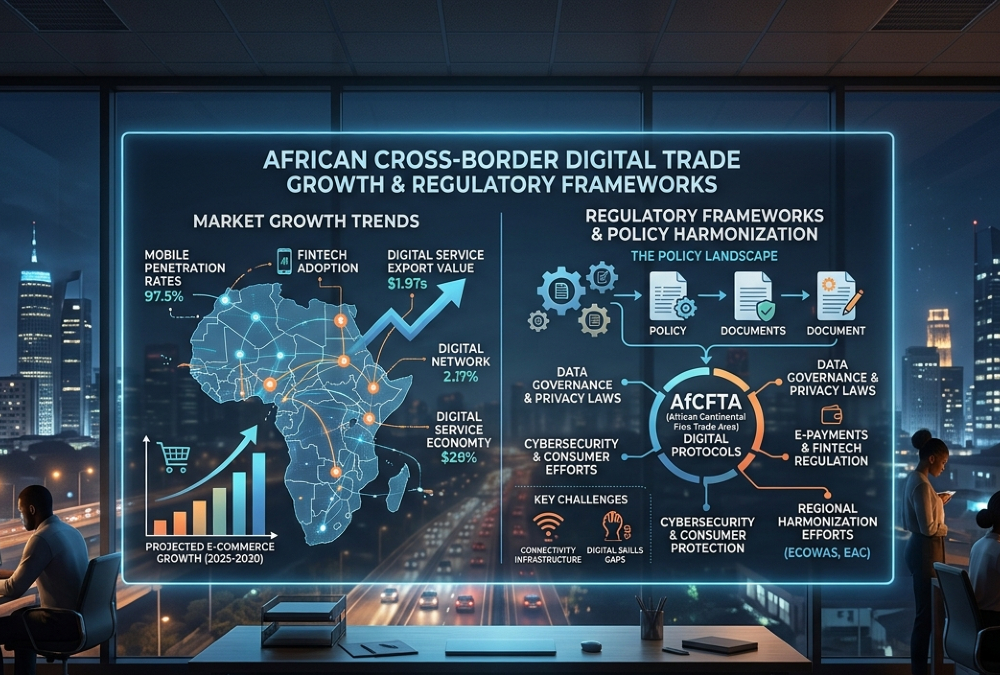

By Danilo Desiderio
Africa’s digital economy is expanding faster than the rules meant to govern it. Startups now ship code across borders as easily as farmers once shipped cocoa, but the legal terrain beneath them remains a patchwork of incompatible data laws, uneven cybersecurity standards, and customs systems that still run on paper in some capitals and blockchain pilots in others.
A joint report from the World Trade Organization (WTO) and the Organisation Internationale de la Francophonie (OIF), Digital Trade and Regulatory Frameworks: Pathways to Inclusive Growth, makes a persuasive case that closing this gap will determine whether the continent’s digital promise becomes a durable economic engine or remains a collection of disconnected national experiments.
The report’s core insight is deceptively simple: technology alone does not create a digital economy. Legal certainty does. Interoperability does. Cross-border trust does. And in Africa, it is increasingly the continent’s Regional Economic Communities (RECs) – not national governments acting alone, and not yet the African Continental Free Trade Area (AfCFTA) itself – that are doing the unglamorous work of building that foundation.
Regional Blocs as Regulatory Laboratories
The RECs have effectively become Africa’s rule-making laboratories. By harmonizing digital regulations among their member states, they are shrinking the legal fragmentation that has long made cross-border e-commerce a costly gamble for African businesses. Each bloc is also generating something the AfCFTA cannot yet produce on its own: real-world evidence of what digital integration looks like in practice, tested against the messy realities of implementation rather than the tidy logic of a treaty text.
The East African Community (EAC) offers the clearest proof of concept. Its member states adopted a regional cyberlaw framework as early as 2009, covering electronic transactions, digital signatures, cybercrime, data protection, and consumer safeguards – years ahead of similar efforts elsewhere on the continent. A follow-up regional e-commerce strategy in 2021 extended that legal groundwork into practical implementation. The lesson from East Africa is that harmonized law is necessary but not sufficient; it must be paired with the infrastructure and operational systems that let ordinary businesses and consumers actually use it.
The Economic Community of West African States (ECOWAS) has pursued a parallel path, building common frameworks for cybersecurity, electronic transactions, data protection, digital identification, and electronic payments. The goal is straightforward: reduce the legal uncertainty that discourages firms from operating across West Africa’s fifteen member states, and give consumers enough confidence in digital markets to actually use them.
Farther east and south, the Common Market for Eastern and Southern Africa (COMESA) has taken a more operational route, focusing less on writing new digital-economy legislation and more on digitizing the trade process itself – electronic customs, single-window platforms, and digital certification designed to cut the time and cost of moving goods across borders. The Southern African Development Community (SADC), meanwhile, has concentrated on harmonizing ICT policy, building out cybersecurity frameworks, and expanding regional broadband infrastructure, even as implementation still varies considerably from one member state to the next.
Complements, Not Competitors, to the AfCFTA
It would be easy to read these overlapping regional efforts as a threat to continental coherence – one more layer of institutional complexity in a region already known for it. The WTO/OIF report argues, convincingly, for the opposite view.
Regional experimentation is not competing with the AfCFTA’s Protocol on Digital Trade; it is preparing the ground for it. The RECs are accumulating exactly the kind of institutional knowledge – what regulatory harmonization actually requires, how systems can be made interoperable, where implementation tends to break down – that continental rule-makers will need to draw on.
The relationship, in other words, is complementary rather than hierarchical: lessons learned regionally can be scaled continentally.
That convergence is already visible in substance, if not yet in form. Despite their different starting points and institutional priorities, the RECs are gravitating toward the same short list of regulatory priorities: electronic transactions, data protection and privacy, cybersecurity, digital identity and authentication, consumer protection, interoperable digital payments, and the digitization of customs procedures.
This is no coincidence. It reflects a hard-won recognition that removing tariffs and quotas – the traditional currency of trade liberalization – does little for a digital economy unless the underlying regulatory systems can actually talk to one another.
The Bottom Line
The story emerging from Africa’s regional blocs is one of quiet, cumulative institution-building rather than dramatic policy announcements. Through legal harmonization, coordinated infrastructure investment, and the slow, deliberate work of making systems interoperable, the RECs are constructing the governance architecture that cross-border digital trade requires.
As the AfCFTA’s digital trade protocol moves from text to implementation, the experience banked by the EAC, ECOWAS, COMESA, and SADC will likely prove less a footnote to that process than its foundation. Africa’s digital single market, if it arrives, will not be built in Addis Ababa or Accra alone – it will be assembled, piece by regional piece, from lessons learned closer to the ground.
Danilo Desiderio serves as the CEO of Desiderio Consultants Ltd in Nairobi, Kenya, specializing in African customs, trade, and transport policies and is a senior associate to the Horn Economic and Social Policy Institute (HESPI).
