
Opinion
Namibia’s Reciprocal Visa Policy: A Bold Gamble for Global Mobility
By requiring visas from every country that requires one from its own citizens, Namibia has turned a bureaucratic adjustment into a statement about who gets to set the rules of global travel.

By Ashish Muley
There is a particular kind of indignity familiar to many African travelers: queuing for hours at a foreign consulate, paying a non-refundable fee, and waiting weeks for a decision that may simply be “no” – all to visit a country whose own citizens can stroll into yours with nothing but a passport stamp. For decades, this arrangement was treated as an unfortunate fact of global travel, the diplomatic equivalent of weather. Namibia has decided it is something else entirely: a policy choice, and one that can be reversed.
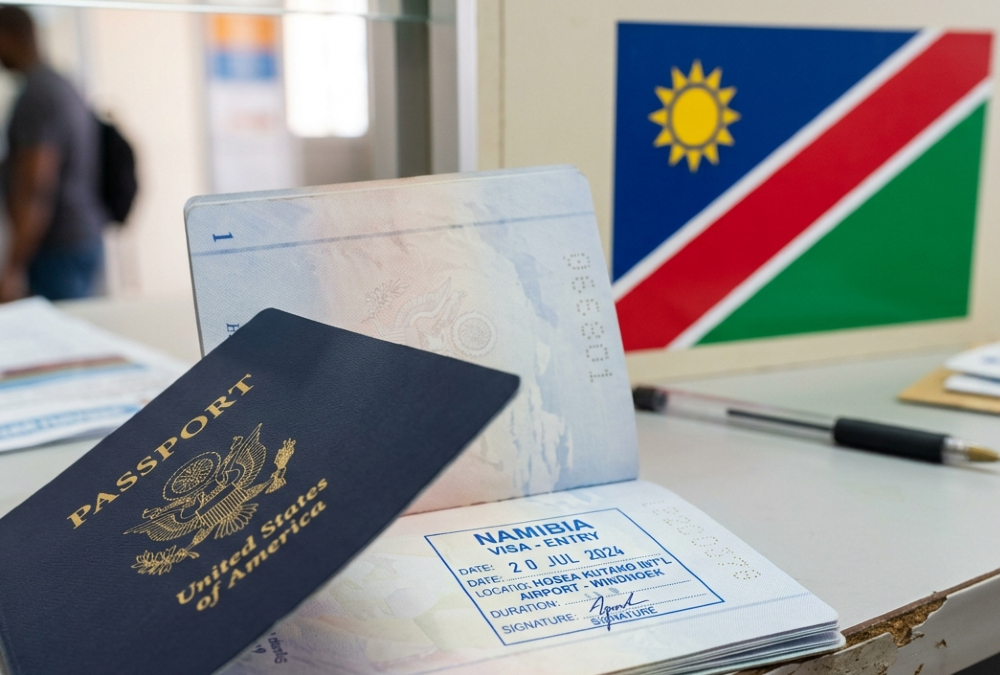
Since April 2025, Windhoek has required visas from citizens of roughly 30 countries – including the United States, the United Kingdom, Germany, France, and several other European Union member states – on the simple grounds that those countries require visas from Namibians. The principle is not new in international law; reciprocity has always been a quiet undercurrent in diplomacy. What is new is a small African nation invoking it so plainly, and following through.
The Logic of Tit-for-Tat
The policy itself is unglamorous in its mechanics: an e-visa portal, fees in the range of US$90 to US$150, and a 30-day stamp for most travelers. But its symbolism is doing a great deal of work. Namibia is not simply tightening its borders – it is asking a pointed question that has lingered, mostly unspoken, across African diplomacy for years: why should African passports be treated as inherently more suspect than others?
This is the heart of the matter, and it has little to do with visas as such. It is a question of dignity in international relations – whether mobility agreements reflect mutual respect between sovereign states or simply reflect who has historically held the leverage. Namibia’s foreign ministry has framed the move as a matter of fairness rather than retaliation, and the framing matters: this is not a tariff war dressed up in travel-document clothing, but an attempt to correct what amounts to a one-way street.
What Namibia Stands to Gain
The potential upside is real, even if difficult to quantify precisely. A reciprocal visa regime strengthens Namibia’s hand in future bilateral negotiations – it is far easier to ask for concessions when you have already demonstrated you are willing to act unilaterally. It generates modest but meaningful visa revenue and forces an upgrade of border infrastructure that was, by the government’s own admission, in need of modernization. The country’s cabinet has already directed a multi-agency effort to fix “operational inefficiencies” at Hosea Kutako International Airport, the kind of unglamorous administrative housekeeping that rarely happens without external pressure.
There is also a continental dimension worth noting. While Namibia has been tightening entry for visa-reciprocal nations, it has simultaneously been loosening it for others – expanding visa-on-arrival access to more than 50 countries and rolling out visa-free entry on arrival for African passport holders specifically, as a stated first step toward eventual visa-free travel across the continent. The message is consistent even if the mechanics differ: openness should be earned through reciprocity, not assumed through old hierarchies.
Namibia is not alone in moving this direction. Ghana and Zambia recently agreed to scrap visa requirements between each other. Togo has dropped visa requirements for African travelers altogether. A continent-wide campaign is pushing, with real political backing, for visa-free travel across Africa by 2030. Namibia’s policy fits a broader pattern: African governments increasingly treating mobility not as a favor to be requested, but as a right to be negotiated.
The Risk on the Other Side of the Ledger
None of this comes free. Germany has historically been Namibia’s largest source of tourists, and Germany is among the countries now facing the new visa requirement – a fact the local tourism industry has not greeted warmly. Visa friction, however modest, tends to nudge marginal travelers toward destinations with fewer hoops to jump through, and Namibia competes for long-haul tourists against countries that impose no such requirements at all.
There is a parallel risk for business travel, trade delegations, and investment flows, which are generally more sensitive to friction than leisure tourists but also more economically consequential. And there is a diplomatic risk, too: a reciprocity policy can be read by some governments as principled fairness and by others as a needlessly confrontational gesture, depending entirely on how it is communicated and implemented. A clunky, error-prone e-visa system would turn a matter of principle into a self-inflicted economic wound – which is precisely why Namibia’s follow-through on airport and digital infrastructure will likely determine whether this policy is remembered as a model or a misstep.
The Lesson Beyond Namibia
Namibia’s move will not, on its own, rewrite the global visa order. The Henley Passport Index, the most widely cited ranking of travel freedom, still places Namibia in the middle of the pack – visa-free or visa-on-arrival access to around 74 destinations, respectable but unremarkable by the standards of the world’s most powerful passports. One country’s reciprocity policy is not going to dislodge that hierarchy.
But policy shifts often matter less for their immediate effect than for the conversation they force into the open. Namibia has made an argument – implicitly, through action rather than speeches – that fairness in international mobility is not an abstraction but a choice nations make and can unmake. Other African governments are watching closely, weighing the same trade-off Namibia has just made explicit: the appeal of asserting sovereignty against the cost of remaining competitive for trade, investment, and tourism dollars.
That balance is not easy to strike, and Namibia has not yet proven it can strike it. What it has done is harder to ignore than another diplomatic communiqué: it has shown that the imbalance so many African nations have quietly tolerated for decades is not, in fact, a law of nature. It is a policy. And policies, as Namibia has just reminded the rest of the world, can change.
Ashish Muley is an independent consultant with Stalwart Management Consulting, with 27+ years in agricultural commodity value chains, export markets, and international trade. He has led projects on business development and capacity building across African countries in partnership with international organizations. Formerly, he spent 15 years in financial services leadership, focusing on sales, marketing, and business development. Based in Pune, India, Ashish advises on agricultural trade, commodity markets, and Asia–Africa economic opportunities, and regularly writes on international trade and logistics.
