
Opinion
How China’s Tariff Gambit Is Quietly Rewriting Africa’s Financial Landscape
As Beijing removes trade barriers for dozens of African nations, the yuan is gaining ground – and the dollar’s long dominance may be entering a new phase of quiet erosion.

By Mark-Anthony Johnson
When South Africa’s Standard Bank connected to China’s Cross-Border Interbank Payment System last November, it processed half a billion dollars in transactions within its first four months of operation. For most financial institutions, that would be a notable milestone. For a continent whose trade relationship with China is accelerating at a remarkable pace, it may prove to be a mere opening act.
China-Africa trade surged by nearly 18 percent last year, according to Chinese customs data. In May, Beijing went further, eliminating tariffs on imports from 53 African countries – a sweeping gesture that is already reshaping the flow of goods through Chinese ports.
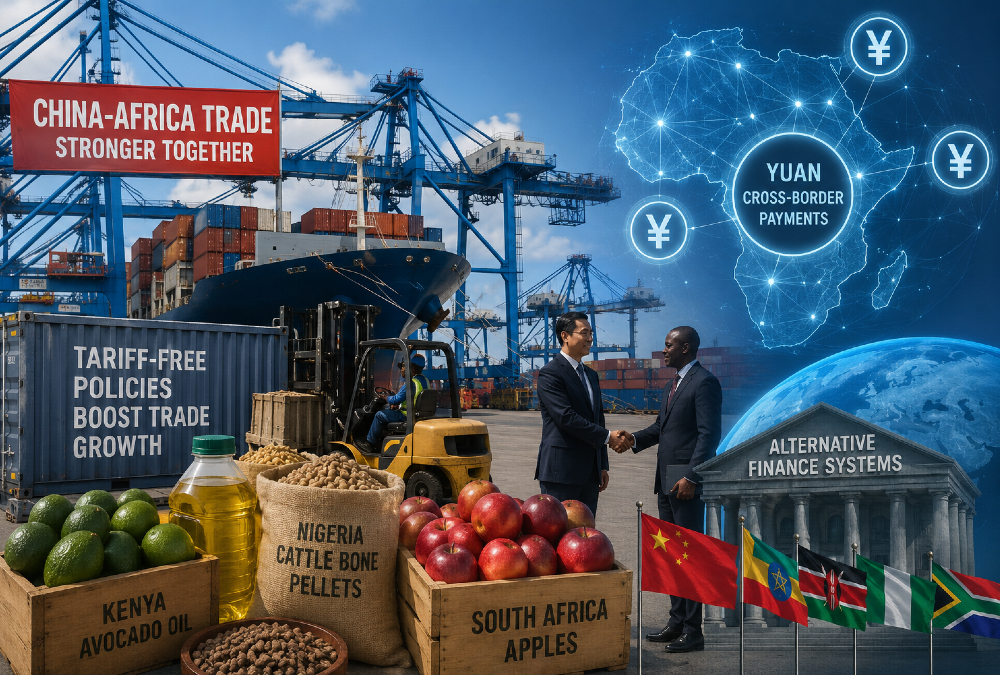
Nigerian cattle bone pellets, Kenyan avocado oil, South African apples: the variety of African cargo arriving in China signals not just growing commercial ties, but a deliberate strategic pivot by Beijing to position itself as Africa’s indispensable economic partner.
The Yuan Follows the Freight
The financial consequences of this deepening relationship deserve close attention. Research by the International Monetary Fund has established a clear correlation: as a country’s trade exposure to China grows, so too does its use of the yuan in settling transactions.
Beijing, well aware of this dynamic, announced fresh measures this week to accelerate the internationalization of its currency. The logic is straightforward – more trade means more yuan-denominated invoicing, more yuan-denominated settlements, and, over time, more yuan-denominated reserves.
“Against a backdrop where unilateralism and protectionism are posing difficulties and challenges for African nations, China is leveraging the advantages of its vast market,” said He Yadong, a spokesman for China’s Ministry of Commerce. The framing is deliberate: Beijing is presenting itself as the free-trade alternative to a West that African policymakers increasingly view as unreliable.
Building the Rails
The architecture supporting this shift is quietly expanding. Standard Bank, Africa’s largest lender by assets, became the first African commercial bank to connect to CIPS – China’s answer to the SWIFT messaging network – and is now working to extend that connectivity to additional countries.
“The transactions we have seen have been primarily driven by import and export activities between China and Africa,” said Ives Yang, head of sales at Standard Bank CIB’s transactional banking division. New payment platforms are proliferating, and some African governments are renegotiating debt into yuan, attracted by lower borrowing costs.
Yet it would be premature to sound the dollar’s death knell. Reliable data on yuan usage across Africa remains scarce, and those closest to the transactions counsel against overcorrection.
“We see it as complementary,” said Birju Sanghrajka, chief executive of Standard Chartered Kenya, who acknowledges the currency’s growing footprint but sees little evidence of it displacing the dollar in any meaningful way – at least not yet.
That qualifier matters enormously. The yuan’s rise in Africa is not a revolution; it is a slow, structural shift driven by the gravitational pull of commerce.
Each new tariff elimination, each new CIPS connection, each new yuan-denominated loan makes the next step marginally easier and more natural. The infrastructure of dollar dominance – correspondent banking relationships, reserve accumulation patterns, commodity pricing conventions – does not crumble overnight. But it can be quietly circumvented, one trade corridor at a time.
A Continent With More Options
For Western policymakers, the lesson is not that Beijing has found a magic formula for currency internationalization. It has not. The yuan remains inconvertible on the capital account, a fundamental obstacle to its becoming a true global reserve currency. What Beijing has found, however, is a playbook for expanding monetary influence at the margins: reduce the friction of trade, build the payment rails, and let commercial logic do the rest.
Africa, for its part, is not a passive actor in this story. Many of its governments are actively diversifying their financial relationships, motivated less by ideological alignment with Beijing than by a pragmatic desire for leverage.
A continent that can settle transactions in yuan as readily as in dollars is a continent with more negotiating room – with China, with Western creditors, and with multilateral institutions alike.
The half-billion dollars processed through Standard Bank’s CIPS connection in four months is a small number in the context of global finance. But the direction of travel is unmistakable, and the pace is accelerating.
Beijing is playing a long game, and it is playing it with patience, infrastructure, and tariff schedules. That, historically, is how monetary orders change.
Mark-Anthony Johnson is the founder and CEO of JIC Holdings, a global asset and investment management firm founded in 2009. With over 30 years of experience and strong ties to Africa, his investments span mining, infrastructure, power, shipping, commodities, agriculture, and fisheries. He is currently focused on developing farms across Africa, aiming to position the continent as the world’s breadbasket.
