
Opinion
Standing Between Two Worlds – Because That Is Where the Work Is
On bridging the gap between academic AI research and the realities of African smallholder farming.

By Jean Claude Niyomugabo
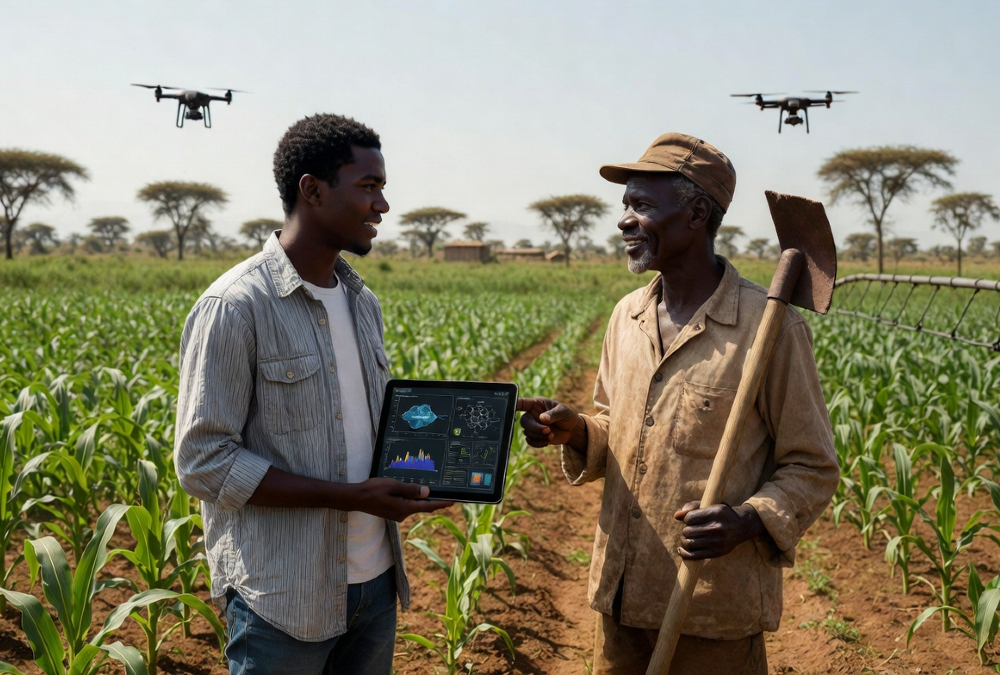
Some researchers stand between two worlds not out of indecision, but out of purpose. For those working at the intersection of artificial intelligence and African agriculture, that liminal space is not a sign of confusion – it is the job.
On one side sits the university: seminar rooms and peer-reviewed journals where AI adoption, trust frameworks, and technology design are debated with models, methods, and methodological rigor. On the other side lies the African farm – where every tool, no matter how sophisticated, must answer a far more unforgiving question: Does this actually understand our situation?
That question is not rhetorical. It is diagnostic.
When Technical Excellence Is Not Enough
Too much discourse around AI in agriculture fixates on model sophistication – accuracy rates, processing speed, and the elegance of underlying algorithms. Far less attention is paid to whether a farmer in rural Zambia, Malawi, or Northern Nigeria can trust a recommendation enough to act on it.
Trust, in this context, is not a soft or peripheral concern. It is the central variable in the adoption equation.
A tool can be technically flawless and still fail completely. If it does not account for local cost structures, seasonal risk, language, indigenous knowledge systems, and the granular daily decisions that smallholder farmers make under genuine uncertainty, it will sit unused – regardless of how many benchmarks it clears.
Technological sophistication without contextual intelligence is not innovation. It is waste.
Building the Bridge Between the Classroom and the Field
This is the bridge that urgently needs building: one that connects the rigor of academic research to the pragmatism of on-the-ground agricultural realities. It requires listening – genuinely and systematically – to both university advisors and the farmers themselves.
It requires treating communities not as subjects of study, but as co-producers of knowledge.
African smallholder farmers are not passive recipients of technology designed elsewhere. They are experienced decision-makers managing complex, high-stakes systems with limited margins for error. AI tools designed to serve them must reflect that complexity – in language, in risk modeling, in the assumptions baked into every recommendation engine.
The goal, then, is not to choose between research and farming. It is to refuse that false choice entirely.
For researchers shaped by smallholder agriculture – who have stood in those fields and sat in those classrooms – the position between two worlds is not a compromise. It is a vantage point. And from that vantage point, the work of making AI genuinely useful to African farmers becomes not just possible, but necessary.
That is exactly where the work is. And that is exactly where we need to be.
Jean Claude Niyomugabo is an entrepreneur and digital communication specialist with a strong passion for Africa’s development. He is dedicated to harnessing the power of social media to drive positive change and enhance livelihoods. With diverse interests and a strategic approach to digital engagement, he strives to create meaningful impact through innovation and connectivity.
