
Business
Africa Is Not China’s Next Factory – It Is a Different Test Entirely
The continent offers genuine commercial opportunity – but only for those willing to operate on its own terms.

By Lance Chisue
Many Chinese factory owners are turning their attention to Africa. The motivation is not that China has lost its competitive edge – its manufacturing base remains formidable. Rather, margins are tightening, product cycles are compressing, and domestic competition has become relentless. Against that backdrop, Africa appears to offer something increasingly scarce at home: room to grow.
On paper, the logic is compelling. A rising consumer class. Underpenetrated distribution networks. Demand that has yet to be organized into entrenched brand loyalty. For a factory owner squeezed between falling prices and rising input costs, Africa can look like a second act.
The reality, however, is considerably more complex.
Expectations Meet the Ground
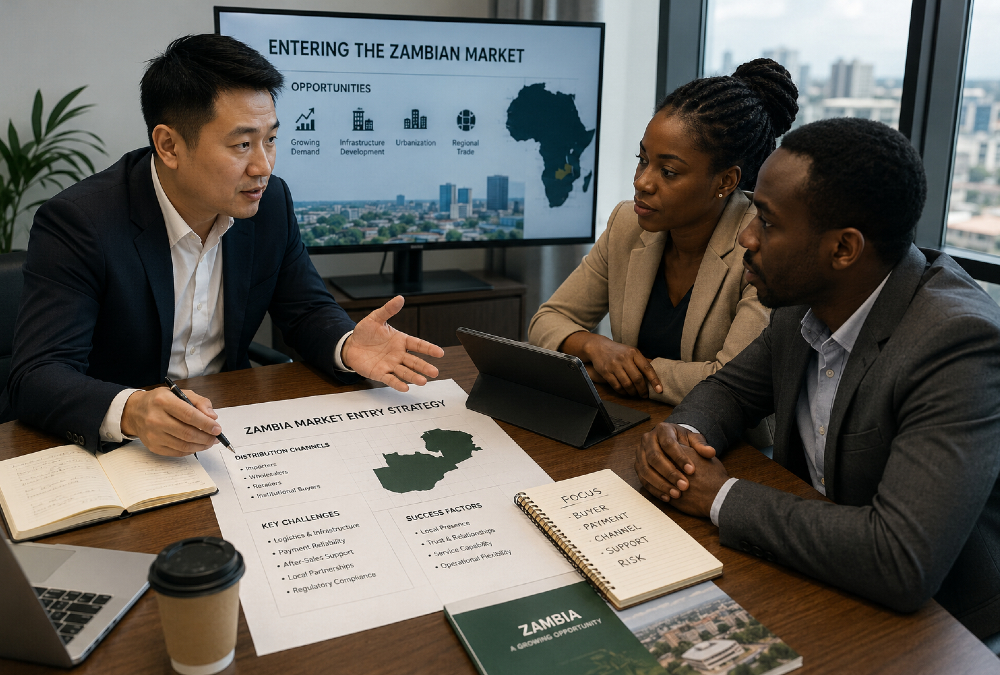
Having encountered several such manufacturers during visits to Zambia, a pattern emerges with striking consistency. Before landing, their expectations tend to be straightforward: warehouses, distributors, and a fast path to market entry.
Within days on the ground, however, the questions change entirely.
Who is the real buyer? Who pays reliably and on time? Who actually controls the distribution channel? Who provides after-sales support locally – and who ultimately absorbs operational risk when things go wrong?
These are not peripheral concerns. They are the central questions on which market entry succeeds or fails.
A Different Operating Environment
Africa is not a low-competition version of China. It is a fundamentally different operating environment – and conflating the two is where most entry strategies unravel.
In China, scale problems are typically solved through logistics infrastructure, digital platforms, and supply chain efficiency. Execution in many African markets depends on something less easily replicated: trust, local presence, and the depth of relationships built over time.
Algorithms cannot substitute for a reliable partner on the ground. A warehouse does not replace the network that moves goods from it.
This distinction is not a critique of either market. It is simply a recognition that the tools and instincts honed in one environment do not transfer automatically to another.
The Right Question
The commercial opportunity in Africa is real. Demand exists, and in many sectors it is growing. But opportunity is not the binding constraint. Capability is.
The question that matters is not whether there is demand in Africa – there plainly is. The question is whether a given manufacturer is genuinely built to serve it: consistently, with local accountability, and under real-world operating conditions that may include unreliable infrastructure, fragmented regulatory frameworks, and payment terms that require patience rather than speed.
Those who enter with that understanding – who invest in the institutional knowledge, the local relationships, and the operational flexibility the market demands – will find Africa rewarding. Those who arrive expecting a simplified version of a market they already know will find instead a market that demands to be understood on its own terms.
That distinction, ultimately, is what separates those who enter Africa from those who merely visit it.
Lance Chisue is the Founder and CMO of Sales Connect Africa, a Pretoria-based firm specializing in helping manufacturers enter and grow in Southern African markets. He leverages sales expertise and strategic visibility to connect products with buyers, supporting manufacturers in navigating complex regional market dynamics and distribution channels. Lance is dedicated to empowering manufacturers to succeed by bridging gaps between products and customers in emerging African markets
