
Opinion
Africa in 1914: Understanding Total Colonization to Prevent Its Recurrence

By Mark-Anthony Johnson
The Scramble for Africa stands as one of history’s most audacious acts of collective dispossession. A century later, its consequences remain very much alive – and the forces that enabled it are not as dormant as we might hope.
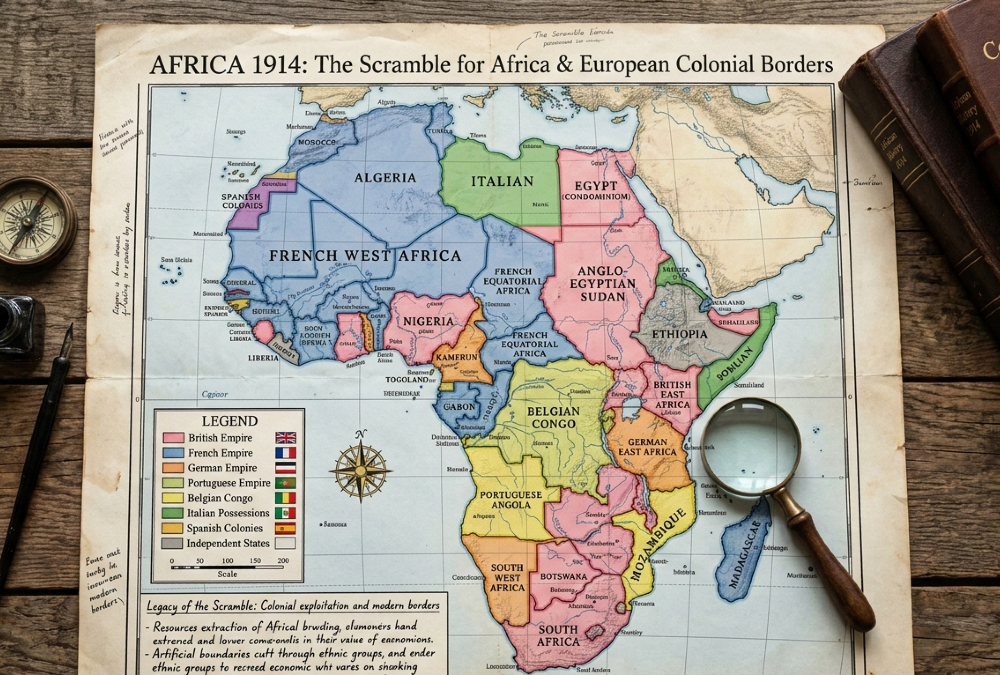
In the span of roughly four decades, the European powers executed one of the most sweeping territorial land-grabs in recorded history. By 1914, approximately 90 percent of the African continent had been carved up and placed under the formal control of just seven nations: Britain, France, Germany, Belgium, Italy, Portugal, and Spain.
The speed, scale, and savagery of this colonization shattered existing political orders, fractured communities, and entrenched patterns of extraction that would define the continent’s relationship with the wider world for generations. Understanding how it happened is not merely a matter of historical curiosity – it is a prerequisite for ensuring it cannot be repeated.
A Continent Partitioned
The numbers alone are staggering. In 1870, European powers formally controlled only about 10 percent of Africa, largely confined to coastal footholds and trading outposts.
Within four decades, that figure had exploded to 90 percent. Only two nations survived with their sovereignty nominally intact: Liberia, shielded in part by its association with the United States, and Ethiopia, which famously repelled Italian forces at the Battle of Adwa in 1896.
The ambitions of the colonizing powers were brazenly geographic. Britain dreamed of a contiguous corridor stretching from Cairo to Cape Town – a north-south axis that would dominate the continent’s most resource-rich terrain.
France, meanwhile, pushed deep into West Africa, establishing a vast empire of its own. Germany, Portugal, and Belgium staked claims to territories that would become synonymous with some of colonialism’s darkest chapters.
The 1884–85 Berlin Conference codified the rules of this competition. European ambassadors and heads of state gathered in the German capital and drew lines across a map of Africa – lines that bore no relationship to the linguistic, ethnic, or political realities on the ground.
No African representative was present. No African voice was heard. The resulting borders split ethnic communities in two, forced historical rivals into the same administrative units, and landlocked dozens of peoples who had long relied on river and coastal trade routes.
The human cost was immediate and catastrophic. Nowhere was this more grotesquely illustrated than in the Congo Free State, the personal fiefdom of Belgium’s King Leopold II.
Under his reign, an estimated ten million Congolese people perished as a result of forced labor, starvation, and systematic terror in the service of rubber extraction. It was not an anomaly. It was colonialism operating at full efficiency.
The Wound That Did Not Close
The formal end of colonial rule across Africa – mostly accomplished between the late 1950s and the mid-1970s – did not erase the structural damage colonialism had inflicted. In many respects, it merely changed its form.
Economically, the colonial enterprise was never designed to develop Africa. It was designed to extract from it. Colonial administrations oriented entire national economies around the export of a single raw commodity – gold, rubber, cotton, minerals – feeding European industrial expansion while deliberately suppressing local manufacturing and industry.
The result was a structural dependency that persisted long after independence. Many African nations emerged from colonialism without diversified economies, with infrastructure built to serve ports rather than populations, and with a debt burden shaped by the demands of their former occupiers.
The borders were equally ruinous in their afterlife. The arbitrary lines drawn in Berlin did not dissolve with independence – they were largely preserved, at the insistence of newly formed African governments who feared that any revision would open a Pandora’s box of territorial claims.
That pragmatic decision has nonetheless carried a heavy price. Ethnic conflicts, secessionist movements, and civil wars across the continent trace many of their roots to communities forcibly divided or yoked together by colonial cartographers who had never set foot on African soil.
The destruction of indigenous governance was no less consequential. Traditional leadership structures, legal frameworks, and cultural systems that had evolved over centuries were dismantled, discredited, or co-opted by colonial administrations.
The resulting institutional vacuum proved deeply difficult to fill after independence, contributing to cycles of instability that outsiders were often too quick to misread as evidence of African incapacity rather than colonial legacy.
The New Scramble
The danger today is not that European powers will once again divide Africa at a conference table. The danger is subtler, and in some ways more insidious.
Neocolonialism – the exercise of economic and political dominance by foreign powers over nominally sovereign states – has proven to be colonialism’s most durable offspring.
The pattern is familiar. Foreign investment arrives in resource-rich African nations under the banner of development, but the terms are structured to ensure that profits flow outward.
International financial institutions attach conditions to debt relief that constrain domestic policy choices. Military partnerships grant foreign powers basing rights and influence in exchange for security guarantees that serve the patron’s strategic interests as much as the host nation’s.
The language has changed. The architecture has not.
Nor is this exclusively a Western phenomenon. China’s expanding infrastructure investment across the continent has generated both genuine development and legitimate concerns about debt dependency and the subordination of local labor.
Russia’s deepening military footprint in the Sahel has arrived under an anti-Western banner, but the logic of external interference for strategic gain is recognizable regardless of which flag it flies under. Africa’s resources – its minerals, its land, its growing consumer markets, its demographic youth – remain among the most coveted prizes in 21st-century geopolitics.
Why This Demands Our Attention
History does not repeat itself on a timetable. But it does rhyme – and the rhymes are currently growing louder.
The 1914 map of Africa is not a relic. It is a warning.
Preventing a replication of colonialism’s logic requires clarity on several fronts. African sovereignty must be treated as non-negotiable – not as a courtesy to be extended when convenient, but as a principle that governs every investment treaty, security arrangement, and development partnership.
Economic relationships with the continent must be restructured to prioritize local industrialization, value-added production, and the terms that African governments and peoples themselves define as equitable.
The international community also owes a more honest reckoning with how existing global institutions – the architecture of trade, finance, and security established largely by and for Western powers in the post-war era – continues to disadvantage African nations. Reforming those institutions is not charity. It is the minimum condition for a genuinely rules-based international order.
None of this is to suggest that Africa is a passive actor in its own story. Far from it. From the African Union’s Agenda 2063 to the African Continental Free Trade Area, the continent is building the institutional architecture of genuine economic independence.
Pan-African movements, civil society organizations, and a new generation of policymakers and entrepreneurs are constructing alternatives to dependence with remarkable energy and ambition.
But external actors have a responsibility, too – one that begins with understanding what was done in 1884, what it cost, and why the world cannot afford to allow any version of it to resurface.
The Scramble for Africa was not an accident of history. It was a choice, made by powerful nations that prioritized their own enrichment over the rights and lives of others.
Recognizing that is not self-flagellation. It is the first step toward a relationship between Africa and the wider world that is built on something more durable than exploitation.
Mark-Anthony Johnson is the founder and CEO of JIC Holdings, a global asset and investment management firm founded in 2009. With over 30 years of experience and strong ties to Africa, his investments span mining, infrastructure, power, shipping, commodities, agriculture, and fisheries. He is currently focused on developing farms across Africa, aiming to position the continent as the world’s breadbasket.
