
Opinion
A “Kenyan election” in the United States is not something one sees every day
By Patrick Gathara
The 2020 election in the United States seemed both familiar and strange. Familiar because it looked very much like the last 2 Kenyan presidential elections, in 2013 and 2017, which witnessed problematic and delayed vote counts, allegations of rigging and were both eventually decided by the Supreme Court – the first was upheld and the second was annulled. It was strange for the same reason it seemed familiar. A Kenyan election in the United States is not something one sees every day.
It is important to make a distinction here: by Kenyan election, I do not mean an African election. Many African countries hold much better polls than either Kenya or the United States. It is however undeniable that my country has distinguished itself in its bizarre inability to count particular votes, specifically those cast for president – the syndrome does not seem to affect lower races.
The United States, on the other hand, has been marketed to us since childhood as the model democracy, “the shining city on a hill”. And it is true that many of us did drink the Kool-Aid. Despite its many hypocrisies abroad – the United States was the country that loudly supported my generation’s struggle against autocracy in the 1990s but had also helped prop up murderous dictatorships across the African continent – at home, it was believed to be largely accountable to its citizens.
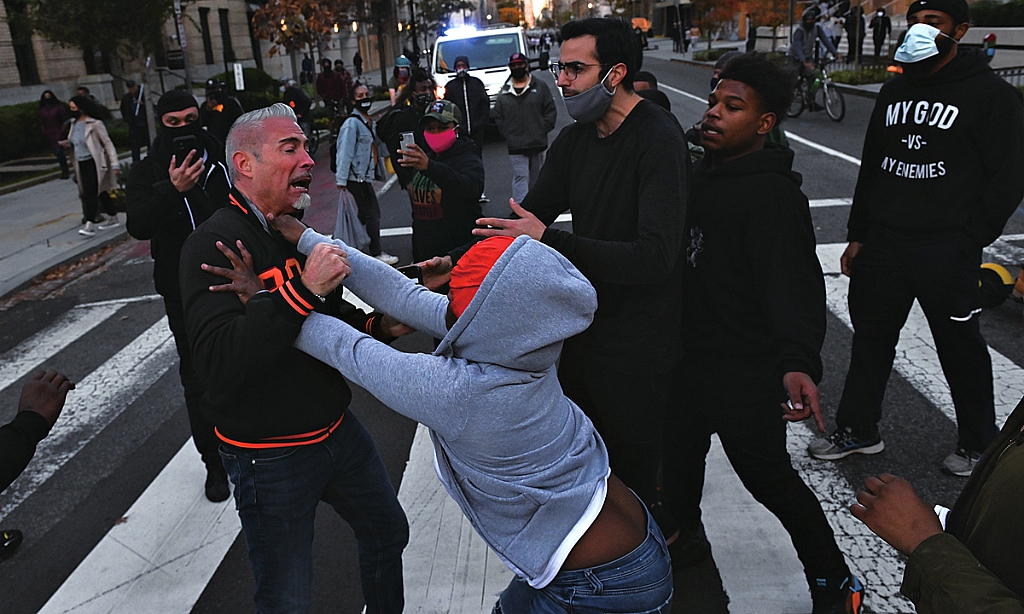
A supporter of US President Donald Trump (l) is attacked by anti-Trump demonstrators in Black Lives Matter Plaza in Washington DC on Saturday, November 14, 2020. PHOTO/AFP
Donald Trump’s shock win in 2016 amid allegations of Russian interference, followed by 4 norm-busting years where the White House became associated with nepotism, corruption, the public embrace of white supremacy and a lack of accountability, severely undermined the notion of America as a paragon of democratic governance. At the same time, the continuing rise of China and, more locally, Rwanda, seemed to suggest better models.
2020 has delivered the coup de grace. There are positives – America has not dissolved into violence despite the dispute. Still, the attempt by Trump to cling on to power despite losing the election by most counts, his discrediting of the electoral system, and the prospect, however remote, that the Republicans may still find a way to overturn the election at the Electoral College, have turned the United States into a laughing stock across the continent.
It is a bittersweet moment. On the one hand, an entitled, boastful, self-righteous bully is getting his comeuppance. On the other, this will do real damage to those who look to the United States to support them in their own democratic struggles. Already, in countries like Tanzania, Guinea and Cote D’Ivoire, autocrats have basically ignored concerned statements from the U.S. State Department. Joe Biden may try to re-establish U.S. democratic hegemony with his proposed Summit for Democracy, but there’s probably no going back to the status quo. The only path left is one where the United States demonstrates it can take the medicine it has long prescribed to others—democratic reform.
Patrick Gathara is a strategic communications consultant, writer and award-winning political cartoonist in Kenya.
POLITICO © Copyright 2020
