
Opinion
A Diamond Does Not Travel: Botswana’s Bold New Stand on Sovereignty

By Des H Rikhotso
President Duma Boko’s refusal to visit the White House signals a bolder African posture on sovereignty – and may be backed by a mineral windfall that changes everything.
When Botswana’s President Duma Gideon Boko reportedly declined an invitation to the White House, he did more than snub a powerful ally. He made a statement – one that is resonating across a continent increasingly impatient with the old terms of engagement.
“If there is any business to discuss,” Boko declared, “it should take place in Botswana.”
The logic, stripped of diplomatic niceties, is straightforward: buyers travel to sellers, not the other way around. It is a principle so elementary that its application to geopolitics feels almost radical.
And yet, for generations, African leaders have routinely flown to Washington, London, and Beijing to negotiate deals over resources that sit in African soil. Boko is signaling, plainly, that Botswana is no longer interested in that arrangement.
Whether this assertiveness is geopolitical theater or a genuine realignment of leverage depends, in large part, on what lies beneath the Kalahari.
A Discovery That Could Rewrite Botswana’s Future
Botswana has long been defined – economically and symbolically – by diamonds. The stones account for roughly 80 percent of the country’s export revenue and approximately 25 percent of its GDP.
For decades, that was enough. But the global diamond market is in structural retreat, undercut by the rise of lab-grown alternatives that are 30 to 70 percent cheaper per carat.
As synthetic diamonds flood the luxury market, Botswana’s economic foundation has cracked visibly.
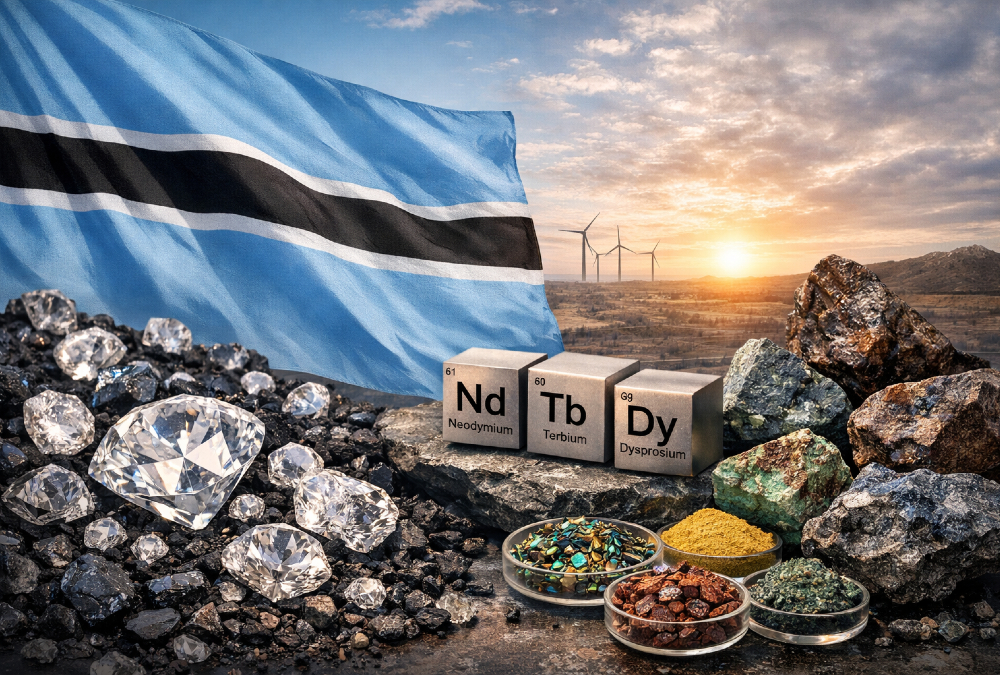
The timing of a potentially transformative mineral discovery, then, could hardly be more consequential. Tsodilo Resources Limited, a Canadian exploration company operating in Botswana’s northwest, reported in late February 2026 that early findings suggest the presence of all 15 rare-earth minerals featured on the United States Geological Survey’s 2025 Critical Minerals List.
The deposits – identified at sites designated C26 and C27 within the Gchwihaba Metals project – are located between 20 and 50 meters below the surface. That shallowness matters enormously: deeper extraction means higher costs, and shallower deposits can be commercially viable far sooner.
Tsodilo has been careful to note that further research is needed before any commercial conclusions can be drawn. But the initial indicators are, by the company’s own characterization, high-grade.
In addition to rare-earth elements, the company reported the discovery of copper, cobalt, nickel, vanadium, and silver – a suite of critical minerals whose strategic importance is growing rapidly as the world races toward electrification, defense modernization, and clean energy infrastructure.
Why the World Is Paying Attention
Rare-earth minerals are not glamorous, but they are indispensable. They are embedded in electric vehicle batteries, smartphones, wind turbines, telecommunications networks, and electronic defense systems.
Demand is expected to surge dramatically in the decades ahead as governments accelerate the green energy transition and defense spending rises globally.
The problem, for Western nations in particular, is that the supply chain for these materials runs almost entirely through China. Beijing currently produces approximately 44 million metric tonnes of rare-earth minerals annually and controls around 70 percent of global mined supply.
More critically, China processes nearly 90 percent of the world’s rare-earths – meaning it imports raw materials from other countries and refines them, exercising decisive influence over the entire value chain.
Western officials have repeatedly identified this concentration as a strategic vulnerability. The United States, the European Union, and their allies have spent years scrambling to identify alternative sources and reduce dependence on Chinese processing capacity.
In that context, a significant rare-earth discovery in a stable, democratic, and English-speaking African nation is not merely commercially interesting – it is geopolitically significant.
Leverage, Earned and Asserted
This is the backdrop against which President Boko’s posture should be understood. Botswana is not bluffing from weakness; it may, in fact, be negotiating from a position of quietly accumulating strength.
The country has a track record that lends credibility to its ambitions. Since independence, Botswana has been one of Africa’s most stable democracies and among its most competent managers of natural resources.
Its partnership with De Beers – structured to ensure that diamond revenues funded public services and national development – became a model study in how resource-rich nations could resist the “resource curse” that hollowed out so many of their neighbors.
Now, as diamonds fade in value and new minerals emerge, the Boko administration says it is prioritizing exploration for base metals, coal, and critical minerals to diversify the economy and attract a new generation of foreign investment. The rare-earth findings, if confirmed, would accelerate that pivot dramatically.
Boko’s message to international partners is, at its core, commercial: Botswana has something you need, and the terms of access will be set here, not in Washington.
A Broader African Signal
Botswana’s stance does not exist in isolation. Across the continent, a generation of leaders is pushing back against the paternalistic choreography of global resource diplomacy – the assumption that African nations must court foreign capital on foreign terms, in foreign capitals.
The Democratic Republic of Congo, Zimbabwe, Namibia, and others have all, in different ways, begun asserting greater control over how their mineral wealth is accessed and priced.
What distinguishes Botswana’s moment is the convergence of institutional credibility, democratic legitimacy, and a potential resource discovery arriving at precisely the moment when the world is most desperate for alternatives to Chinese supply chains.
For Washington – and for any other capital eyeing Botswana’s minerals – the president’s message contains an implicit offer beneath its assertive surface: the door is open. Just walk through it from the right direction.
Des H Rikhotso is a seasoned C-Suite Multi-Industry (Automotive – OEM + Retail, Logistics, Oil & Gas, etc) business executive with 25+ years of Business Leadership Experience across the South, East and Western Sub-Sahara Africa Region. Based in Kampala, Uganda he serves as East Africa Region Country Director and Business Executive, driving Business Strategic Growth and Operational Excellence – contributing his Business Leadership Experience to the Region. Des has held Business Leadership roles at BMW Group Africa, Volkswagen Group Africa, Peugeot Motors South Africa, Toyota/Lexus South Africa, Lexus East Rand (Unitrans/CFAO), Nissan Group of Africa, G.U.D Holdings (Africa Exports Operations Division),The HDR Group of Companies and The Ezra Group of Companies (a Leading Uganda & East Africa Conglomerate). He holds Under-Graduate and Post-Graduate business degrees from the University of the Western Cape, Wits University (Wits Business School) and the University of South Africa.
