
Opinion
Why Rational Farmers and Rational Processors Still Add Up to a $50 Billion Problem
Africa’s food paradox isn’t a knowledge gap. It’s a risk-sharing failure – and fixing it starts with asking who should actually carry the risk.

By Sheena Raikundalia
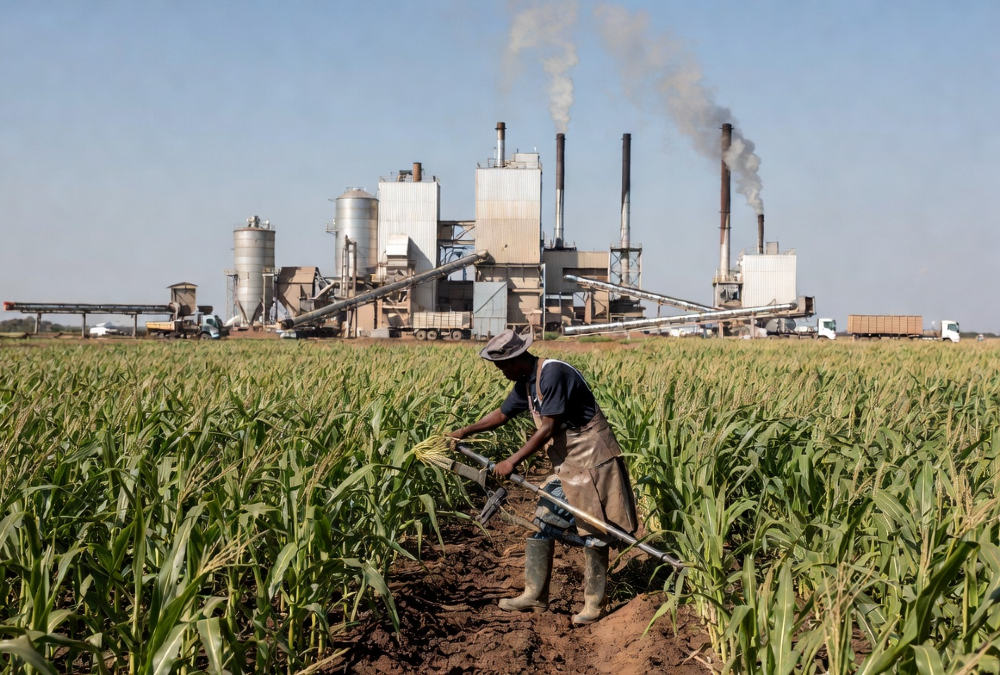
Africa spends an estimated US$50 billion a year importing food that it could, in principle, grow and process itself. At the same time, many of the continent’s food-processing plants are running at less than half of their capacity. These two facts sit awkwardly side by side, and reconciling them was the subject of a recent debate we hosted around a deceptively simple proposition: farmers are rational to choose informal markets, and it is the formal system that must adapt.
The conversation challenged one of agriculture’s most persistent assumptions – that if farmers only understood what processors and buyers wanted, value chains would sort themselves out.
The Knowledge Myth
There is something to that assumption. Through the Kuza One TRANSFORM project – a partnership between Unilever, the UK’s Foreign, Commonwealth & Development Office, and EY – we have watched genuine “aha moments” unfold as farmers learn why buyers insist on particular grades, sizes, or moisture levels. The requirements stop feeling arbitrary.
The processor isn’t being difficult; there is a reason behind the specification. But knowledge alone doesn’t explain why farmers keep walking away from formal markets.
The Farmer’s Math
Put yourself in a farmer’s position. Months are invested before harvest. Inputs are financed up front. Weather is risked. Labor is paid for out of pocket. The crop is delivered – and then the farmer waits, sometimes for weeks or months, to be paid. Occasionally the produce is rejected for reasons that are never fully explained. Against that backdrop, an informal trader who pays cash on delivery starts to look less like a worse option and more like the only one a farmer can actually afford.
Choosing the informal market isn’t irrational. It’s the obvious, rational choice.
The Processor’s Mirror
Then the processors told a strikingly similar story. They sell on to supermarkets and distributors, and they, too, wait 30, 60, even 90 days to be paid. They borrow at expensive rates to bridge the gap. They contend with unreliable supply. They have their own payroll to meet and their own cash-flow cliffs to manage. From where they sit, their decisions are rational as well.
Everyone Wins the Logic, Everyone Loses the Outcome
That is the real finding from the debate: everyone in the chain is behaving rationally, and the result is a continent that imports food while its own processing capacity sits idle. Individually sound decisions are adding up to a collectively bad outcome. Nobody – not the farmer, not the processor, not the consumer paying import-inflated prices – actually wins.
From Stakeholders to People
None of these pressures were news to anyone in the room. What was different was hearing them from each other rather than about each other. A farmer described what a delayed payment means for a household budget. A processor described what it feels like when payroll is due and customers haven’t paid yet. Somewhere in that exchange, people stopped talking about “stakeholders” and started listening to people.
And once that happened, solutions started to surface: upfront payments staggered over time, and payment terms that loosen as trust between buyer and seller builds.
Who Should Carry the Risk?
This reframes the central question. It isn’t whether farmers are irrational, or whether processors are irrational. It’s that the system, as built, lets perfectly rational individual decisions cancel each other out.
Farmers commit months of labor and capital before they see a return. But can processors realistically be expected to absorb that risk when many of them are waiting just as long to be paid themselves?
If the answer is no on both counts, a harder question follows: if not the farmer, and not the processor, who should carry the risk? More precisely – who in Africa’s food system is actually positioned to finance trust between the people who grow food and the people who turn it into something a supermarket will sell?
That question, more than any technical fix to a value chain, may be the one worth answering first.
Sheena Raikundalia is an accomplished entrepreneur, former lawyer, government policy advisor, and angel investor with deep expertise across the legal, financial services, and impact investment sectors in Europe and Africa. She has played a pivotal role in advancing Africa’s technology and innovation ecosystems, leveraging a career that spans top-tier London law firms, leadership as Country Director of the UK-Kenya Tech Hub for the UK Foreign, Commonwealth & Development Office (FCDO), and her current position as Chief Growth Officer at agri-tech company Kuza One. Sheena is recognized for her strategic vision, commitment to fostering innovation, and strong advocacy for Africa’s growth potential in technology, entrepreneurship, and impact investment.
