
Opinion
Why Institutions Matter More Than Heroes
No continent can be transformed sustainably through personalities alone.

By Daki Nkanyane
Africa has spent too much time waiting for the right person.
The right liberator. The right strongman. The right reformer. The right technocrat. The right father of the nation. The right outsider. The right savior with the right speech at the right historical moment.
This hope is understandable. In societies under pressure, personalities feel easier to believe in than systems. A person can be seen, heard, admired, followed, mythologized. A person can carry emotion – can become the vessel into which millions pour frustration, longing, and deferred national ambition.
But a continent cannot build its future on emotional dependency dressed up as political strategy. That is too fragile a foundation. Afrobarometer’s latest research shows that most Africans still prefer democracy and reject one-man rule, even amid widespread dissatisfaction with how democracy performs in practice. That tension is revealing: citizens want accountable systems, not merely dominant personalities.
This is the lesson Africa keeps having to relearn.
Heroes may open moments. Institutions sustain them. Heroes may symbolize possibility. Institutions convert possibility into continuity. Heroes may inspire. Institutions endure.
Character Without System
That is why institutions matter more than heroes. Not because character is irrelevant, but because character without system remains vulnerable to reversal, capture, exhaustion, succession failure, and death. A great leader can signal a new direction. But if courts remain weak, procurement remains porous, local government remains ineffective, regulators remain politicized, and public administration remains thin, then progress remains trapped inside a personality.
Once that personality leaves, so does much of the momentum. The World Bank has stressed that strengthening state capacity and the institutions that support a market economy is critical to sustainable development in Africa.
This is one of the deepest structural weaknesses in African public life: the overpersonalization of hope.
The Overpersonalization of Hope
We often speak as though nations are changed by exceptional individuals rather than by the standards, rules, norms, and capabilities that outlast them. We narrate politics through faces. We attach national possibility to names. We analyze public life in the grammar of personalities because personality is dramatic, while institutions are slow, procedural, and emotionally unsatisfying.
But history is not secured by drama. It is secured by repeatable competence. The Mo Ibrahim Foundation defines governance in terms of the political, social, economic, and environmental goods a state has the responsibility to deliver to its citizens. That definition is institutional by nature. It does not ask whether a leader seemed impressive. It asks whether a state reliably functions.
That distinction should change how Africa judges power.
The Dangers of Hero Logic
A continent governed through hero logic becomes vulnerable in predictable ways. It becomes susceptible to personality cults, overcentralization, the weakening of independent institutions, succession crises, and patronage politics disguised as loyalty. It breeds a public passivity that waits for exceptional individuals instead of demanding durable standards. Even good leaders become dangerous under these conditions, because the more a system depends on one person, the less it learns how to function without that person. The United Nations Development Programme has placed institutional resilience and public trust at the center of democratic renewal across Africa, precisely because durable governance cannot rest on personal authority alone.
This is why Africa must become more suspicious of hero politics – even when the hero seems admirable.
The problem with heroes is not only that some fail. The problem is that hero dependency weakens institutional imagination. It teaches societies to look upward for rescue rather than outward toward norms, and downward into the systems that shape daily life. It trains citizens to ask, “Who will save us?” instead of “What must be built so that no one needs to save us every election cycle?” That is the more mature question.
Because a functioning country is not one that is repeatedly rescued. It is one that becomes harder to ruin.
What Institutions Actually Do
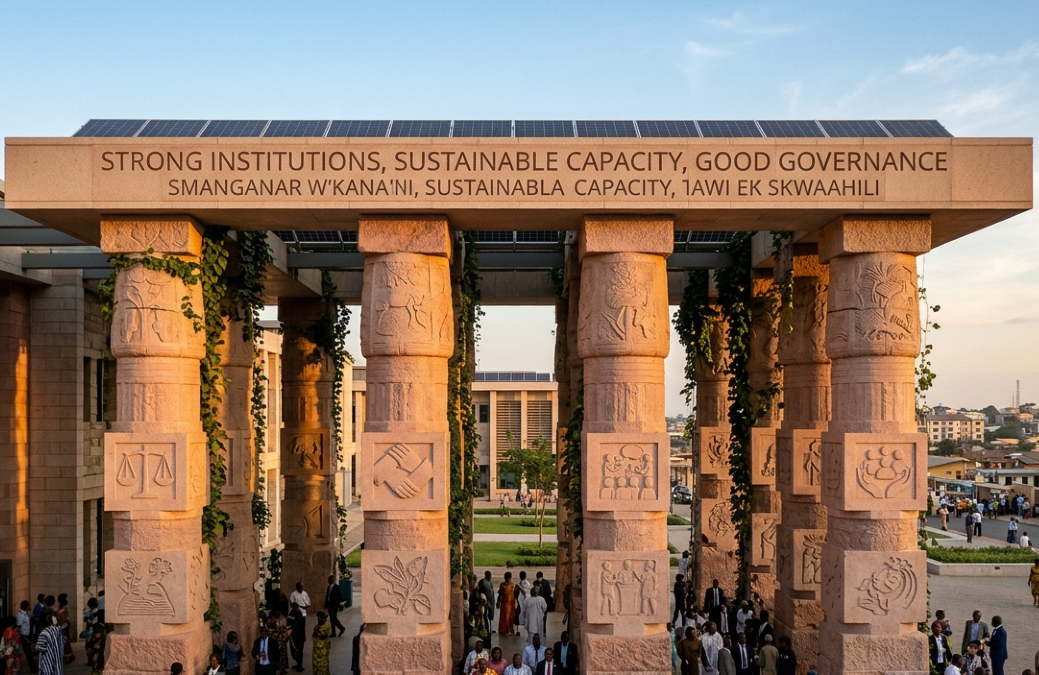
That is what institutions do. They make societies less dependent on virtue and less vulnerable to vice. They create routines of accountability. They shape incentives, constrain appetite, and protect process. They allow public life to continue under leaders who are ordinary, flawed, or even disappointing, because the system itself carries enough discipline to resist collapse. That is why strong institutions are not glamorous. They are civilizational insurance.
Africa needs more of that insurance.
It needs electoral bodies trusted beyond the fate of a single contest. It needs municipalities that function regardless of who currently enjoys the applause. It needs courts that command legitimacy beyond political moods. It needs professional civil services that are not hollowed out with every factional transition.
It needs procurement systems harder to bend toward private appetite. It needs parliaments, competition authorities, local governments, audit mechanisms, and regulators that do not become theatrical accessories to executive power. The World Bank has been explicit: stronger institutions, greater transparency, accountability, and state effectiveness are essential if African economies are to translate growth into jobs and poverty reduction at the required scale.
And yet Africa keeps returning to the fantasy of the exceptional figure.
The Weight of History
Part of that is historical. Liberation movements often emerged through towering personalities. Newly independent states, fragile and uncertain, were frequently narrated through singular men who came to symbolize national aspiration. In moments of crisis, populations naturally gravitate toward figures who seem decisive.
But history can become a trap when its emotional patterns are repeated uncritically. A liberation generation may have required symbolic figures. A mature continent requires institutional depth. The problem is that many African states still carry the emotional architecture of liberation politics inside the practical demands of modern governance.
That is no longer enough.
The everyday challenges now confronting Africa are too complex for hero worship. Electricity reform is not solved by charisma. Industrial policy is not implemented by symbolism. Urban planning is not rescued by personality. Education quality does not rise because a leader is eloquent.
Trade systems do not deepen because a president is admired. These tasks require technocratic stamina, institutional memory, administrative seriousness, data infrastructure, professional culture, and norms of accountability. They require structures that will still function tomorrow morning, whether the leader is inspiring or not.
That is what heroes cannot replace.
A speech cannot perform the work of a treasury. A rally cannot substitute for a court. A movement cannot permanently replace a civil service. A personality cannot become a constitution.
These should be obvious truths. But they are still violated in practice because hero narratives are politically useful. They help leaders centralize legitimacy. They help parties substitute identity for delivery. They help citizens simplify complexity into personal loyalty or personal blame. And they help entire societies postpone the harder work of building institutions, because it is easier to attach hope to a person than to build respect for a process.
But process is where freedom survives.
A society with weak institutions is always one election, one health crisis, one succession struggle, or one predatory coalition away from instability. That is why Afrobarometer’s research on democratic vulnerability carries such weight: Africans continue to support democratic norms – constitutional term limits, parliamentary oversight, media freedom, judicial independence. Citizens are signaling that they understand something important. They do not just want leaders. They want rules strong enough to govern leaders.
That should become the center of African political maturity.
The question must shift from “Who is the hero?” to “What is the institution?” Not “Who can command the nation?” but “What can outlast the commander?” Not “Who gives us hope?” but “What makes hope less perishable?”
This is also a moral issue. Hero politics flatters ego. Institutional politics disciplines it. Hero politics invites adoration. Institutional politics invites answerability. Hero politics encourages national life to orbit around persons. Institutional politics insists that office is temporary and that rules stand higher than rulers. That is why institutions are not merely technical devices. They are moral structures that remind both rulers and citizens that no one is bigger than the public trust.
Africa needs that reminder more urgently than ever.
The continent is young, restless, politically alive, and increasingly unwilling to endure failure in silence. But unless that energy becomes institutional energy, it will remain vulnerable to repeated disappointment – charismatic disappointments, reformist disappointments, populist disappointments, generational disappointments. The names will change. The cycle will not.
Unless institutions interrupt it.
The Work of Statecraft
That interruption is the real work of statecraft: to build systems that reduce the cost of human weakness; to create norms that survive personalities; to ensure that competence does not disappear when the applause does; to make public goods less dependent on who currently occupies the stage; to build nations that are not always one heroic figure away from hope and one failed figure away from despair.
Because despair is often what follows when heroes are asked to do the work that only institutions can do. Africa must grow beyond that psychology.
It must stop overinvesting emotionally in personalities and underinvesting politically in systems. It must teach its young that admiration is not governance, that inspiration is not administration, that symbolism is not delivery, and that a continent becomes serious not when it produces unforgettable figures, but when it produces functioning institutions that make unforgettable figures less necessary.
That is the real mark of maturity.
The strongest societies are not those with the most celebrated heroes. They are those in which ordinary competence becomes normal, public trust becomes less naive, and institutions grow strong enough that even mediocre leaders cannot easily destroy what generations have built.
That is the Africa that must be imagined now.
Not a continent forever waiting for its next savior, but a continent finally committed to becoming governable through standards.
Because in the end, heroes may start a chapter. Only institutions make sure the story continues.
Daki Nkanyane is a South African – born Pan-African thought leader, entrepreneur, keynote speaker, and strategist with over 25 years of experience driving innovation, identity, and development across Africa. He is the Founder & CEO of Interflex Capital, AfrisoftLive, QonnectedAfrica, and iThinkAfrica, where he focuses on youth empowerment, entrepreneurial ecosystems, and Africa’s economic and ideological renewal. His work spans technology, digital transformation, major international events, and strategic advisory for future-ready African institutions. As a contributing writer for The Habari Network, Daki covers African innovation, leadership, human capital, economics, entrepreneurship, and Africa–Caribbean relations through cultural, philosophical, and developmental perspectives. His mission is to help shape a new African consciousness rooted in pride, possibility, and self-determination for Africans on the continent and in the diaspora. He can also be reached on Facebook and X.
