
Opinion
India’s Soybean Shortage Is Africa’s Export Opportunity
As Indian demand for non-GMO soybeans outstrips domestic supply, African producers are positioned to fill the gap – if they can build the right trade connections.
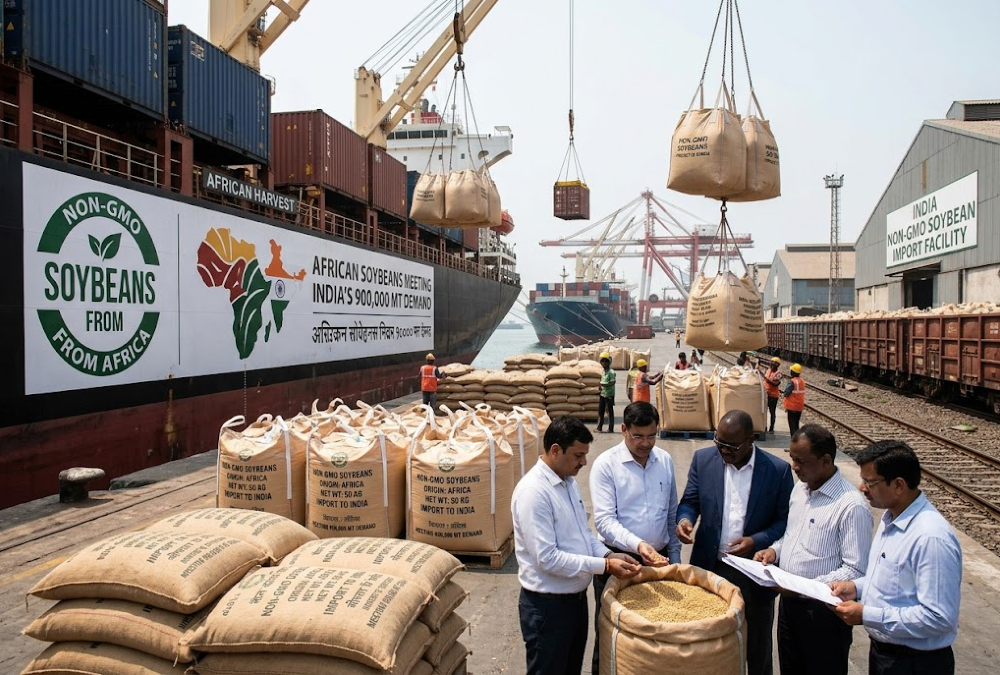

By Ashish Muley
Every commodity shortage tells two stories at once: a problem for the buyer, and an opening for the seller. India’s soybean market is no exception. Faced with a persistent shortfall in domestic production, the country is turning outward – and African producers, long overlooked as soybean suppliers, are emerging as the answer.
A Widening Supply Gap
India’s soybean imports are projected to reach roughly 900,000 metric tons during the 2025–26 oil year, according to trade estimates. That is a substantial figure for a country that has historically relied on domestic crushing to meet its edible oil and animal feed needs. What makes the shift notable is not just the volume, but where India is looking to source it.
India’s soybean production has been affected by fluctuating yields, increasing domestic consumption, and strong demand from the edible oil, poultry feed, and livestock sectors. These factors have widened the supply gap, creating opportunities for reliable overseas suppliers capable of delivering high-quality non-GMO soybeans.
Estimates suggest African suppliers could account for as much as 800,000 metric tons of that total – nearly the entire import requirement. Nigeria, Togo, Niger, and Mozambique have already established themselves as key sources, while Tanzania and Malawi have made inroads into the supply chain. Benin, Zambia, and Uganda represent the next wave of potential exporters, provided they can meet the volume and quality standards Indian buyers demand.
Africa has emerged as a preferred supplier for a simple reason: India’s import demand is concentrated in non-GMO soybeans. Unlike many of the world’s major soybean exporters, where production is predominantly genetically modified (GM), several African countries naturally produce non-GMO soybeans.
This gives African exporters a distinct competitive advantage in serving India’s growing preference for non-GMO imports, without the additional cost and complexity associated with producing or certifying non-GMO alternatives. As a result, Africa is well positioned to become a reliable long-term sourcing destination for Indian buyers seeking high-quality, traceable non-GMO soybeans.
Who Stands to Benefit
This is not an opportunity reserved for a handful of established exporters. The field is open to a wide range of participants:
- Government-supported agricultural agencies
- Large private soybean exporters and commodity traders
- Farmer cooperatives and producer organizations
- Large-scale commercial farmers
- Agribusiness companies
- Soybean aggregators with access to substantial volumes
But access alone won’t secure a deal. Success in the Indian market depends on five fundamentals:
- Consistent supply volumes and quality
- Competitive and transparent pricing
- Proper documentation and product traceability
- Compliance with Indian import regulations and phytosanitary requirements
- Reliable logistics from farm to port and onward to the buyer
Suppliers that consistently meet above mentioned all five expectations are well positioned to build long
Indore: Connecting African Suppliers with Indian Markets
Located in Central state of India Madhya Pradesh – India’s leading soybean-producing state-Indore is one of the country’s foremost soybean trading, processing, and commercial hubs. The city plays a pivotal role in connecting producers, processors, exporters, and buyers across India’s soybean value chain, making it a natural gateway for international suppliers seeking access to the Indian market.
Indore is also home to the registered office of the Indo Global SME Chamber (IGSC), which has positioned itself as the connective tissue between Africa’s soybean producers and India’s trade network. At IGSC, we help businesses expand internationally: promoting exports, identifying joint-venture partners, and navigating the regulatory maze that international trade inevitably involves.
We currently have direct access to a major Indian buyer with substantial soybean requirements, and we are actively seeking reliable African suppliers who can offer consistent volumes at the required specifications. Our role is to make the introduction – connecting qualified African suppliers with genuine Indian buyers, and helping both sides move efficiently from conversation to contract. Whether you represent a government-backed agency, a private exporter, a commodity trading house, a farmer cooperative, a producer organization, a commercial farm, an agribusiness, or an aggregator, we would welcome the chance to explore what’s possible together.
The Bottom Line
Africa has the production potential. India has the demand. What stands between the two is not opportunity – it’s infrastructure, trust, and the right introductions. Building those trade connections now, while India’s demand curve is still rising, is how African soybean producers turn a temporary shortage into a lasting export market.
Ashish Muley is an independent consultant with Stalwart Management Consulting, with 27+ years in agricultural commodity value chains, export markets, and international trade. He has led projects on business development and capacity building across African countries in partnership with international organizations. Formerly, he spent 15 years in financial services leadership, focusing on sales, marketing, and business development. Based in Pune, India, Ashish advises on agricultural trade, commodity markets, Warehouse Receipt System (WRS) and Asia–Africa economic opportunities, and regularly writes on international trade and logistics.
