
Opinion
From Aid to Agency: Africa Must Graduate From Rescue to Power
Sixteen years after Dambisa Moyo’s Dead Aid, the development industry still measures success in dollars disbursed rather than dependency dismantled. It’s time to ask a harder question: how much power has aid actually built?

By Wavinya Makai
When Dambisa Moyo published Dead Aid in 2009, she forced Africa – and the vast global industry built around helping it – to sit with an uncomfortable possibility: what if the very machinery designed to end dependency was, in practice, quietly reproducing it?
This is not an argument against humanitarian relief. When people are starving, displaced, or caught in the path of war, flood, or drought, help is not optional – it’s a moral obligation. Nor is it an indictment of the thousands of committed professionals inside NGOs and development institutions who show up every day genuinely wanting to see societies flourish.
The question is bigger than any single organization or intervention. It’s about architecture.
The Vocabulary Problem
After decades of aid, technical assistance, policy missions, evaluations, capacity-building programs, and development frameworks, why do so many African countries still get described using almost identical language?
Weak institutions. Low productive capacity. Debt vulnerability. Unemployment. Poverty. Governance challenges. Capacity constraints.
The words haven’t changed. That should trouble us more than it does.
At some point, the relevant question stops being how much aid does Africa receive and becomes how much African power has the development system actually produced? Because development, properly understood, should eventually make the developer unnecessary. A hospital that keeps a patient permanently on a drip – without ever restoring the patient’s ability to live independently – cannot point to the number of fluid bags administered as proof of healing. Volume is not the same as recovery.
When Aid Manages Weakness Instead of Ending It
This is the uncomfortable core of the concern: sometimes aid doesn’t eliminate weakness. It manages it – indefinitely.
Another mission arrives. Another consultant is deployed. Another country diagnostic is commissioned. Another technical-assistance program launches. Another policy framework is drafted. Another donor conference convenes. Another report explains, carefully and diplomatically, why the last round of interventions didn’t produce the transformation everyone had promised.
And then the cycle begins again.
It takes real intellectual honesty to ask whether an entire political economy has been built around permanent rescue – one with its own incentives, careers, budgets, and institutional survival instincts, all of which quietly depend on the problem persisting long enough to justify the next intervention.
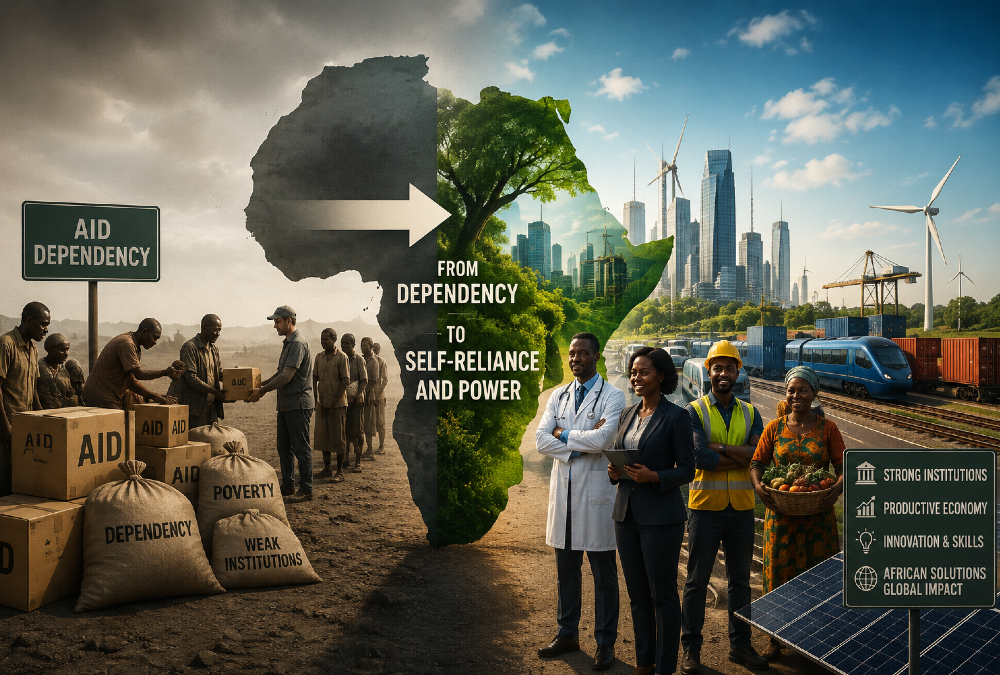
From Rescue to Power
Africa’s task now is not incremental reform of the aid model. It’s graduation from it entirely.
- From technical assistance to technical mastery.
- From policy advice to policy intelligence.
- From imported solutions to institutional memory.
- From dependence on external financing to productive economies capable of financing their own ambitions.
- From being perpetually developed by others to holding the organized, self-directed capacity to develop themselves.
None of this is a rejection of partnership. It’s a redefinition of its purpose.
The Questions Worth Asking
Where has aid genuinely built lasting capability – institutions, industries, and expertise that now stand on their own? And where has it, however unintentionally, reproduced the very dependency it was meant to cure?
Above all: what would the development system have to build differently if the goal were no longer to keep Africa alive inside the system – but to make Africa powerful enough to eventually outgrow it?
That is the measure of success worth adopting. Not how long the drip stays in, but how soon it can safely come out.
Wavinya Makai is a Kenyan author, development strategist, and Pan-African scholar specializing in African economic sovereignty. Her work focuses on youth development, unemployment, and education reforms that cultivate innovators. She is the author of Capital Violence: The Economic War on African Dignity and holds a Master of Philosophy in Development Studies from the University of Cambridge. Makai has been featured as a development analyst on Citizen TV Kenya and is a frequent speaker on leadership and human rights.
