
Opinion
Watts Before Algorithms: Why Africa’s AI Future Depends on Gigawatts, Not Aid
The artificial-intelligence revolution is fundamentally an infrastructure race. To avoid becoming a mere consumer of foreign compute, Africa must forge energy partnerships, not rely on aid.

By Victory Azimih
In a private conversation on the sidelines of last week’s Nigeria–Liberia Investment Summit, one sentence came up that I haven’t been able to shake since: energy is the bedrock of Africa’s AI future.
It sounds obvious. It isn’t being treated that way.
Around the world, governments and companies are racing to build the infrastructure that will power artificial intelligence for the next generation. Africa, meanwhile, is still largely stuck discussing adoption – how to use AI tools that others have built, rather than how to build the foundation AI runs on. In doing so, the continent is skirting the one question that actually determines who wins this race: where will the electricity come from?
Everyone Wants the Wrong Thing First
The pattern is familiar by now. Everyone wants GPUs; almost no one is planning for gigawatts. Everyone wants data centers; few are asking whether the grid can power them reliably, affordably, and at scale. Everyone talks about “sovereign AI” – but sovereignty without energy security is a slogan, not a strategy.
That is the uncomfortable truth at the heart of this moment: the AI revolution is, first and foremost, an infrastructure race. It runs on a simple chain – energy, then compute, then intelligence, then economic power. Whichever countries can supply abundant, reliable, and competitively priced electricity will end up owning the AI economy. Everything else is downstream of that.
Not Short on Resources – But Short on delivery
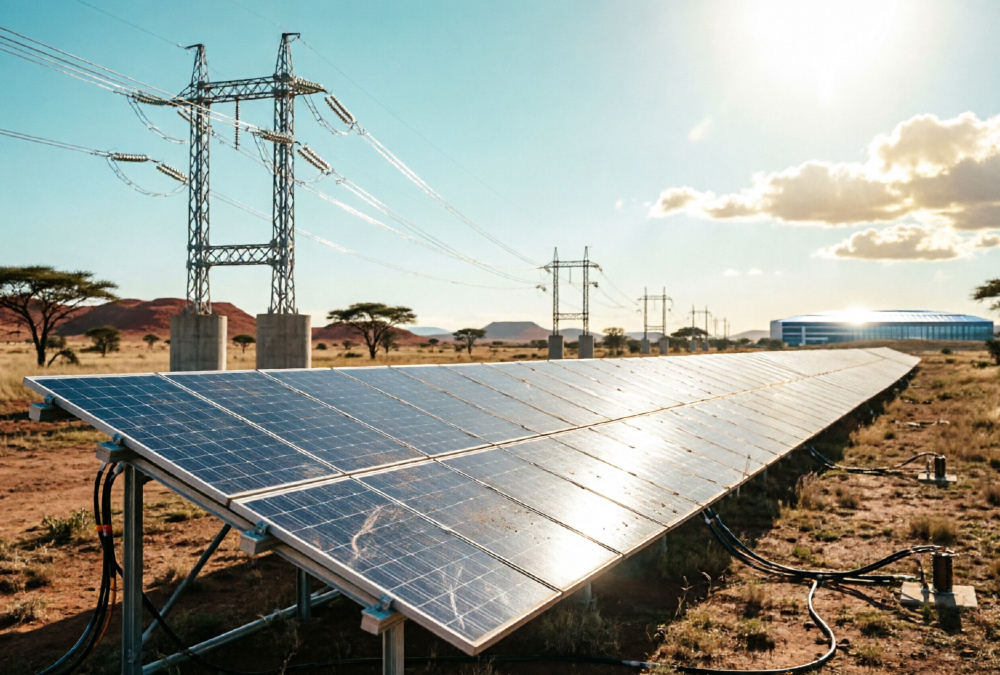
This is where the conventional narrative about Africa gets it backward. The continent isn’t resource-poor; if anything, it is one of the most energy-endowed regions on Earth. Nigeria alone holds gas reserves capable of powering industrial-scale data centers. The continent’s solar potential is the kind of asset other regions can only model in a spreadsheet.
The real constraint isn’t sunlight or gas in the ground. It’s the infrastructure, capital, transmission networks, and policy frameworks needed to convert that potential into power people and businesses can actually use.
Picture what happens when those pieces come together: African energy resources, matched with private capital, independent power producers (IPPs), regional grids, data centers, sovereign compute capacity, university-led research, and real industrial demand. The result isn’t just more electricity on a balance sheet. It’s the foundation of genuine economic capacity – the kind that compounds.
From Aid to Investment
Getting there requires a fundamental shift in how this conversation is framed:
- From aid to investment
- From dependency to partnership
- From promises to execution
Each actor in this system has a distinct role to play. Gulf investors bring capital and deep energy-sector expertise. Infrastructure funds can finance projects at the scale this challenge demands. IPPs are the ones who actually build generation capacity.
African governments must supply the one thing capital always looks for first: credible, stable policy and regulation. Pension funds and sovereign wealth funds bring the patient, long-term capital that energy infrastructure requires. Universities anchor the research base. And the diaspora – as investors, founders, and builders – remains one of the most underused resources in this entire equation.
The Equation That Matters
This point bears repeating, because it’s the crux of the argument: data without compute is dependency. Compute without energy is vulnerability. And energy without an industrial strategy is simply wasted potential.
Put the pieces together, though, and something different emerges: energy, plus compute, plus capital, plus policy, equals African intelligence infrastructure – a system capable of generating value rather than just consuming it.
That is the real transition on offer here. Not from poverty to progress, in the way aid narratives like to frame it, but from extraction to production, from consumption to ownership, from dependency to capability, from infrastructure to intelligence. Call it independence, redefined for the AI era.
Two Questions Worth Sitting With
To the policymakers, heads of state, sovereign wealth funds, investors, energy leaders, university leaders, founders, and members of the diaspora reading this, two questions are worth real debate rather than another panel discussion:
- What will it actually take to make Africa the world’s destination of choice for energy-intensive AI infrastructure?
- Which African country is best positioned to become the continent’s first major AI energy hub – and what does it need to do differently to get there?
The future of artificial intelligence will be built on electricity. Africa cannot afford to watch that future get built somewhere else.
Victory Azimih is a visionary entrepreneur and global investment consultant specializing in Africa’s economic growth and industrial transformation. As the CEO and founder of Azeemi Global, he leads a pioneering firm dedicated to accelerating the continent’s development through cutting-edge technology and infrastructure solutions. Under his leadership, Azeemi Global focuses on harnessing the potential of artificial intelligence, blockchain, and smart infrastructure to unlock sustainable investment opportunities across Africa. Based in Lagos, Nigeria, Azimih is at the forefront of driving Africa’s future as a hub of innovation and industrialization.
