
Opinion
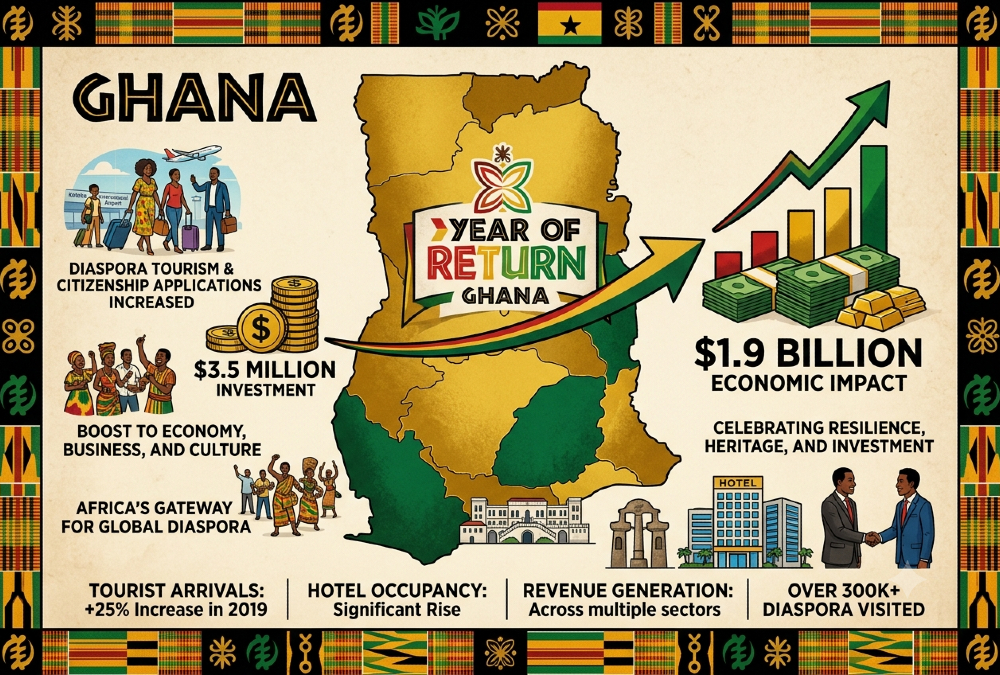
How Ghana Turned a $3.5 Million Diaspora Campaign into $1.9 Billion
What the Year of Return reveals about the future of diaspora investment in Africa.

By Caleb Maru
In 2019, Ghana wagered US$3.5 million on a deceptively simple idea: come home.
The campaign, branded the Year of Return, marked the 400th anniversary of the first enslaved Africans being dragged from the Gold Coast’s shores. For twelve months, Ghana remade itself into a homecoming – festivals, concerts, heritage pilgrimages through the dungeon corridors of Cape Coast Castle. President Nana Akufo-Addo unveiled the initiative in Washington, then personally worked the Caribbean, selling the invitation face to face.
And the diaspora answered. Idris Elba. Naomi Campbell. Steve Harvey. Hundreds of thousands of others whose names will never make a headline but whose spending reshaped a national economy.
The numbers read like a case study no MBA program has quite caught up with:
- Visitor arrivals surged 45 percent in a single year.
- Average spending per visitor climbed from USUS$1,862 to USUS$2,589.
- The Ghanaian consulate in Houston simply ran out of visas.
Total return on the campaign: roughly US$1.9 billion in tourism revenue. For a US$3.5 million outlay, that is a multiplier most venture capitalists would frame on their office wall.
The Sequel Was Always the Point
Here is what separated Ghana’s effort from a well-executed tourism blitz: the Year of Return was never meant to end.
When the calendar flipped past 2019, Accra launched Beyond the Return, a ten-year strategic sequel running through 2030. And it underwrote the invitation with statute. Since 2001, anyone of African descent in the Americas has held the legal right to reside in Ghana indefinitely. After 2019, the machinery around that right accelerated. Citizenship ceremonies went from symbolic gestures to a steady cadence – 126 new citizens in 2019, hundreds more in the years that followed, and a single ceremony in 2024 that naturalized 524 people at once.
All told, roughly 1,500 members of the diaspora have gone beyond a holiday and actually immigrated.
The capital followed them. Diaspora buyers now account for nearly 30 percent of high-end property purchases in Accra, turning nostalgia into square footage and equity.
A Different Kind of Foreign-Investment Strategy
Most developing economies court anonymous foreign capital – sovereign-wealth funds, multinational joint ventures, portfolio inflows that can vanish at the next Federal Reserve rate decision. Ghana tried something more radical: it courted its own people.
The genius was structural. Tourism served as the top of the funnel – emotionally accessible, logistically simple, Instagram-ready. But the funnel was designed to narrow toward something stickier: residency, property, citizenship, long-term investment. A painful historical anniversary was converted, deliberately and methodically, into a national economic strategy.
The playbook worked well enough that “moving back” has drifted from the margins of diaspora conversation into a genuine, continent-wide movement. From Senegal to Rwanda to Sierra Leone, governments are experimenting with their own versions of the homecoming pitch.
The Missing Piece: the How
Yet for all the momentum, a conspicuous gap remains. No government, no institution, no serious infrastructure yet exists to answer the most practical question a diaspora professional can ask: How do I actually do this?
Not the inspiration. Not the symbolism. The visas, the tax implications, the school searches, the property due diligence, the business registrations, the honest accounting of what works and what doesn’t. The pathways, the playbooks, the structured on-ramps that turn a powerful feeling into a functional life decision.
That gap is the one The Big Move was built to fill – a resource and community connecting the African diaspora to the concrete opportunities waiting on the other side of the Atlantic. Not a travel brochure. A blueprint.
If the question of returning has ever surfaced in your own thinking, it is worth seeing how people are navigating it in practice – the logistics, the finances, the mistakes, the victories.
The Question Worth Asking
Ghana proved the model. The return on investment is documented, the legal architecture exists, and the emotional pull is undeniable. The next wave of this movement will be shaped by whichever countries and institutions figure out how to make the process as seamless as the invitation.
So: which other nations are building – or should be building – their own “come home” campaigns? And more important, which ones will follow Ghana’s lead in backing the rhetoric with residency law, citizenship pathways, and a genuine economic welcome?
The diaspora is ready. The question is whether the infrastructure will be.
Caleb Maru is Founder and CEO of Tech Safari, Africa’s leading tech community and media company, specializing in tech innovation, market trends, and exclusive insights across the continent. Based in Nairobi, Kenya
