
Opinion
Africa’s Next Integration Frontier: Connectivity and the DR Congo Link

By Danilo Desiderio
Africa’s story of economic integration has always been a story about geography. Countries integrated first with whoever happened to be next door, building regional economic communities around shared borders, well-worn trade routes and common interests. The results – the East African Community, ECOWAS, SADC, COMESA – are real and durable. They remain indispensable. Proximity, after all, is where integration almost always begins: neighbors trade with neighbors before they trade with strangers, infrastructure follows the shortest path, and political cooperation is easiest to build where economic ties already exist.
But proximity is a starting point, not a destination. And Africa is running up against the limits of what proximity alone can deliver.
The continent has built vibrant regional neighborhoods. What it has not built is a functioning system connecting those neighborhoods to one another.
The Numbers Behind the Problem
According to the African Export-Import Bank (Afreximbank), intra-African trade made up just 15.3 percent of the continent’s total trade in 2024. That figure alone is sobering. Look closer, and the picture gets more uneven still: Southern Africa accounted for 42.1 percent of intra-African trade flows, West Africa 23.3 percent, East Africa 14.5 percent, North Africa 12.6 percent, and Central Africa a mere 7.5 percent.
These figures deserve some caution – informal cross-border trade is significant and unevenly captured across regions – but the underlying story is hard to dispute. Africa is not yet a single economic space. It is a constellation of regional trading blocs, each reasonably well-integrated internally, but only weakly linked to one another. The continent has built islands of integration. It has not yet built the bridges between them.
A Framework Is Not a Network
This is the deeper challenge now facing the African Continental Free Trade Area (AfCFTA). For the first time, Africa has a continental architecture designed to connect its patchwork of regional economic systems. But no framework, however ambitious, creates a functioning economy by itself. Trade agreements open borders. Networks are what make those open borders usable. A continental market can exist in law years before it exists in the daily reality of the businesses and producers meant to benefit from it.
For the AfCFTA to be more than a document, Africa needs to build the physical and digital geography beneath it. That means more than tearing down tariffs. It means linking transport corridors that currently stop dead at regional boundaries; connecting power grids that fall short of neighboring markets; extending payment systems trapped within national or regional silos; wiring together digital infrastructure that still cannot talk to itself; and building production networks that rarely cross a regional bloc’s outer edge. The task ahead is not simply removing barriers between African economies. It is shrinking the economic distance between them.
Why the Congo Matters More Than Its Troubles Suggest
Few countries illustrate this challenge – or this opportunity – as vividly as the Democratic Republic of Congo.
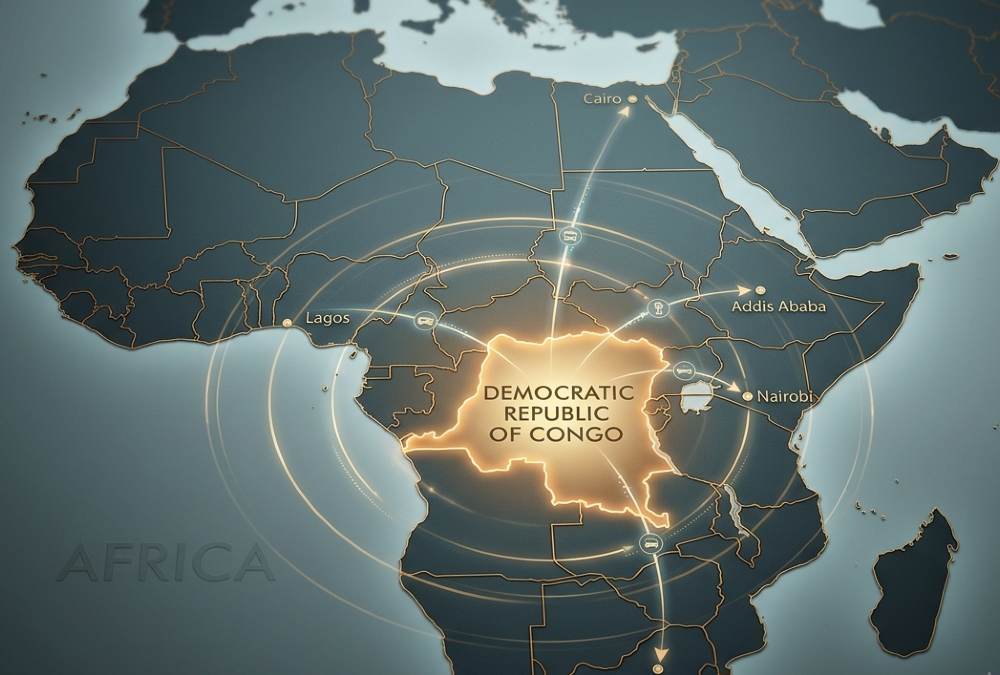
Geographically, the DR Congo sits at the heart of the continent. It borders nine countries and straddles the meeting point of Central, Eastern and Southern Africa. No other country is as naturally positioned to link Africa’s major regional economic zones. And yet economically and infrastructurally, the DR Congo remains strikingly disconnected from the systems around it. Its roads and railways are inadequate, but the deficit runs deeper than transport: its energy networks are poorly linked, and its digital and financial infrastructure has so far failed to convert geography into economic weight. The country at the geographic center of Africa is not, in any meaningful sense, at the center of Africa’s economic networks.
That paradox turns the DR Congo’s development challenge into something bigger than a national problem. It becomes a continental one. Africa cannot claim to be connecting its regional markets while leaving a gap at the very center of its map. The DR Congo is not simply another country in need of roads and power plants. It is a live test of whether Africa can convert geographic centrality into economic centrality.
Infrastructure, though, is only half the story. The DR Congo’s disconnection is also a product of prolonged conflict, institutional fragility and governance strain, particularly in its eastern provinces. Corridors do not function merely because asphalt has been laid; they require security, predictable institutions, competent border management and enough confidence for businesses to invest and operate across them. Connectivity, in other words, is as much a political and institutional project as an engineering one. Without stability and governance, even a beautifully engineered corridor risks becoming a line on a map that nobody actually uses.
The opportunity on offer, even so, is extraordinary. The DR Congo holds some of the planet’s most important reserves of critical minerals, alongside vast agricultural potential and enormous untapped hydropower capacity. Properly connected, it could link economic systems stretching from the Atlantic coast to the Great Lakes, and from Central Africa toward East and Southern Africa. But resources alone do not build networks. Geography alone does not create connectivity. Potential, left alone, does not circulate. Only networks do that.
Building the Skeleton – and the Nervous System
Seen this way, the DR Congo is not just a country awaiting infrastructure. It is the missing link in Africa’s economic map. A corridor linking the DR Congo to its neighbors is a useful regional asset. A network linking Central Africa to East and Southern Africa is continental infrastructure – a fundamentally different order of magnitude.
The same logic applies to power. A single plant serving a local grid is valuable development infrastructure. An interconnected system capable of moving electricity across borders can become the foundation for regional industrialization. The DR Congo’s hydropower potential makes the point plainly: Africa’s real challenge is not generating more electricity, but connecting that electricity to productive demand wherever it exists. Energy only becomes transformative once it can flow.
Not every path to connectivity moves at the same speed, however. Some require decades of capital and political coordination – large-scale hydropower projects like Inga, cross-border transmission lines, railways, strategic transport corridors. Others can move much faster, through institutional cooperation and comparatively modest investment. Cross-border digital payment platforms such as the Pan-African Payment and Settlement System (PAPSS) can cut transaction friction long before anyone agrees on a common currency. Harmonized customs procedures, interoperable digital systems and smarter border management can deliver connectivity gains well ahead of any major construction project breaking ground.
The strategic task, then, is to build both the skeleton and the nervous system of continental integration at once: heavy, long-term infrastructure that moves people, goods and power, alongside faster-moving digital, financial and institutional systems that let transactions and information move with far less friction.
Integration as a Circulatory System, Not a Checklist
This calls for a broader rethink of what integration actually means. Africa already has scale. Fifty-four countries, a vast and youthful population, an enormous resource base and highly diverse markets give the continent an economic mass few regions can rival. What it lacks is a circulatory system to put that mass to work.
Infrastructure is only the visible skeleton of an integrated economy. What Africa needs looks more like a circulatory system – the veins, arteries, organs and connective tissue through which goods, services, people and capital can move across borders, interact and generate value in different corners of the continent.
Roads and railways are the veins, but they cannot function alone. Energy grids are the arteries that power production. Digital payment platforms are the financial capillaries carrying transactions from place to place. Manufacturing clusters and industrial networks are the organs where value is actually created and transformed. Regional value chains are the pathways along which inputs, knowledge, technology and capital travel from one economy to the next, gaining value as they move. Ports, logistics corridors and border systems are the gateways connecting the whole system to the outside world.
Understood this way, integration is not just about making it easier for a product to cross a border. It is about creating the conditions under which economic activity itself can circulate freely across borders.
The goal, then, should not simply be more intra-African trade by volume, as much conventional analysis suggests. It should be a continental economic system in which value can move, interact, transform and accumulate across borders – where a mineral mined in one country is processed in a second, financed in a third, powered by energy generated in a fourth, and folded into a manufacturing chain spanning several more. At that point, integration has moved past trade altogether. It has become a continental architecture of production.
A Network of Networks, Not a Hierarchy
This is where Africa’s real opportunity lies. The continent does not need to manufacture scale – it already has it. It needs to build the circulatory system that lets that scale become productive. The AfCFTA supplies the institutional framework, but the networks underneath it – energy, logistics, digital, financial, industrial – will decide whether Africa’s continental market lives only on paper or becomes an everyday economic reality.
None of this means the AfCFTA should replace Africa’s regional economic communities, nor should continental integration be imagined as a hierarchy in which the continental level simply supersedes the regional one. A more useful model is a network of networks: regional communities providing the foundation of proximity-based integration, with the AfCFTA supplying a continental coordination layer that makes those regional systems increasingly interoperable. Proximity still matters in this model. It just stops being the limit of what’s possible.
The real measure of African integration, under this model, would not be how intensely countries trade with their immediate neighbors, but how effectively the continent connects economic systems that are geographically and institutionally distant from one another. Integration would be judged by the strength of the bridges between regions, not just the density of activity within them.
Which brings the argument back to the Congo.
Africa’s Most Underrated Asset Isn’t Underground
The DR Congo is routinely described as a country of enormous untapped potential – usually a reference to its minerals. But that framing may miss the larger point. The country’s greatest untapped resource may not be a mineral deposit or a hydropower site at all. It may be its location.
A connected DR Congo could serve as a bridge between regional economic systems that currently operate as separate worlds. It could turn Central Africa from a relatively isolated economic space into a connective one, letting energy flow, minerals get processed rather than merely extracted, goods circulate, and production networks stretch across borders that have historically been dead ends. In short, the DR Congo could help Africa solve a problem no trade agreement can solve on its own: how to make the continent’s regional economies behave like parts of a single system rather than neighbors who happen to trade occasionally. Connecting the DR Congo, in that sense, isn’t just about connecting the DR Congo. It’s about connecting Africa to itself.
The Test Ahead
Africa’s integration project has spent decades building neighborhoods. Its next phase has to connect them – through corridors that cross regional boundaries, energy systems that link productive centers, digital platforms that lower transaction costs, financial systems that let capital move freely, and value chains that let economic activity accumulate across borders. The continent already has the scale, the resources, the population and the regional institutions, and now, with the AfCFTA, a continental framework as well. What’s still missing is the connective and circulatory system to make those assets function as parts of one economic organism.
The DR Congo sits squarely at the center of that paradox. Left disconnected, Africa’s regional economies will keep behaving like neighboring islands – trading with each other, but never quite functioning as one system. Connected – physically, energetically, digitally, financially and productively – the consequences could ripple far beyond its own borders. The geographic center of Africa could become an economic gravitational field, pulling in corridors, capital and production while radiating connectivity outward across regional lines, helping turn separate economic systems into a genuinely continental network.
That is the deeper test facing the AfCFTA: not whether Africa can declare itself a single market, but whether it can make its economic systems actually function as one. Africa’s integration story began with proximity. Its next chapter has to be written in connectivity. In the end, the true measure of continental integration may not be found at Africa’s borders at all, but at its center – in whether the country at the geographic heart of the continent can finally become the economic engine through which its regions connect, circulate and grow together.
Danilo Desiderio serves as the CEO of Desiderio Consultants Ltd in Nairobi, Kenya, specializing in African customs, trade, and transport policies and is a senior associate to the Horn Economic and Social Policy Institute (HESPI).
