
Opinion
Africa’s Trade Protocol for Women Needs More Than Applause – It Needs Implementation
Six months after the AfCFTA Protocol on Women and Youth in Trade was adopted, the hardest work is only beginning.

By Ziad Hamoui
When African Union leaders gathered in Addis Ababa earlier this year, they signed off on something genuinely new: a continent-wide framework built specifically to help women and young entrepreneurs trade freely across borders. The African Continental Free Trade Area (AfCFTA) Protocol on Women and Youth in Trade promised gender-disaggregated data, easier access to financing for small businesses, streamlined customs procedures, and the repeal of laws that keep women out of formal commerce.
Six months on, the protocol deserves recognition. But a signature is not a border crossing, and a communiqué does not issue a trader identification card. The document has done its job. Now governments must do theirs.
The Scale of the Problem
The stakes could hardly be higher. In Ghana alone, women own 44.6 percent of all registered micro, small, and medium enterprises (MSMEs), and their businesses generate an estimated 70 percent of the country’s GDP. Yet a striking share of the cross-border trade these women conduct happens off the books entirely – unregistered, untaxed, and invisible to the very institutions meant to support it.
This is not a minor technicality. A trader who does not appear in official statistics cannot benefit from a policy designed around those statistics. Africa’s most productive informal economy is, in effect, operating outside the reach of its own reform agenda.
Where the Gap Actually Lives
The shortfall is not one of ambition; it is one of execution. Consider the evidence:
- Representation is missing. Most national trade facilitation committees across the Economic Community of West African States (ECOWAS) still lack any formal seat for women’s trader associations – the very groups whose members the protocol was written to protect.
- Infrastructure wasn’t built for them. Border crossings across the region were rarely designed with women’s safety, schedules, or day-to-day realities in mind.
- Awareness hasn’t reached the ground. Recent research from the Overseas Development Institute (ODI) found that many informal traders don’t even know the protocol exists.
These aren’t policy failures. They are delivery failures – and they are fixable.
What Progress Actually Looks Like
One pilot project offers a preview of what serious implementation can achieve. Along the Senegal–Guinea-Bissau corridor, a program run by Germany’s development agency, GIZ, issued formal ECOWAS trader identification cards to 206 women engaged in informal cross-border trade. That single initiative moved more women into the formal economy than months of high-level dialogue.
It is a small number in absolute terms. But it proves the model works – and it shows exactly where governments should be investing next.
Three changes would accelerate that progress considerably:
- Give women’s trader associations permanent seats on national trade facilitation committees, not advisory status.
- Convert Border Information Centres into genuine support hubs – places where traders can access safety resources, documentation help, and real-time information, not just signage.
- Make digital payments the default, cutting traders’ reliance on cash and the security risks that come with carrying it across borders.
A Measurable Deadline
Vague commitments invite vague results. So here is a simple scorecard. By July 2027, African governments and regional bodies should be able to answer three concrete questions:
- How many women traders hold formal ECOWAS identification – and how many were added this year?
- How much have border processing times shrunk for small-scale, cross-border traders?
- Which ECOWAS member states are publishing gender-disaggregated trade data on a regular, ongoing basis?
If those numbers don’t exist in 2027, neither will meaningful progress – no matter how many summits produce new commitments in the meantime.
The Destination Is Set. Now Comes the Journey.
Africa has already agreed on where it wants to go: a continent that is peaceful, prosperous, and economically integrated. The AfCFTA Protocol on Women and Youth in Trade lays out a credible route to get there. But routes only matter if people actually travel them.
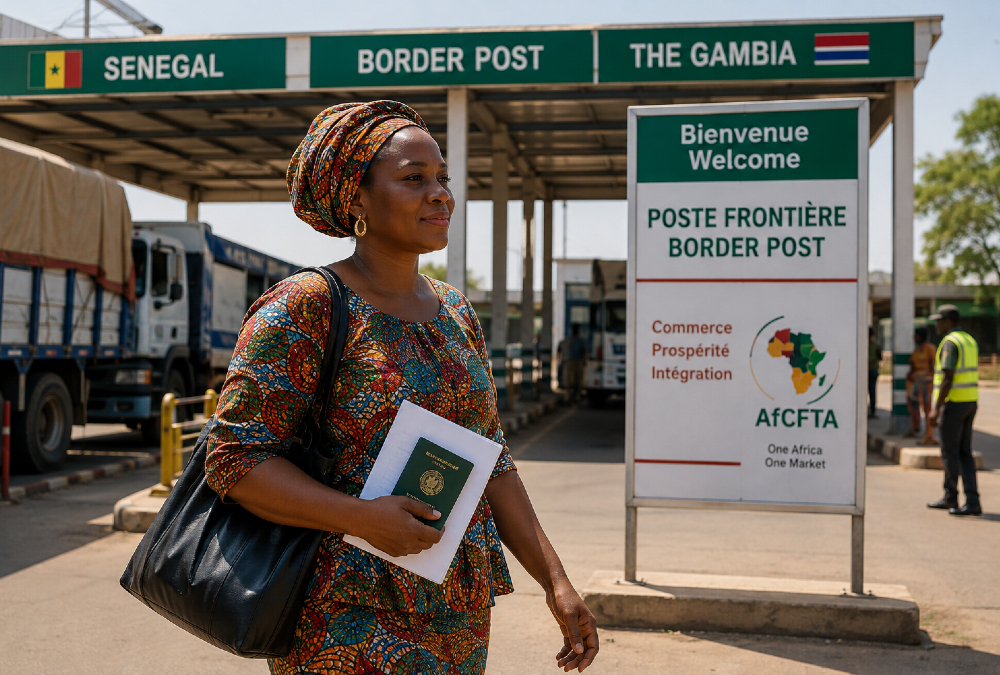
The measure of this protocol’s success will not be found in Addis Ababa. It will be found at border posts – in whether a woman trader can cross with an ID card in hand, clear customs in a fraction of the time it once took, and show up as more than a footnote in national trade data.
That is the Africa worth building. The next eighteen months will determine whether the continent gets there.
Ziad Hamoui is the Co-Founder and Past President of the Borderless Alliance, a leading private-sector advocacy group promoting economic integration and removing trade and transport barriers in West Africa. With extensive experience in Ghana’s road transport, logistics, and shipping sectors, he currently serves as Executive Director of Tarzan Enterprise Ltd., a long-established family business. He is a former Co-Chair of the Africa Food Trade Coalition, Co-Founder of the Trade Facilitation Coalition for Ghana, and serves on multiple high-level advisory committees on trade, transport, agriculture, and security. A Chartered Fellow of the Chartered Institute of Logistics and Transport (CILT) Ghana, he is also a former member of its Governing Council.
