
Opinion
Africa’s Palm-Oil Boom Is Built on Women. It Must Not Leave Them Behind.
As industrial investment pours into the sector, the women who built it risk being pushed out.

By John Dale
Palm oil is Africa’s best-kept economic secret – and it is, overwhelmingly, a woman’s business.
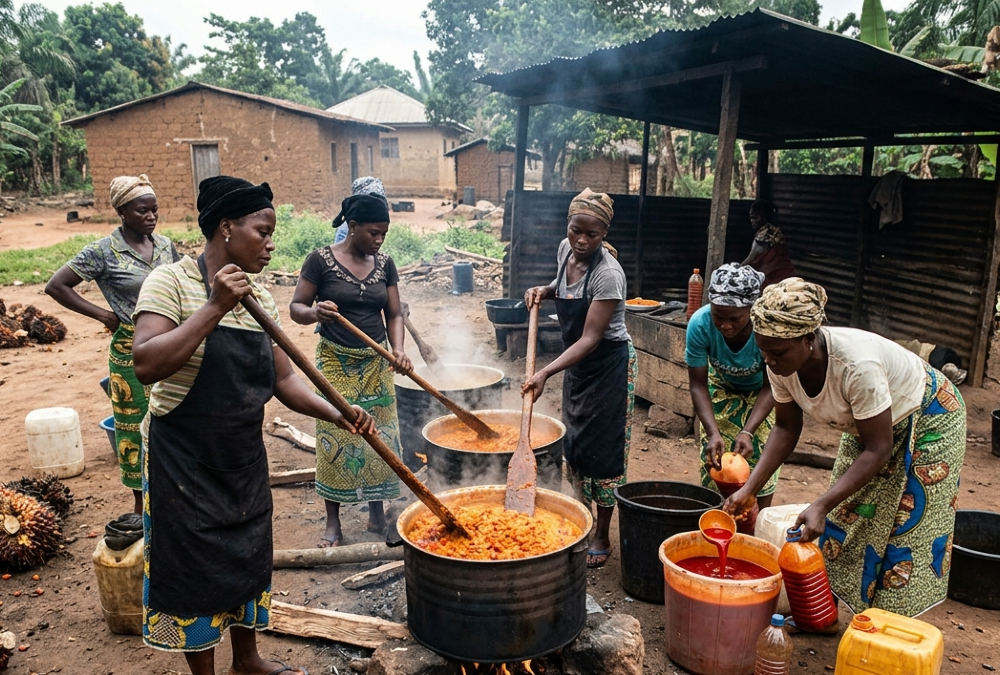
Across the continent, more than 60 percent of palm oil processors are women. In Nigeria, the pattern is even starker: over 80 percent of the country’s palm oil is produced by the informal sector, and within that informal economy, women account for more than 60 percent of the workforce. No other major agricultural value chain on the continent is as thoroughly powered by women.
Behind every liter of palm oil sold in a rural market is a woman whose livelihood depends on it. She processes the fruit. She extracts the oil. She separates the kernels. She refines, packages, and trades the final product. Women have not merely participated in this industry – they have built and sustained it, generation after generation, into one of Africa’s largest informal economies, worth billions of dollars a year.
Here is the paradox: that dominance evaporates the moment the industry scales up.
The Industrial Shift
At industrial scale, the picture changes completely. Men make up more than 70 percent of the formal, large-scale palm oil workforce – a shift that fundamentally alters who captures the value the industry creates. The same sector that empowers millions of women informally becomes, on an industrial footing, a predominantly male one.
This is not a hypothetical concern. It is the direction the industry is already heading, and it carries a real risk: if Africa industrializes palm oil without deliberately redesigning the value chain, it could end up replacing one of the continent’s largest women-led informal economies with a male-dominated industrial one – trading broad-based livelihoods for concentrated profit.
Designing Inclusion In, Not Bolting It On
I am currently designing an end-to-end industrial ecosystem for the palm oil sector, and one lesson has become unmistakable through that process: women’s inclusion cannot be an afterthought.
If women power more than 60 percent of today’s informal processing economy, they must be intentionally built into the industrial ecosystem from the design stage – not added later as a corrective measure. That means creating real opportunities for both experienced and emerging women across the value chain, not only as beneficiaries of development programs, but as aggregators, quality control specialists, packaging operators, distributors, traders, and business builders in their own right.
The question facing Africa’s palm oil sector is no longer whether to industrialize. Industrialization is coming, and it should come. The real question is who that industrialization empowers.
Growth Without Displacement
Industrialization should not simply mean higher output and greater value creation. It should mean shared prosperity across the entire value chain – for everyone who helped build the industry in the first place.
Women have been the backbone of Africa’s palm oil economy for decades. Any industrial model that overlooks that reality isn’t just incomplete – it’s building on a false premise about who does the work.
As Africa’s informal palm oil industry moves toward industrial scale, the goal must be integration, not replacement. Women should not be pushed out by the very growth their labor made possible. Instead, the industrial ecosystem now taking shape should be built to include them from day one – improving their livelihoods, productivity, and access to opportunity as the industry grows, rather than growing past them.
John Dale is an agricultural expert, procurement specialist, and export entrepreneur with 20+ years of experience in Nigeria’s agro-commodity value chain. He has deep expertise in farming, sourcing, storage, and international trade of commodities such as cashew, palm oil, ginger, and cocoa. As Co-Founder of Storgit Ltd., an agro-fintech company, he develops innovative solutions for commodity storage, trading, export, and livestock investment. Passionate about reducing post-harvest losses, strengthening procurement systems, and improving export infrastructure, John is dedicated to building a digital, efficient, and inclusive future for African agriculture.
