
Opinion
Africa’s Simplified Trade Regime Faces Its Real Test at the Border
Southern Africa’s simplified trade rules look good on paper. Making small-scale cross-border trade actually predictable is the harder test.

By Danilo Desiderio
Rules are easy to write. Habits are hard to break. That, in essence, is the lesson emerging from a two-day gathering of trade officials, customs agents, and cross-border traders in Lusaka this month, where five Southern African countries recommitted to speeding up a scheme meant to make life easier for the region’s small traders. The event was unglamorous – a “High-Level Policy Dialogue Forum,” in the leaden argot of development bureaucracy – but the question at its heart is anything but small: can Africa’s regional blocs make formal trade genuinely more attractive than the informal kind?
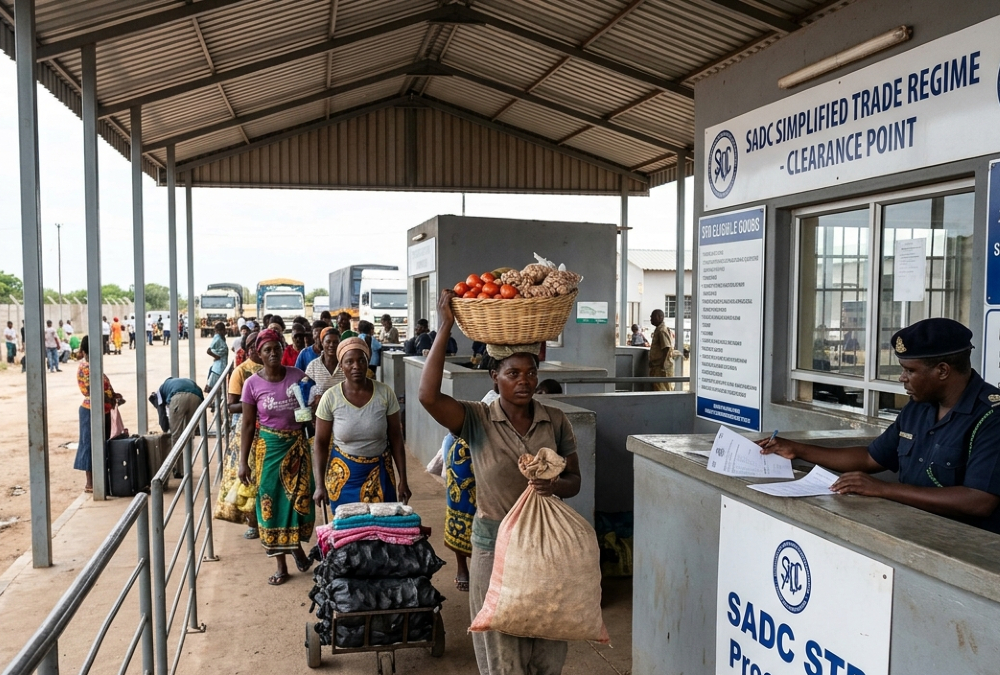
The scheme in question is the Southern African Development Community’s Simplified Trade Regime, or STR, a mechanism that trims customs procedures and rules-of-origin paperwork for small consignments crossing borders within the bloc. The Committee of Ministers of Trade signed off on the framework back in 2021; training manuals followed a year later. Implementation, however, has crawled along a bilateral track rather than a regional one. Malawi and Mozambique launched the first working arrangement in October 2024, covering goods worth up to US$1,000. Malawi has since struck a similar deal with Tanzania. Zambia and Zimbabwe were among the roughly 50 delegates in Lusaka pushing for more.
The August 4–5 forum, convened by SADC with backing from the African Development Bank’s Trade and Transit Facilitation Programme, drew policymakers, parliamentarians, revenue officials, gender specialists, and representatives of cross-border traders’ associations. Their message was less celebratory than clarifying: a simplified framework on paper does not guarantee simple trade in practice.
Old Problems, New Region
None of the obstacles identified at the forum will surprise anyone who has watched similar reforms unfold elsewhere on the continent. Traders often don’t know the rules exist. The procedures that do exist can be cumbersome. Digital exclusion locks out those without smartphones or internet access. Infrastructure is patchy, and customs officials are frequently under-resourced to apply the new rules consistently. Corruption, harassment, and unsafe conditions at border posts remain persistent complaints – problems that fall disproportionately on women, who make up a large share of small-scale cross-border traders in the region.
SADC has an advantage here that earlier reformers lacked: hindsight. The Common Market for Eastern and Southern Africa (COMESA) and the East African Community (EAC) have both run comparable simplified-trade schemes for years, and their successes and stumbles are well documented. The Lusaka forum leaned explicitly on that experience, along with recent SADC border assessments, to identify where implementation is likely to snag. The task now is not to rediscover these problems but to design around them before scaling up.
Why Informality Persists
The deeper issue is one that policymakers often underestimate: informal trade is not simply a rational response to red tape or high compliance costs. It is, more precisely, a learned behavior. When traders repeatedly encounter unpredictable procedures, arbitrary enforcement, and uncertain costs at the border, they adapt – and they share those adaptations with others. Over time, workarounds harden into habits, and informality becomes the default, self-reinforcing way of doing business, regardless of what the rulebook says.
Seen this way, the Simplified Trade Regime is not merely a customs-reform exercise. It is an attempt to reshape the behavioral environment of the border itself. Cutting costs matters, but it isn’t sufficient. Procedures also need to be visible, predictable, and consistently applied – enough that traders come to trust them more than the informal alternatives they already know how to navigate. Formal trade wins converts only when it is a more reliable bet than the informal system it’s competing against.
A Continental Test Case
The stakes extend beyond these five countries. SADC’s efforts are unfolding alongside talks on a Tripartite Simplified Trade Regime Framework, which would harmonize the approaches taken by COMESA, the EAC, and SADC into something more coherent than today’s patchwork of bilateral deals. That tripartite framework offers a chance to pool lessons across regions – including debates over raising consignment thresholds and introducing self-certification for traders – rather than each bloc relearning the same lessons in isolation.
Delegates in Lusaka called for faster bilateral negotiations, pilot projects at specific border posts, closer cooperation between governments and the private sector, and measures tailored to the safety and needs of women traders. Sensible as these steps are, they amount to incremental fixes rather than a silver bullet. Formalization, as the Lusaka discussions underscored, cannot simply be legislated into existence. It has to be experienced – repeatedly, predictably – before traders will trust it enough to change how they work.
That is the real test facing Southern Africa’s regional integration project. It won’t be decided in ministerial communiqués or committee rooms, but at the border post itself: whether crossing it formally becomes, for the ordinary trader, simply the easiest thing to do.
Danilo Desiderio serves as the CEO of Desiderio Consultants Ltd in Nairobi, Kenya, specializing in African customs, trade, and transport policies and is a senior associate to the Horn Economic and Social Policy Institute (HESPI).
