
Opinion
What I learned about Stop and Frisk from watching my black son
By Christopher E. Smith
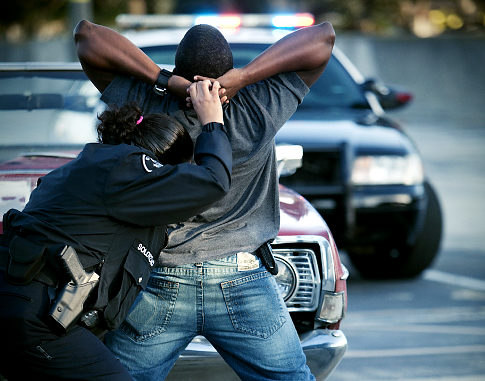
Policewoman frisking man. PHOTO/Getty Images
When I heard that my 21-year-old son, a student at Harvard, had been stopped by New York City police on more than one occasion during the brief summer he spent as a Wall Street intern, I was angry. On one occasion, while wearing his best business suit, he was forced to lie face-down on a filthy sidewalk because – well, let’s be honest about it, because of the color of his skin. As an attorney and a college professor who teaches criminal justice classes, I knew that his constitutional rights had been violated. As a parent, I feared for his safety at the hands of the police – a fear that I feel every single day, whether he is in New York or elsewhere.
Moreover, as the white father of an African American son, I am keenly aware that I never face the suspicion and indignities that my son continuously confronts. In fact, all of the men among my African American in-laws – and I literally mean every single one of them – can tell multiple stories of unjustified investigatory police stops of the sort that not a single one of my white male relatives has ever experienced.
In The Atlantic’s April feature story “Is Stop-and-Frisk Worth It?” author Daniel Bergner cited Professor Frank Zimring’s notion that stop and frisk is “a special tax on minority males.” I cannot endorse the conclusion that this “special tax” actually helps make communities safer. As indicated by the competing perspectives in Atlantic essays by Donald Braman and Paul Larkin, scholars disagree on whether crime rate data actually substantiate the claims of stop and frisk advocates. Either way, I do believe that the concept of a “special tax” deserves closer examination.
Proponents of stop and frisk often suggest that the hardships suffered by young men of color might be tolerable if officers were trained to be polite rather than aggressive and authoritarian. We need to remember, however, that we are talking about imposing an additional burden on a demographic that already experiences a set of alienating “taxes” not shared by the rest of society.
I can tell myriad stories about the ways my son is treated with suspicion and negative presumptions in nearly every arena of his life. I can describe the terrorized look on his face when, as a 7-year-old trying to learn how to ride a bicycle on the sidewalk in front of our suburban house, he was followed at 2-miles-per-hour from a few feet away by a police patrol car – a car that sped away when I came out of the front door to see what was going on. I can tell stories of teachers, coaches, and employers who have forced my son to overcome a presumption that he will cause behavior problems or that he lacks intellectual capability. I can tell you about U.S. Customs officials inexplicably ordering both of us to exit our vehicle and enter a building at the Canadian border crossing so that a team of officers could search our car without our watching – an event that never occurs when I am driving back from Canada by myself.
If I hadn’t witnessed all this so closely, I never would have fully recognized the extent of the indignities African American boys and men face. Moreover, as indicated by research recently published in the American Journal of Preventive Medicine, the cumulative physical toll this treatment takes on African American men can accelerate the aging process and cause early death. Thus, no “special tax” on this population can be understood without recognizing that it does not exist as a small, isolated element in people’s lives.
It’s equally important to recognize the more acute dangers posed by these encounters. When my son was walking home one night during his summer in New York City, 2 men jumped out of the shadows and grabbed him. Any reasonable person would instantly have been jolted into wondering, “Am I being robbed?” That question demands quick decision-making: “Do I defend myself? Do I break free and try to run away?”
