
Opinion
What Biden Should Do
Dear President Biden,
As you know, the economic relationship between the U.S. and Africa has always attracted bipartisan support from 1600 Pennsylvania Avenue, and in the bicameral U.S. Congress. Richard Nixon visited eight African nations as Dwight Eisenhower’s vice president. John Kennedy had a relationship with Kwame Nkrumah. Reagan ramped up the U.S. presence in Africa. Clinton had the African Growth & Opportunity Act (AGOA). George W. Bush II gave us PEPFAR, and Barack Obama had the first U.S. – Africa Summit.
At each of these stages, a camaraderie grew to mirror the words of Chinua Achebe: A kinsman in trouble had to be saved, not blamed because anger against a brother was felt in the flesh, not in the bone.
But the last four years have somewhat been different. Whereas Trump launched programs to bolster Africa’s capacity for global business, and even an innovative development finance vehicle, both sides of the Atlantic did not feel the warmth of kinship. At least, not until you were sworn in as president. On the other hand, you are no ordinary kinsman. As President of the United States, others may be impressed by your house, car and black briefcase with red buttons. But presidential scholar Richard Neustadt was right. You, Mr. President, must be a persuader-in-chief in times such as these. Given that the U.S. is still recovering from a global pandemic, your priority is to persuade others to see your vision for getting Americans back to work. So, our five asks of you are quite realistic.
Ask One: Raising Africa’s Profile in the United States
Mr. President, your first POTUS address to the African Union this past February 2021 was very well received throughout Africa. We all felt your warmth and sincerity, knowing that you have taken pan-Africanism to heart. In stating that the United States ‘… stands ready to be [a] partner [that believes in the] continent-wide spirit of entrepreneurship and innovation …’ you also capture the essence of our first recommendation. As research literature shows, one of the reasons Africa does not attract adequate amounts of American investment stems from an information asymmetry. In this scenario, while the opportunities exist, potential partners just don’t know enough about us. As occurred during the 2014 Summit between the United States and 50 African heads of state, you, alongside President Obama gave the region a sizable platform, with Africa recognized as a key to the future of global business.
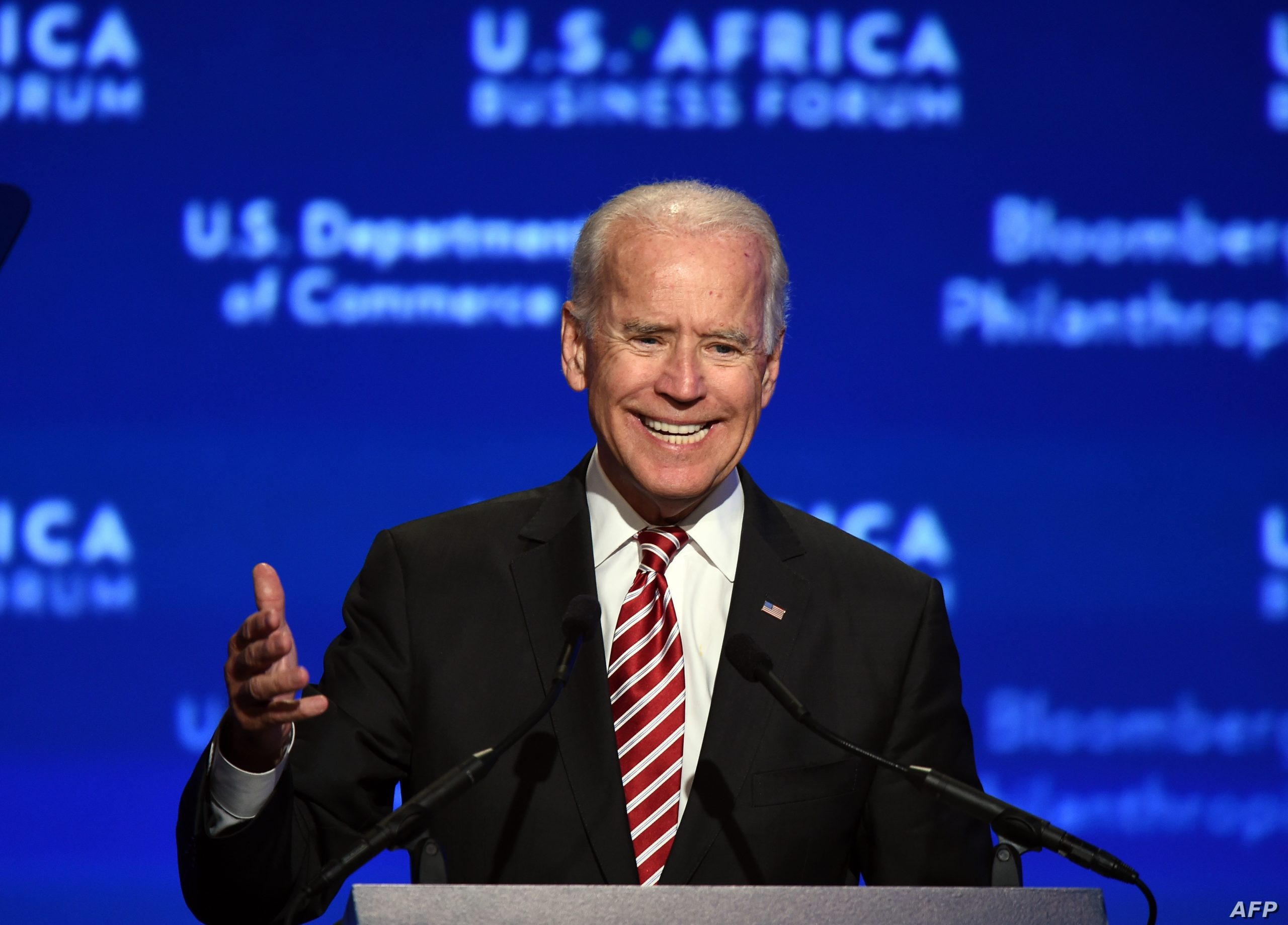
US Vice President Joe Biden speaks during US-Africa Business Forum on the sideline of the US-Africa Leaders Summit in Washington, DC, on August 5, 2014. US heralded $14 billion worth of new investments in Africa Tuesday as Washington seeks to demonstrate it is ready to take a strong role in the continent’s economic takeoff. AFP PHOTO/Jewel Samad (Photo by Jewel SAMAD/AFP).
Since 2014, both The Economist and the Brookings Institution have established that seismic shifts have taken place on the continent – the kind of changes that the American private sector would, no doubt, be interested in knowing about, and ultimately benefit from. However, given the way American society and media operate, we believe that if the POTUS spoke about the twenty-seven leadership changes that had occurred on the continent by 2019, and the fact that thirty-four countries had improved their governance performance, the private sector would sit up and take note.
With your pulpit, Mr. President, you could raise Africa’s profile once again. Africa is not just another opportunity. As most recent Afrobarometer surveys show, the region is a natural American ally, and will propagate U.S. national security.
Ask Two: Support for the AfCFTA
Mr. President, as you, no doubt, know, whereas U.S. exports of goods to Africa’s fifty-five countries increased from US$ 10.9 billion in 2000 to US$ 22 billion in 2020, the figures from 2020 represented 1.53 percent of total U.S. exports of US$ 1.43 trillion. Equally, even if Africa’s exports to the United States once stood at US$ 113 billion in 2008, the United States imported about US$ 23.6 billion worth of goods from Africa in 2020, approximately 1 percent of the total goods imports of US$ 2.35 trillion for the same period. The lopsided nature of both total and two-way trade-in-goods figures validate what the Economic Commission for Africa (ECA) and the U.S. International Trade Commission (USITC) suggested was a sub-optimal partnership between the United States and Africa. In the same vein, the numbers reveal that if Africa had adequate lead time to achieve competitiveness, the continent would be in a prime position to enter into a WTO-compatible reciprocal agreement with the United States. And Mr. President, we believe that a well-implemented African Continental Free Trade Area (AfCFTA) represents an invaluable opportunity for partnership between the United States and the partner you mentioned in your recent speech to the African Union.
As part of Agenda 2063 – a framework to achieve the Africa We Want – the Member States of the African Union designed blueprints for a free trade regime to cover the entire continent. To use your famous statement, Mr. President, the AfCFTA is a big, BIG deal! It expounded upon the incredible progress made by regional bodies like the EAC and ECOWAS.Instead of combining tariff schedules of fifty-five nations, the AfCFTA built upon the regional protocols establishing common customs procedures to facilitate trade. Political will and donor support facilitated a functional reciprocal pact as Step One. Stakeholders rightfully wondered whether fifty-five developing nations would succeed at regionalism in an era where the European Union struggled to corral twenty-eight developed ones. Others said there was no real value in a reciprocal agreement that pitted developed countries against less developed ones since Africa is yet to harness infrastructure for intra-African trade. Whether Eritrea eventually joins the AfCFTA or not, the current fifty-four Member States still make the AfCFTA the world’s largest trade area by participating countries since formation of the World Trade Organization.1 Therefore, the U.S. should give priority to the successful implementation of the AfCFTA. With the completion of Phase I and with trading under the AfCFTA now in progress, the U.S. can play a significant role in shaping the fortunes of Phase II – dealing with Trade in Services, Intellectual Property, eCommerce, and Investment.
Fortunately, during confirmation hearings to be the U.S. Trade Representative, Ambassador Katherine Tai suggested that she would prioritize relations between the U.S. – Africa and also look into the importance of the AfCFTA. Ambassador Tai’s signal reverberated across our trade policy circles because we continue to hope that global distribution chains can operate throughout Africa without having to deal with border formalities currently maintained by fifty-five nations.
But this is not to say that the benefit will go to Africa alone. There are various ways for U.S. companies to benefit from the AfCFTA. In the first place, we have to look at the potential of the market. To boost intra-African trade in goods and services – amongst the 1.2 billion people and fifty-five states whose gross domestic product (GDP) stands at over US$ 3.4 trillion – we must invest in both hard and soft infrastructure. With expertise at logistics, warehousing, and digital cross-border strategies, American firms could come play in a region whose estimated gross domestic product (GDP) stands at over US$ 3.4 trillion. Also, as per the AfCFTA rules of origin, as long as there is sufficient African value-added to meet the origin requirements, U.S. components could be incorporated into African produced products. This would be a win-win scenario.
Ask Three: Democratic Values, Peace and Security
After what the world witnessed these past four years, it should come as no surprise that some African leaders will not want post-Trump lectures on democracy. Hence, we must re-invite the United States to, once again, become part of the conversation around governance and democracy. We leaders must be held to a higher standard not for the sake of standards and indices on global scales but because Africans want action. On the other hand, while our people are keen to hold governments accountable for either egregious abuse or small scale malfeasance, the United States has could contribute significantly to peace and security via sharing information and intelligence to combat terrorism.
As your National Counterterrorism Center (NCTC) demonstrates, there is incredible value in sharing information with partners in your counter-terrorism enterprise.
Similarly, the United States could garner similar value from deeper information sharing partnerships on the continent which continues to grapple with all forms of terrorism. Overall, stakeholders on either side of the Atlantic call for your strong support in regard to democratic values, peace and security in Africa. As you well know, respect for human rights and democratic values closely align with economic empowerment. Security goes with governance. Trade & investment go in tandem with gender equity. Development, health and food security go hand-in-glove with FDI.
Ask Four: A Role in America’s New Policy Direction
Mr. President, over the past few decades, your nation has infused significant resources in economic development the world over. In 2018, USAID revealed a comprehensive and robust philosophy in its Journey to Self-Reliance framework. The plan reorients American resources to a time when assistance can be replaced by partnership and program models. Given the lessons of the COVD-19 pandemic, we endorse any plans that wean nations off overseas development assistance. We also agree with the proposition that if the U.S. supported a more transparent trade and investment platform with cross-Atlantic business linkages and finance, Africa will make a bigger dent in global business. Between Prosper Africa and the DFC, Americans are, indeed, investing in leveling the playing field for the American private sector to grow investments in frontier markets.
The time is nigh for a prime time speech on the dynamic and importance of economic relations between the U.S. & Africa.
This prime time speech should remind people that America is already working to ensure that Africa is a more self-reliant partner. With the AfCFTA and herculean efforts for reform amongst the African Union Member States, more capacity building and institutional infrastructure can help spur entrepreneurship and additional market-led facets into blossoming. Also, by continuing to elevate the strategic partnership between the United States and Africa, you will have doubly elevated African and American private sector entities that continue to work to grow cross-Atlantic linkages via our good friends at Corporate Council on Africa and the U.S. Chamber of Commerce.
Ask Five: The Importance of Institutions
President Biden, like you, we entered public service as very young idealistic men. We wanted to change the world. We wanted to help people. We wanted to reduce poverty. Improve health and human security. Over the decades, we’ve learned that individual men—however strong—can only move anthills but never mountains. With strong institutions, Africa can move mountains such as the annual financial deficit standing at between US$ 410 billion and US$ 2 trillion. Here, our hope is that your strong relationship with the African Union can demonstrate that the continent has a host of multilateral institutions that would serve as reference points for the business community keen on taking on a multi-country approach to doing business with Africa. We must push for investments into ventures that provide employment; those that augment rapid urbanization, and the readiness for the Fourth Industrial Revolution. Additionally, as Porter’s diamond, and the African Development Bank stipulate, unless we strengthen our governance and institutions, we will not attract adequate FDI. Fortunately, we have a host of investment grade institutions. But infamous American muscle is still missing throughout Africa’s financial services sector and amongst multilateral entities. With your innovative DFC, the U.S. could take equity in African entities and give the American private sector confidence in Africa investments outside the extractive sector.
As we close, Mr. President, we thank you for recognizing the unique role of our kinsmen in the United States. As a key constituency of the African Union, the diaspora have a vantage point in brokering relationships on both sides of the Atlantic. As Prosper Africa stipulates, it is these relationships that will dispel negative notions, and ensure that you continue to walk in the bipartisan footsteps of your predecessors.
Notes
- Official AfCFTA trading begun on January 1, 2021, with customs unions submitting tariff schedules on behalf of 34 African countries. Alongside the 34, eight other countries – Democratic Republic of Congo (DRC), Egypt, Madagascar, Malawi, Mauritius, Sao Tome & Principe, Seychelles, and Zambia submitted tariff schedules on their own. However, because only Malawi and Zambia had ratified the AfCFTA, official trading parties are 36. In this case, Economic & Monetary Community of Central Africa (CEMAC) submitted schedules for Cameroon, Central African Republic, Chad, Republic of Congo, Equatorial Guinea & Gabon. East Africa Community (EAC) submitted schedules for Burundi, Kenya, Rwanda, South Sudan, Tanzania, and Uganda. Economic Community of West African States (ECOWAS) presented Mauritania’s tariff schedule alongside its 15 member states, Benin, Burkina Faso, Cape Verde, Cote d’Ivoire, Gambia, Ghana, Guinea, Guinea-Bissau, Liberia, Mali, Niger, Nigeria, Senegal, Sierra Leone, and Togo. The world’s oldest customs union, the Southern African Customs Union (SACU), did likewise for Botswana, Eswatini, Lesotho, Namibia, and South Africa.
_______________________________
About Mukhisa Kituyi
Mukhisa Kituyi is currently running to be President in Kenya’s elections in 2022. Until recently, he was UNCTAD’s seventh Secretary-General, serving from September 2013. Dr. Kituyi has an extensive background as an elected official, an academic, and a holder of high government office. He also has wide-ranging experience in trade negotiations, and in African and broader international economics and diplomacy. He was twice elected to the Kenyan Parliament in 1992, and was Kenya’s Minister of Trade and Industry from 2002 to 2007. He also served as chairman of the Council of Ministers of the African, Caribbean and Pacific (ACP) Group of States, and was lead negotiator for Eastern and Southern African ministers during the European Union-ACP Economic Partnership Agreement negotiations.
From 2008 to 2012, Dr. Kituyi was a member of a team of experts advising the presidents of the nations of the East African Community on how to establish more effective regional economic links. From 2011 to 2012, he was a consultant for the African Union Commission, where he helped to develop the structure for the AfCFTA. Immediately prior to becoming Secretary-General, Dr. Kituyi was Chief Executive of the Kenya Institute of Governance, based in Nairobi. The Institute is a think tank and advocacy organization that focuses on linking academic research and the development of public policy. He also served as a non-resident fellow of the Africa Growth Initiative of the Brookings Institution.
About Erastus Mwencha
Mr. Mwencha was elected in January 2008, as Deputy Chairperson of the African Union Commission by the Heads of State and Government of the 55 Member States of the African Union and re-elected to the same position in July 2012. During his first tenure as Deputy Chairperson of the AUC, Mr. Mwencha placed particular emphasis on supporting continental development agenda and programs as well as strengthening internal institutional systems. Prior to his election at the AUC, he worked at Common Market for Eastern and Southern Africa (COMESA) for over 25 years and served as Secretary General for ten years. Mr. Mwencha contributed to the transformation of the regional body into a viable economic integration entity, with the largest free trade area (FTA) in Africa. Mr. Mwencha also held several senior roles within the Ministry of Industry in Kenya.
Hon. Mwencha currently serves on various boards of directors, trustees and think tanks including as Board Chairman of TradeMark East Africa and Equity Bank Kenya.
