
Opinion
Tripartite Free Trade Area: Great Strides in Africa’s Unity
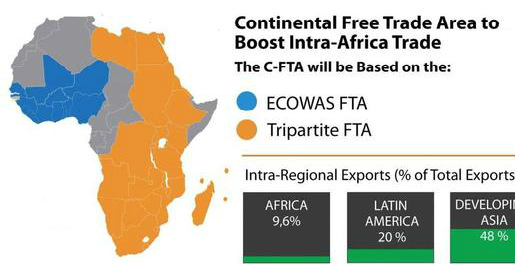
Negotiations were conducted under the following structures:
(i) The Tripartite Summit – as the highest policy making body;
(ii) The Council of Ministers – as the organ mandated to oversee and guide the negotiations;
(iii) The Tripartite Sectoral Ministerial Committee on Trade, Finance, Customs, Economic Matters and Home/Internal Affairs – as the organ to manage and supervise
the negotiations;
(iv) The Tripartite Committee of Senior Officials (TCSO) – as a higher level negotiating structure; and
(v) The Tripartite Trade Negotiations Forum (TTNF) – as the negotiating body.
The TTNF created four Technical Working Groups (TWGs) to assist with the technical work in the negotiations.
The negotiating bodies, namely the TTNF and TCSO, adopted their terms of reference, rules of procedure and schedule of negotiations. The TTNF held 10 negotiation sessions between December 2011 and October 2014, the TCSO met 7 times, while trade ministers met 3 times over the same period.
Challenges in the Negotiations
Some of the main challenges and pitfalls of the Tripartite FTA have been the not-so ambitious tariff liberalization threshold. The 60-85 percent liberalization threshold is less than trade liberalization thresholds attained under the 3 REC FTAs, and the failure to respect fully the principle of acquis in this respect. [Secondly], the apparent contradiction between some principles, notably between variable geometry which would allow countries that are ready to make progress while allowing slower countries to join later.
On the other hand the principle of decision-making by consensus which resulted in slow progress as countries that were not ready could not allow others to proceed. [Thirdly], meeting the principle of transparency – exchanging and sharing information on tariffs, non-tariff trade measures and other trade-related policies
was a daunting task; and [Lastly] funding of the negotiations has also been a great challenge as the Tripartite has four (4) working languages and all documents
have to be translated; negotiation rooms and facilities had to be secured and financed; interpreters and translators needed to be paid, and above all, trade experts and negotiators themselves required finances for travel and subsistence. Countries that were not able to meet these expenses, were sometimes not represented at
some negotiating meetings.
Trade Flows – Tripartite Region
In terms of the intra-regional trade status quo among the Tripartite RECS, the intra-trade in the COMESA region grew from US$8 billion to US$22 billion between 2004 and 2014; intra-trade in the SADC region grew from US$20 billion to US$72 billion between 2004 and 2014, and intra-trade in the EAC region grew from US$2.6 billion to US$8.6 billion between 2004 and 2014. The combined intra-trade of the three RECS grew from US$30.6 billion to US$102.6 billion between 2004 and 2014. This translates to a more than threefold growth in a period of 10 years. This growth has taken place on the basis of the individual FTAs of the three RECs.
I am confident that the establishment of a COMESA – EAC – SADC FTA would follow the same growth path, however at an accelerated growth pace, supported
by infrastructure and industrialization programs.
Turning to Africa, the continent’s trade with the rest of the world grow from US$602 billion in 2005 to US$1.2 trillion in 2013, thus doubling in less than
10 years. On the other hand its intra-trade rose from US$61 billion in 2005 to US$174 billion in 2013.
Taking into account the growth in trade, which has been registered in the 3 RECs on the basis of individual FTAs, it is imperative that once the single grand FTA
is established in Africa, trade would follow an exponential growth trajectory. The reduction or elimination of tariffs would greatly reduce the transaction costs across the continent. It is however imperative that the tariff reduction should be complimented with other trade facilitation mechanisms and strategies to boost productivity in agriculture, mining and manufacturing sector, just to mention a few.
