
Opinion
The Interoperability Imperative: West Africa’s Real Trade Deficit
Customs offices have gone digital. Now they need to start talking to each other.

By Ziad Hamoui
West Africa is not short on digital trade infrastructure. It is short on digital trade infrastructure that talks to itself.
Across the region, customs administrations, single-window systems, transit platforms, and payment networks are being built at a remarkable clip. The investment is real, the ambition is real, and the technology, by and large, works. What doesn’t work is the handoff between one system and the next. Too often, these platforms operate as islands – technically impressive, administratively isolated, and unable to exchange so much as a manifest with the system next door.
That diagnosis came through clearly at last week’s ECOWAS Regional Trade Facilitation Committee meeting in Banjul, where officials converged on an uncomfortable but useful conclusion: the next frontier of trade facilitation in West Africa is not digitization. It is integration.
The Progress Is Real
It’s worth pausing on how far the region has come. Côte d’Ivoire’s Guichet Unique, its national single window, now links more than 80 government agencies and clears 95 percent of manifests electronically – a genuine logistical achievement.
SIGMAT, the regional transit-monitoring system, is enabling real-time exchange of customs transit data across borders. New platforms for reporting non-tariff barriers, processing payments, and issuing certificates are in active development.
By any measure, this is progress. But progress on parallel tracks isn’t the same as progress toward a single destination.
Where the System Breaks Down
The trouble is that many of these platforms still can’t communicate with one another. A trader clearing goods in one country often has to re-enter the same data when those goods cross into the next, because the systems on either side of the border were never built to talk.
Agencies that should be sharing information instead operate in silos. Procedures that ought to be seamless remain fragmented, stitched together more by paperwork than by code.
This is the implementation gap, and it’s an important one to name correctly: it isn’t a shortage of digital tools. It’s a shortage of connections between the tools that already exist.
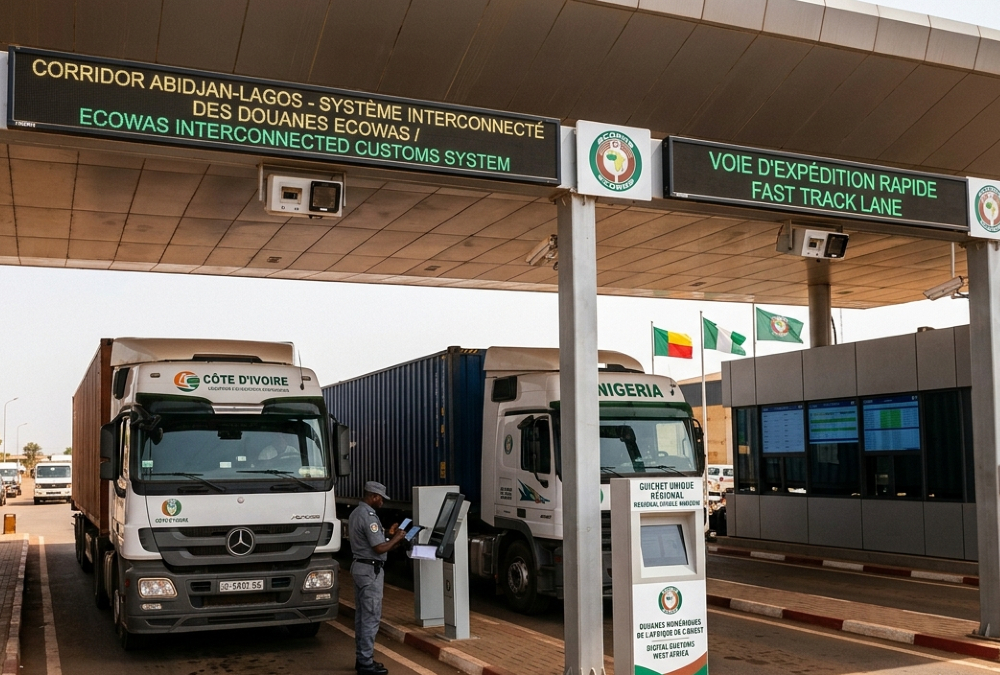
The cost of that gap is not abstract – it shows up at the border, in hours and dollars. Along the Abidjan-Lagos Corridor, one of West Africa’s busiest trade arteries, crossing times range from a brisk 2.5 hours to a punishing 47 hours or more, with customs procedures consistently flagged as the primary bottleneck. Trucks can face dozens of checkpoints over a single journey.
Informal payments, meanwhile, remain a persistent and significant cost for transport operators – a quiet tax on inefficiency that digitization alone has not eliminated. No amount of additional digitization will unlock its own value if the systems it produces can’t speak the same language.
The Fix Is Architectural, Not Technological
This is precisely why one of the most consequential recommendations to emerge from the Banjul talks wasn’t a call for more platforms, but for shared foundations: common data standards, common API protocols, and a regional digital architecture capable of linking national systems into one coherent network.
The distinction matters. Building more platforms is relatively easy. Building platforms that interoperate requires something harder – political coordination, technical standardization, and a willingness among national agencies to design for the region, not just for themselves.
Success, going forward, should not be measured by how many digital systems West Africa manages to launch. It should be measured by something simpler and more demanding: whether information entered once can move seamlessly across borders, across agencies, and across countries – without being typed in again at every stop along the way.
The Question for Lagos
These are the reflections I will be carrying to Lagos next week, where I will join a panel at the second AfCFTA Digital Trade Forum. The central question I hope to put to fellow panelists is this: how do we better align regional and continental trade facilitation initiatives, so that digital systems translate into something traders can actually feel – faster border crossings, lower trade costs, and real opportunities for African businesses?
Because in the end, digital trade was never really about the technology. It was always about making trade work.
That remains the goal worth pushing for: an Africa that is peaceful, prosperous, and – at long last – integrated, not just in ambition, but in the systems that move its goods.
Ziad Hamoui is the Co-Founder and Past President of the Borderless Alliance, a leading private-sector advocacy group promoting economic integration and removing trade and transport barriers in West Africa. With extensive experience in Ghana’s road transport, logistics, and shipping sectors, he currently serves as Executive Director of Tarzan Enterprise Ltd., a long-established family business. He is a former Co-Chair of the Africa Food Trade Coalition, Co-Founder of the Trade Facilitation Coalition for Ghana, and serves on multiple high-level advisory committees on trade, transport, agriculture, and security. A Chartered Fellow of the Chartered Institute of Logistics and Transport (CILT) Ghana, he is also a former member of its Governing Council.
