
Opinion
The Diamond State: How Botswana Turned Resources Into an Institution
When the earth yields riches, governments face a choice. Most have made the wrong one.
By Dishant Shah
The annals of economic development are littered with cautionary tales. From Nigeria’s squandered oil billions to Venezuela’s hollowed-out petrostate, the “resource curse” – the paradox by which natural wealth breeds institutional decay, inequality, and stagnation – has proven remarkably durable.
It is a pattern so consistent that economists once debated whether it was, in fact, inevitable. Botswana chose to prove them wrong.
A Nation Built From the Ground Up
When the landlocked southern African nation gained independence from Britain in 1966, it ranked among the poorest countries on earth. It had fewer than a dozen kilometers of paved road, a negligible civil service, and an economy built almost entirely on cattle.
What it lacked in infrastructure, however, it would soon recover in geology. The discovery of diamonds in the late 1960s set in motion one of the most remarkable development transformations of the twentieth century.
Today, diamonds account for roughly 80 percent of Botswana’s export earnings and a commanding share of government revenue. Through a long-standing and repeatedly renegotiated partnership with De Beers Group – formalized through the joint venture Debswana – Botswana did not simply sell its mineral rights and collect royalties.
It insisted on co-ownership, demanded a seat at the table, and used the proceeds strategically. Revenue flowed not into the private accounts of a ruling elite, but into roads, clinics, schools, and the institutions that underpin a functioning state.
The results speak for themselves. Botswana has sustained one of the fastest long-run economic growth rates in the world since independence. It has maintained a degree of political stability and democratic governance that is, by regional standards, exceptional.
Its sovereign wealth fund, the Pula Fund, has served as a financial buffer against commodity price volatility – a tool for prudence that many resource-rich governments have conspicuously failed to deploy.
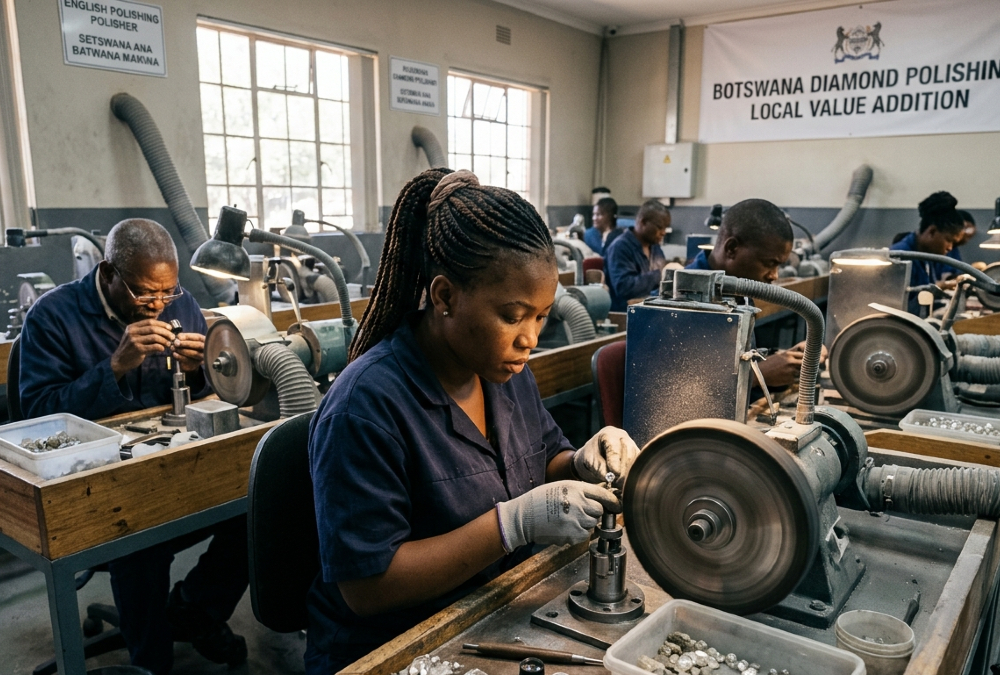
More recently, Gaborone has pushed to capture greater value from its diamonds by expanding downstream activities: cutting, polishing, and trading, rather than simply exporting rough stones. The relocation of De Beers’ global sales operation to Botswana – the result of shrewd renegotiation – was a signal to the world that this was a government that understood leverage.
The Limits of a Single Stone
And yet, for all its achievements, Botswana’s story is not one of uncomplicated triumph. It is, at its core, a story about the danger of dependence – and the urgency of transcending it.
The same commodity that built the modern Botswana state is now subject to forces beyond Gaborone’s control. Global demand for natural diamonds is shifting. Laboratory-grown stones, chemically and visually identical to their mined counterparts, are capturing an increasing share of the consumer market, particularly among younger buyers less attached to the romance of geological provenance.
Prices for rough diamonds have softened. The industry faces a structural reckoning, and no amount of institutional quality insulates a single-commodity economy from the arithmetic of market disruption.
Beyond the Kalahari: Writing the Next Chapter
Botswana’s next chapter, then, will be written not in the mines of the Kalahari but in the decisions its leaders make about diversification. Tourism – anchored by some of the world’s most extraordinary wildlife – offers a compelling foundation.
Financial services, renewable energy, and technology sectors present opportunities for a country with a relatively educated population, sound regulatory institutions, and a hard-won reputation for transparency. None of these transitions will be easy or automatic. They will require the same discipline, long-termism, and resistance to short-term political temptation that characterized the diamond era at its best.
The lesson Botswana offers the world is not, in the end, about diamonds. It is about governance. Natural resources create the conditions for wealth; institutions determine whether that wealth compounds or evaporates. The resource curse, it turns out, was never really about resources at all.
Dishant Shah is a partner at Legion Exim, a company specializing in facilitating the export of high-quality engineering products directly sourced from manufacturers in India to Africa. His areas of expertise include new business development and business management.
