
A Diaspora View of Africa
The Attraction of African Investment

By Gregory Simpkins
Over the past several years, there has been much said and written about African economic progress and the promise for investors. Financial analyst Martin Camara recently reported on LinkedIn that Africa’s market of more than 1.5 billion people, including a growing consumer class of 340-400 million people of which 220 million are premium consumers, is larger than Brazil’s entire population of 216.4 million people. He points out that South Africa, Egypt, Morocco and Nigeria are home to a manufacturing base at a large-scale, including an efficient automotive industry in South Africa and Morocco.
Camara predicts that Africa is the next investment powerhouse with more than US$500 billion expected to flow into Africa in the next decade.
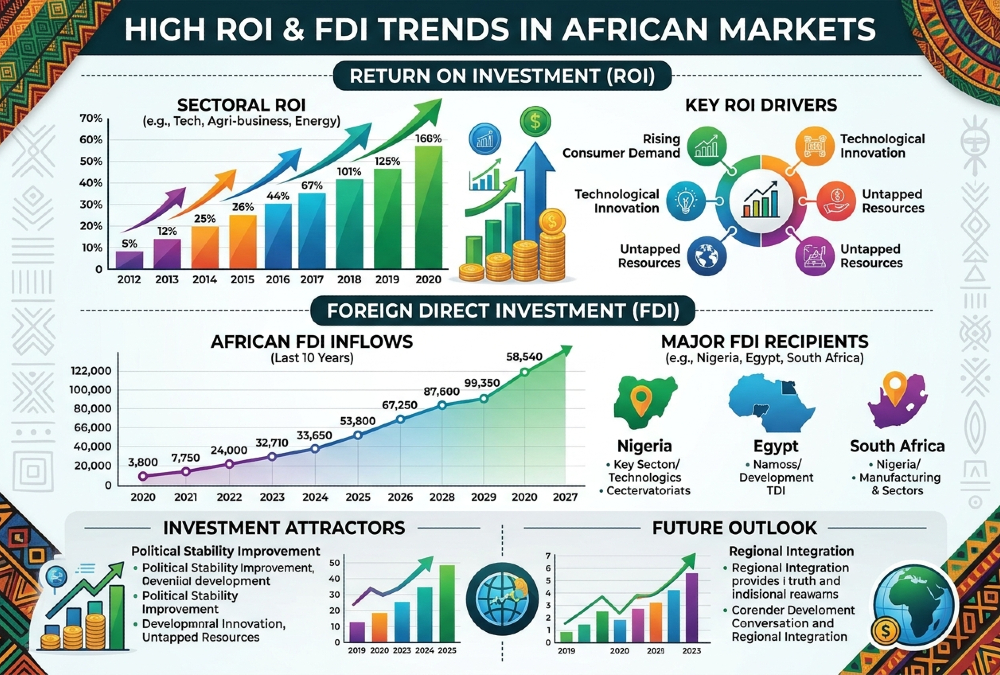
Other analysts also have presented a rosy picture of Africa’s prospects for Foreign Direct Investment (FDI). Yet Africa’s share of global FDI is still less than 5 percent. There was a record high in 2024 as FDI reached US$96 billion, up 71 percent, but US$35 billion of that was one deal: the United Arab Emirate’s Ras El-Hekma city in Egypt. In 2025, Africa’s FDI fell 38 percent to US$56 billion, while global FDI rose 14 percent to US$1.6 trillion. In the first half of 2025 alone, FDI in Africa was down 42 percent to US$28 billion, the steepest fall in any region. UNCTAD, the UN trade and development agency, now calls 2025 “broadly in line with 2023” which means no real growth trend.
The reason money doesn’t flood in is not lack of profitability; it’s perceived risk, small market size and infrastructure costs among other concerns. Investors want 30-55 percent Return on Investment (ROI) in Africa versus 5-7 percent in US/Europe to compensate for political instability / coups (such as in the Sahel and Sudan). There also is regulatory uncertainty and fragmented markets and 54 different investment codes. Then there is currency volatility, for example the Nigerian Naira and the Angolan Kwanza each lost more than 50 percent since 2020.
UNCTAD states that Africa needs approximately US$170 billion per year just for infrastructure. Without roads and adequate power, manufacturing ROI collapses.
Africa is divided into 54 countries – many of them with relatively small populations with similarly small middle classes. However, even some small African nations offer intriguing investment opportunities:
- Seychelles: Known for its tourism sector, Seychelles has a growing economy largely dependent on tourism and fishing.
- Mauritius: This island-nation has a diverse economy with strong sectors in textiles, tourism and financial services.
- São Tomé and Príncipe: The economy is primarily based on agriculture, particularly cocoa and coffee production.
- Comoros: The economy is largely agricultural, with vanilla and ylang-ylang as key exports.
The State of ROI in Africa
Africa is known in investment literature for the FDI Paradox – it has the highest rate of return in the world, but the smallest share of global FDI.
According to the most documented figure, from UNCTAD, the 2006-2011 average rate of return on FDI are:
- Africa: 11.4 percent
- Asia: 9.1 percent
- Latin America and Caribbean: 8.9 percent
- World average: 7.1 percent
Older US data shows an even bigger gap. For US FDI in Africa, since 1990, the average ROI was 29 percent. Since 1991, Africa’s return has been higher than any other region, often by a factor of two.
More recent commercial estimates include:
- Pan African Research: Average Return on Equity 35-55 percent in Africa vs 5-7 percent in US and Europe
- Global Data: Top 40 companies in Africa had annualized returns of 12.9 percent last year, still above global averages
Why so high? The risk premium, low competition, extractive rents in oil and mining and inexpensive labor contribute to higher ROI.
UNCTAD does not publish a clean regional ROI annually, but World Investment Reports breaks it down by where returns are highest in Africa historically:
- North Africa (Egypt, Morocco, Algeria, Tunisia): This region has the most stable FDI, but lower returns – around 8-10 percent. Driven by manufacturing, real estate megaprojects like Ras El-Hekma in Egypt and proximity to Europe. In 2025 North Africa still took in US$22 billion even after a 56 percent fall from the previous year.
- West Africa (Nigeria, Ghana, Senegal): This region has the highest returns in the continent – often 12-15 percent+ – because of oil and gas and mining. Nigeria saw FDI rise again in late 2024-25 despite volatility. West Africa rose 44 percent to US$20 billion in 2025.
- East Africa (Ethiopia, Kenya, Tanzania, Mozambique): This region shows a 10-12 percent average. It is more diversified with manufacturing, agro-processing, and now liquid natural gas in Mozambique, which surged 80 percent to US$6 billion in 2025. East Africa grew 12 percent to US$15 billion.
- Southern Africa (South Africa, Angola, Zambia): This is the most volatile region. South Africa had a negative US$6 billion in 2025 due to Anglo American’s US$7.2 billion divestment of Valterra Platinum. When commodity prices are high, returns are in excess of 11 percent, but when low, they collapse. Angola returned to more than US$3 billion after nine years of net divestment.
- Central Africa (DR Congo, Cameroon, Congo): This is the region with the highest risk. It has the highest theoretical returns in mining (cobalt and copper), but lowest actual inflows – falling 21 percent to about US$5 billion in 2025.
Regional differences are explained by sectoral performance:
- Extractive: more than 20-30 percent
- Telecoms / Fintech: 15-20 percent
- Manufacturing / Services: 8-12 percent
Nevertheless, despite high returns, Africa’s share of global FDI is tiny. Sub-Saharan Africa got 1.87 percent of global net FDI 2010-2016, versus 26.45 percent in East Asia and 30.34 percent in Europe. In 2025, global FDI rose 14 percent to US$1.6 trillion, but Africa fell 38 percent to US$56-59 billion. UNCTAD noted this was a return to normal after an inflated 2024 driven by one Egyptian deal.
If you average it, Africa still delivers roughly 1.5 times the world average return on FDI, with West and Central Africa producing highest returns and North Africa the lowest but most stable.
Over the years that I have been an Africa analyst, I have noted that an overwhelming percentage of the news about Africa focuses on conflict, poverty, disease and other tragic circumstances. Some publications may have an annual Africa issue where positive economic news is highlighted, but Africa coverage normally fails to present economic activity in Africa in a comprehensive manner.
Seasoned investors can find the positive potential for commercial opportunities on the continent, but those not already accessing such information will miss chances to find investment success in African nations. This is a major reason why The Habari Network was established – to allow even those with a casual interest in Africa’s prospects to more easily obtain a holistic view of Africa and its Diaspora.
Success is clearly possible for investment in Africa as many businesses and entrepreneurs have demonstrated, but more comprehensive coverage of the continent is required to expand the pool of those who see a way to commercial success in Africa.
Gregory Simpkins, a longtime specialist in African policy development, is the Principal of 21st Century Solutions. He consults with organizations on African policy issues generally, especially in relating to the U.S. Government. He is Editor-in-Chief of The Habari Network, the premier African Diaspora news website and moderates the Network’s podcast: Real Talk Habari.
