
Opinion
South Africa Has Two Freedoms. It Has Only Delivered One.
Mandela gave South Africa the freedom to vote. A generation later, millions are still waiting for the freedom to eat, to own, and to belong economically. Until that second freedom arrives, xenophobia will keep filling the void.
By Farhia Noor
As an African, I want to ask a question that many feel but few frame clearly: When does a freedom become real?
When apartheid ended, South Africans became free in a way that must never be minimized. Nelson Mandela gave South Africa its first freedom – the freedom to vote, to belong, and to be recognized as fully human under the law.
That freedom was sacred, hard-won, and historic. No honest accounting of the post-apartheid era should begin anywhere else.
But freedom has layers. There is the freedom to vote, and there is the freedom to eat. There is the freedom enshrined in a constitution, and there is the freedom of land, work, ownership, safety, dignity, and opportunity.
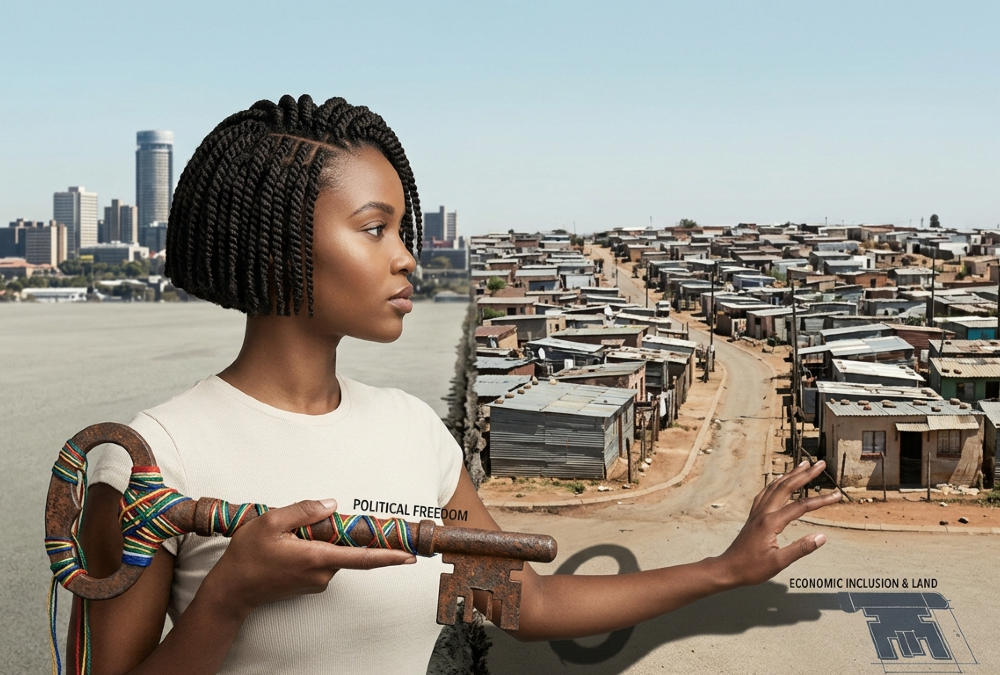
Mandela opened the door. The question his successors have yet to fully answer is: who can actually enter the house of economic freedom?
A Promise Written on Paper, Withheld in Practice
South Africa does not lack the language of transformation. It has policies, programs, funds, speeches, and promises in abundant supply.
But the defining question is no longer what exists on paper. The defining question is who can touch it.
Can the township entrepreneur access capital? Can the young university graduate access opportunity? Can the small-scale farmer access land with water, tools, financing, and markets? Can ordinary Black South Africans access ownership – or are they still being asked to survive outside the house they were promised?
Because a freedom that cannot be touched eventually becomes frustration. And frustration, when it has no clear address, searches for the nearest face.
The Scapegoat and the Invisible Wound
Too often in South Africa, that face belongs to another poor African – one who migrated from Zimbabwe, Mozambique, or Nigeria in search of exactly the dignity that South Africa’s own poor are still waiting to receive.
The foreign African did not design apartheid. He did not draw the township map. He did not decide who would own the land, or who would control capital, or why schools would remain underfunded, or why municipalities would fail. He arrived, visible and vulnerable, and became the face of an invisible wound.
That is why xenophobia in South Africa is not merely a migration issue. It is the sound of unfinished freedom.
There is a Zulu saying – Izandla ziyagezana – that means hands wash each other. Mandela extended the hand of political freedom. But the second hand – economic dignity – remains too weak to complete the embrace. A nation cannot clap with one hand.
A freedom that cannot be touched eventually becomes frustration. And frustration, when it has no clear address, searches for the nearest face.
The Second Freedom Requires More Than Words
President Cyril Ramaphosa’s task, therefore, is not simply to condemn xenophobic violence when it erupts, though he must. It is to answer the hunger that drives it.
Not with another speech. Not with another blue-ribbon commission or a well-worded policy framework. But with access – concrete, measurable, life-changing access.
Access to land that is productive. Access to capital that reaches people who have never held a bank loan. Access to schools that produce capability, not just certificates. Access to government contracts for township businesses. Access to municipalities that function. Access to townships that become genuine economies rather than holding pens for the formally excluded.
Political freedom opened the door. Economic freedom must hand people the keys.
Until dignity reaches the stomach, the streets will keep searching for someone to blame. And if South Africa does not complete its second freedom, the poor will keep fighting the poor – outside a house that was promised to them both.
Mandela opened the door. Now South Africa must give its people the keys – not merely to stand near freedom, but to finally live inside it.
Farhia Noor is a seasoned business consultant based in Dar es Salaam, Tanzania. With a proven track record in developing enterprises and executing turnkey projects across both government and private sectors, she brings deep expertise to the table. Farhia is also a committed advocate for community-led development and is passionate about advancing sustainable, intra-African growth.
