
Opinion
How Mechanized Agriculture Can Secure Africa’s Food Future

By Jean Claude Niyomugabo
Africa stands at a critical crossroads. With climate change intensifying droughts, populations growing rapidly, and arable land shrinking, the continent faces a mounting food security crisis.
The solution lies not in expanding farmland – but in transforming how we farm.
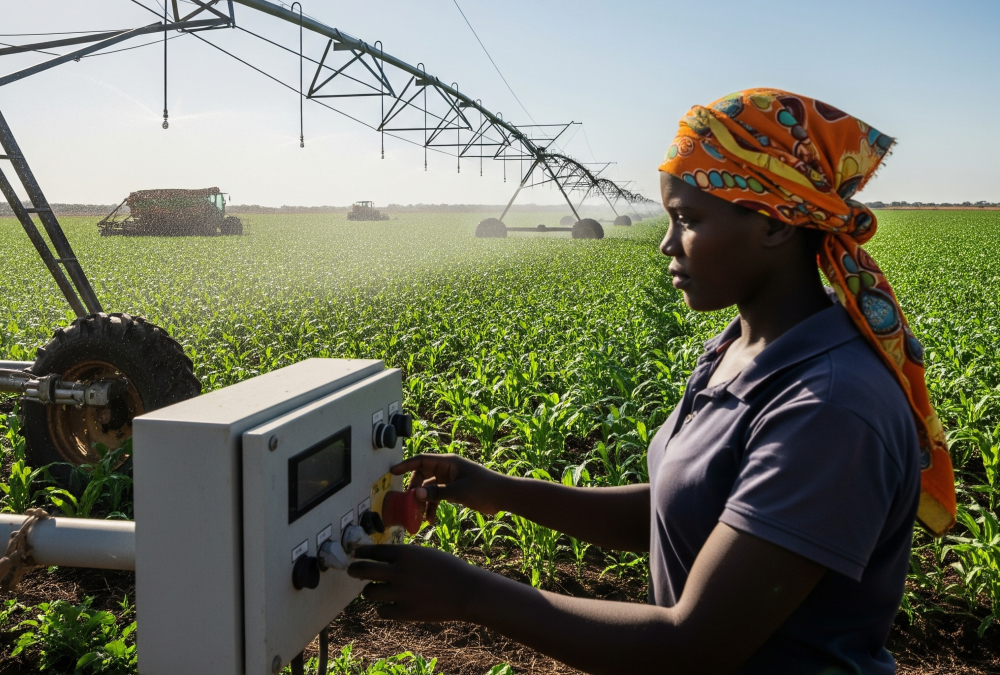
The future of African agriculture is mechanized, data-driven, and resilient. At the heart of this transformation lies smart technology – specifically, advanced irrigation systems like center pivots – that can turn underutilized land into high-yield agricultural zones.
These innovations offer more than efficiency; they promise stability, profitability, and long-term sustainability.
Why Smart Farming Matters
Traditional rain-fed farming is no longer viable across much of the continent. Erratic rainfall patterns have left millions of smallholder farmers vulnerable to crop failure, forcing many African nations to rely heavily on costly food imports.
In 2023 alone, sub-Saharan Africa spent over US$40 billion importing cereals – a drain on foreign exchange reserves that could be redirected toward domestic growth.
Enter center pivot irrigation systems. These circular marvels of engineering can convert drylands into lush fields, enabling year-round cultivation regardless of seasonal rainfall.
Countries like Egypt and South Africa have already demonstrated the potential of this technology, achieving consistent yields and greater water efficiency.
Now it is time for the rest of the continent to follow suit – and go even further.
Powering Progress with Renewable Energy
Imagine a continent-wide rollout of solar-powered center pivot systems. Such a move would not only reduce reliance on fossil fuels but also make large-scale irrigation accessible in remote, off-grid areas.
It would create jobs – particularly for youth and women – stabilize food prices, and bring reliable harvests to both rural and urban communities.
Farmers would gain what they’ve long lacked: control. With predictable water access, they can plan planting cycles, expand acreage, and increase incomes with confidence.
This isn’t just about feeding families – it is about building livelihoods and futures.
Beyond Irrigation: A Digital Agricultural Revolution
Mechanized irrigation is only one part of the equation. Precision farming, drones, satellite imagery, and AI-driven analytics are already reshaping global agriculture.
These tools help farmers do more with less – optimizing inputs, reducing waste, and improving yields.
For Africa, embracing these technologies isn’t just smart economics – it’s essential for survival. As the world’s youngest and fastest-urbanizing continent, Africa must make farming attractive to its next generation.
That means modernizing the sector and positioning it as a hub for innovation and entrepreneurship.
Bridging the Access Gap
Yet, despite the promise, most smallholder farmers remain locked out of this technological revolution. High upfront costs, limited financing options, and weak infrastructure continue to block adoption.
This is where public-private partnerships (PPPs) must step in. Governments, development agencies, and private investors need to collaborate on scalable solutions – subsidies, microloans, leasing models, and training programs – that put transformative tools within reach of those who need them most.
The Time to Invest Is Now
If we want to achieve true food sovereignty, we must stop thinking of agriculture as labor-intensive subsistence. Instead, we must embrace it as a tech-enabled industry – one that drives economic growth, job creation, and environmental resilience.
By scaling mechanized irrigation and digital farming tools, Africa won’t just feed itself. It will position itself as a global food supplier – resilient in the face of climate shocks and competitive in the international market.
So to policymakers, investors, and development partners: If you’re looking to invest in African agriculture, think beyond tractors and seeds. Think technology.
Think innovation. Think long-term impact.
Because the more we invest in mechanization today, the more secure our food systems – and our economies – will be tomorrow.
Jean Claude Niyomugabo is an entrepreneur and digital communication specialist with a strong passion for Africa’s development. He is dedicated to harnessing the power of social media to drive positive change and enhance livelihoods. With diverse interests and a strategic approach to digital engagement, he strives to create meaningful impact through innovation and connectivity.
