
Opinion
From Field to Factory: A Blueprint for Inclusive Mechanization in the Global South

By Curtis Akunfu
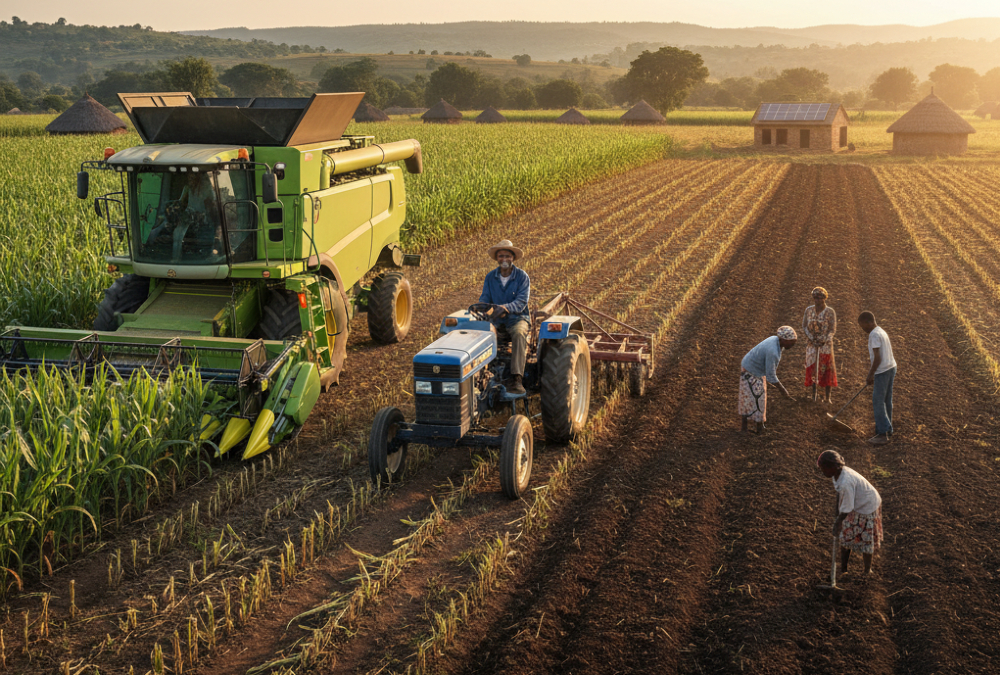
“A farmer with a hoe cannot compete with a farmer driving a combine harvester.“
This simple truth reverberates across the farmlands of the Global South – from Nigeria’s Middle Belt to India’s Gangetic plains. While precision agriculture thrives in the Global North, millions of smallholder farmers still rely on tools unchanged for generations.
The result? Not just lower yields, but a systemic denial of opportunity.
This is not merely a deficit of technology – it is a gap in vision, equity, and ambition.
True mechanization is not just about inserting machines into fields; it is about unlocking human potential, transforming subsistence into enterprise, and anchoring rural prosperity in dignity rather than drudgery.
The Promise and Pitfalls of Mechanization
For decades, agricultural mechanization has been hailed as the silver bullet for boosting productivity in developing economies. And rightly so: tractors, threshers, dryers, and processors can dramatically increase yields, reduce post-harvest losses, and ease the physical burden on farmers – particularly women, who perform the lion’s share of labor in many rural communities.
Yet, too often, mechanization efforts have stalled – or worse, backfired.
Why? Because they were imported, not embedded. Imposed, not integrated. Exclusive, not inclusive.
Across Africa and parts of Asia, gleaming tractors sit idle under mango trees – not for lack of will, but because they were mismatched to local conditions: too costly, too complex, or devoid of repair ecosystems. Government tractor schemes have collapsed under poor maintenance and elite capture.
Donor-funded projects have delivered machinery without spare parts, training, or business models. The lesson is clear: mechanization cannot succeed as a one-off hardware drop. It must be a system, not a spectacle.
Toward an Inclusive Mechanization Compact
To turn promise into performance, the Global South needs a new mechanization paradigm – one that is inclusive, scalable, and grounded in local realities. This requires three fundamental shifts:
1. From Ownership to Access
Most smallholders cannot afford to buy a tractor – but they can pay per acre tilled. The future lies in agri-service models: Uber-style tractor-sharing platforms, cooperative-run processing units, and mobile equipment leasing.
In West Africa, groups like Hello Tractor and WeFarm are proving that access trumps ownership. What matters isn’t who holds the title – it’s who gets to use the machine.
2. From Isolated Machines to Integrated Value Chains
Mechanization must extend far beyond land preparation. It must span the entire agricultural value chain: planting, harvesting, drying, grading, packaging, and processing.
At Duapa Agri in Ghana, for example, we deploy decentralized cashew shelling units – operated by women’s cooperatives and youth groups – that feed into a central finishing facility. This isn’t mechanization as a single event; it’s mechanization as an ecosystem.
3. From Imported Hardware to Local Innovation
Sustainable mechanization demands local fabrication capacity. Instead of shipping in foreign-made machines ill-suited to our soils and crops, we must invest in homegrown engineering.
Imagine Indian agri-tech firms co-designing with African metalworks hubs; young innovators in Kumasi building solar-powered peanut shellers tailored to Beninese terrain; vocational schools teaching repair alongside coding. If it can’t be maintained locally, it’s not mechanization – it’s mechanical charity.
Policy and Finance: The Missing Gears
Technology alone won’t drive this transformation. We need bold public policy and intelligent capital.
Governments must:
- Zero-rate import duties on essential, locally unavailable machinery.
- Fund R&D to adapt and improve equipment for local conditions.
- Establish national registries of mechanization service providers.
- Invest in rural roads, energy, and digital infrastructure to enable machine deployment and market access.
Capital markets must shift gears too:
From short-term donor grants to blended finance; from distorting subsidies to performance-based incentives. Let’s pioneer Mechanization Impact Bonds.
Let pension funds and development finance institutions co-invest in agri-equipment leasing firms. And let asset-backed financing reach smallholder-focused agri-SMEs – so companies like Duapa Agri can scale without drowning in collateral requirements.
The Global South’s Strategic Advantage
Why wait to catch up when we can leapfrog?
Consider this: India already exports agricultural machinery to over 100 countries. Africa holds 60 percent of the world’s uncultivated arable land.
Together, we possess the talent, resources, and markets to build a Global South-led mechanization movement – one that’s designed here, built here, and deployed here.
Picture a woman in rural Benin booking a solar-powered peanut sheller via SMS – operated by a youth cooperative, engineered in Bangalore, fabricated in Kumasi, and financed by an Indo-African agritech fund. This isn’t science fiction.
It’s a plausible, profitable, and profoundly inclusive future – if we choose to build it.
From Field to Factory: A Shared Frontier
Mechanization is not just about metal and motors. It’s about dignity.
About turning backbreaking labor into dignified enterprise. About linking the cassava in the soil to the snack on the supermarket shelf.
About ensuring that as we mechanize agriculture, we do not mechanize inequality.
The journey from field to factory must begin with us – in the Global South. Not as passive recipients of aid, but as architects of our own agricultural transformation.
Let us mechanize – not for machines’ sake – but for people, profit, and planet. The time to act is now.
Curtis Akunfu is the Managing Director of Duapa Agri, a vertically integrated agribusiness operating across West and East Africa. With nearly 20 years of leadership in Africa’s agri-commodities sector, he also serves as a Global Council Member and Chair of the Agricultural Finance and Investment Working Group at the World Agriculture Forum.
