
Opinion
Fixing Africa’s Agro-Industrialization Puzzle: Why Starting at the Farm Matters

By Dian Baldé
Africa’s push for agro-industrialization has long been framed as a race to build factories, attract investors, and export value-added goods. But too often, the continent is industrializing from the wrong end of the chain – building processing plants without securing the steady, reliable flow of quality agricultural inputs they need to run.
The result? Underutilized facilities, broken supply chains, and rural economies left behind.
The truth is, sustainable agro-industrialization doesn’t start in the city. It starts in the field. And it begins with one foundational requirement: Steady, Ready Inputs (SRI).
The Rural Value Capture Gap
Today, rural communities – where over 60 percent of Africans earn their livelihoods – capture only about 11 percent of the final consumer price of agricultural goods. The rest leaks downstream to urban processors, distributors, and retailers.
This isn’t just inequitable – it’s inefficient.
But what if rural areas could capture closer to 42 percent of that value? New analysis shows that with the right interventions, this isn’t a pipe dream.
That’s a +31 percentage point increase in rural income – driven not by subsidies or charity, but by smart, systemic redesign.
Why Current Models Are Failing
Three structural flaws are undermining Africa’s agro-industrial ambitions:
- The SRI Gap: Unpredictable harvests, inconsistent quality, poor aggregation, and seasonal volatility mean processing plants operate at half-capacity – or sit idle. No investor will back a factory that can’t run year-round.
- Spatial Mismatch: Processing, packaging, and wholesale are concentrated in cities, while production happens hundreds of kilometers away in rural basins. This creates long, costly “first-mile” logistics and post-harvest losses (PHL) that can exceed 30 percent for perishables.
- Fragmented Development: We build roads without power. We fund irrigation without packhouses. We train farmers without connecting them to markets. These siloed efforts fail to create an investable ecosystem where agribusiness can thrive.
The Solution: Bring Value Addition Back to the Farm
The data is clear: when SRI is guaranteed – through reliable volume, consistent quality, and timely aggregation – and value addition is co-located near production, the entire system transforms.
Here’s where the gains come from:
- Processing in production zones: +12.9 percentage points in rural value capture
- Local packaging infrastructure: +17.8 pp
- Efficient logistics: Shorter first-mile transport and higher-value shipments add +0.8 pp
Total: +31.5 pp in rural income – on average. (Results vary by crop, but the direction is consistent.)
This isn’t just about fairness. It’s about resilience.
Shorter chains mean fresher food, fewer losses, and more stable urban food prices. It means secondary towns become economic engines, not just dormitories.
And it means cities gain a stronger tax base from real economic activity – not just consumption.
The Pathway to Success: Sequence Matters
Agro-industrialization isn’t a single project. It’s a sequenced transformation:
Stage 1: From Gardening to SRI
Organize rural production basins into coordinated clusters. Secure land tenure, deliver extension services, ensure irrigation and reliable power, and build storage and cold chains.
The goal? Deliver predictable, on-spec output—on time, every time.
Stage 2: Rural Value Addition & Industrialization
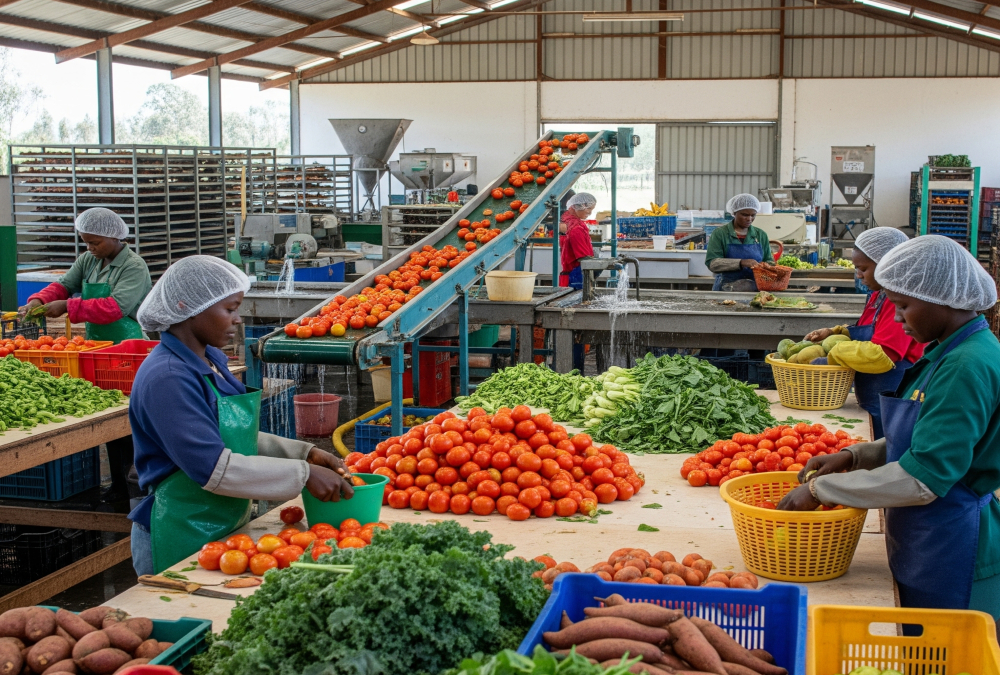
Co-locate grading, processing, packaging, and logistics in serviced rural industrial hubs. Think agro-parks with reliable utilities, cold storage, and digital connectivity.
Professionalize rural wholesale and transport—turning informal networks into formal supply chains.
Stage 3: City-Ready Integration
Link rural hubs to secondary towns and urban markets. Anchor demand through public procurement (school feeding, health programs), export corridors, and municipal planning.
Strengthen local government capacity to manage infrastructure and operations.
Scaling the Model: What It Takes
To make this work at scale, we need coordinated action across six pillars:
- Place-Based Planning: Organize development around production basins with designated rural industrial nodes—packhouses, cold hubs, mini-processing units.
- The SRI Bundle: Invest in integrated packages: land security, inputs, extension, irrigation, power, digital access, feeder roads, storage, and quality assurance.
- Market Enablers: Reform rules to allow competitive trucking and wholesale markets; enforce grades and standards; streamline land permits and enable e-payments.
- Smart Finance: Deploy blended finance, performance-based grants for first movers, risk-sharing facilities for cold chain investments, and results-based utility connections.
- Delivery Architecture: Establish corridor-level delivery units with one-stop investor services, and empower municipalities with capital and operational budgets (capex + O&M).
- Anchor Demand: Guarantee off-take through structured contracts, school feeding programs, and export facilitation.
The Bottom Line
Africa doesn’t need more idle factories. It needs rural industrial ecosystems – where farmers, processors, and communities all win.
The technology and knowledge exist. What’s missing is coordination, sequencing, and political will.
The payoff? More jobs in secondary towns, reduced post-harvest waste, stable food prices in cities, and a fairer distribution of value across the chain.
If you work in agriculture, industrial policy, or urban-rural development – and want to stress-test this model on a specific crop, corridor, or country – I would welcome the conversation.
Because the future of African industrialization isn’t just in the city. It’s rooted in the soil.
Dian Baldé is a political economist with a focus on sustainable development in Africa. He collaborates with governments, local authorities, investors, and development partners to convert economic growth into meaningful jobs and opportunities across the continent. His expertise spans energy policy, climate and blended finance, the water–energy–food nexus, green industrial policy, and the political economy of development. Dian’s work bridges policy, finance, and strategy, driving inclusive and long-term growth for African communities.
