
Opinion
Data Centers Could Provide the Catalyst Africa’s Power Sector Needs

By NJ Ayuk
The digital economy’s insatiable appetite for computing power may prove the catalyst Africa’s electrical infrastructure desperately needs.
A quarter-century into the digital age, technology has woven itself into the daily fabric of billions of lives worldwide – everywhere, that is, except where it’s needed most.
While digital penetration approaches saturation in developed markets, the fastest growth is surging through developing nations where even basic electricity remains a luxury rather than a given. Africa represents the most compelling paradox: a continent where internet adoption is exploding, yet reliable power remains maddeningly elusive.
The contradiction is stark, but therein lies an unprecedented opportunity. Data centers – those energy-hungry engines of the digital economy – could become the unexpected catalyst that finally modernizes Africa’s electrical infrastructure.
The Digital Surge Outpacing the Grid
The numbers tell a remarkable story. According to the Global System for Mobile Communications Association’s 2023 Mobile Economy Report, smartphone adoption in sub-Saharan Africa is projected to leap from 51 percent in 2022 to 87 percent by 2030, propelled by exploding youth populations and increasingly competitive mobile pricing.
More striking still: data usage per mobile device is forecast to nearly quadruple by 2028, jumping from 4.6 GB monthly to 18 GB.
Every search query, every e-commerce transaction, every business application adds to the computational burden. And we haven’t even mentioned artificial intelligence yet.
Generative AI and machine learning applications devour up to ten times more energy than traditional web searches, making this growth exponentially more power-intensive.
Until now, European data centers have shouldered most of Africa’s digital workload. But as African businesses and consumers increasingly demand faster speeds and lower latency, that model is reaching its breaking point.
The infrastructure must move closer to the users.
A Continent Starved for Digital Infrastructure
As of mid-2025, Africa hosts just 223 data centers scattered across 38 countries – a paltry 0.02 percent of the world’s 11,800-plus facilities. The concentration is severe: South Africa leads with 56 centers, followed by Kenya with 19 and Nigeria with 17.
These three nations alone account for 41 percent of the continent’s data center infrastructure.
The African Energy Chamber’s “State of African Energy: 2026 Outlook Report” argues persuasively that cloud infrastructure development in these key markets could serve as catalysts for continental growth. Growing concerns over data sovereignty are reinforcing this imperative, with nations increasingly requiring sensitive data to remain within their borders.
The market potential is enormous. Africa’s data center sector was valued at US$3.49 billion in 2024 and is projected to reach US$6.81 billion by 2030 – a compound annual growth rate of 11.79 percent. Yet realizing this potential requires confronting Africa’s most fundamental challenge: reliable electricity.
The Power Problem: A Self-Perpetuating Crisis
Data centers demand substantial, uninterrupted electricity – precisely what Africa struggles to provide. Nigeria exemplifies the challenge.
Despite hosting Africa’s third-largest concentration of data centers, the country’s notorious power grid delivers electricity for roughly four hours daily.
The nation’s 17 data centers collectively require approximately 137 MW of capacity, forcing operators to compensate with diesel generators that spike both costs and emissions. Even in Lagos, where internet connectivity peaks and 14 data centers cluster, the grid remains chronically unreliable.
The African Energy Chamber forecasts that continental data center power demand will grow at 9 percent annually through 2030, reaching 2 GW. Globally, data center capacity is expected to hit 249 GW by 2030, with total installed capacity including cooling and ancillary loads estimated at 374 GW.
Why Data Centers Could Crack the Investment Code
The relentless, predictable demand of data centers functions as a powerful stabilizer for infrastructure investment – precisely what Africa’s power sector has historically lacked. Investors need certainty that capital deployed today will generate returns tomorrow.
Data centers provide that certainty. This guaranteed demand makes the economics of grid expansion and new generation capacity suddenly viable.
Money flows toward predictable returns. Once infrastructure improves, benefits cascade beyond data centers to residential and commercial customers, spreading fixed costs across a broader base and ultimately reducing electricity prices for everyone.
Moreover, data center growth typically catalyzes innovation in power solutions, including renewable energy integration and advanced grid management technologies. The result: upgraded grids become more sustainable, more resilient, and more extensive.
Regional Strategies: Diverse Approaches to a Common Challenge
North Africa: Geographic Advantage Meets Infrastructure Investment
Egypt and Morocco are emerging as northern hubs, leveraging strategic positioning that connects Europe, Africa, and the Middle East to major internet backbone infrastructure. Egypt offers affordable land and competitive electricity prices, while Morocco is aggressively modernizing its infrastructure and cultivating a favorable legal environment for data center development.
Sub-Saharan Leaders: South Africa and Kenya Chart Different Paths
South Africa, the continent’s largest market, sees particularly robust demand around Johannesburg and Cape Town. Johannesburg benefits from diversified wholesale and retail demand served by both international and domestic providers.
The nation leads Africa in solar integration, exemplified by public-private ventures like the 12 MW solar farm being developed by Africa Data Centres and Distributed Power Africa.
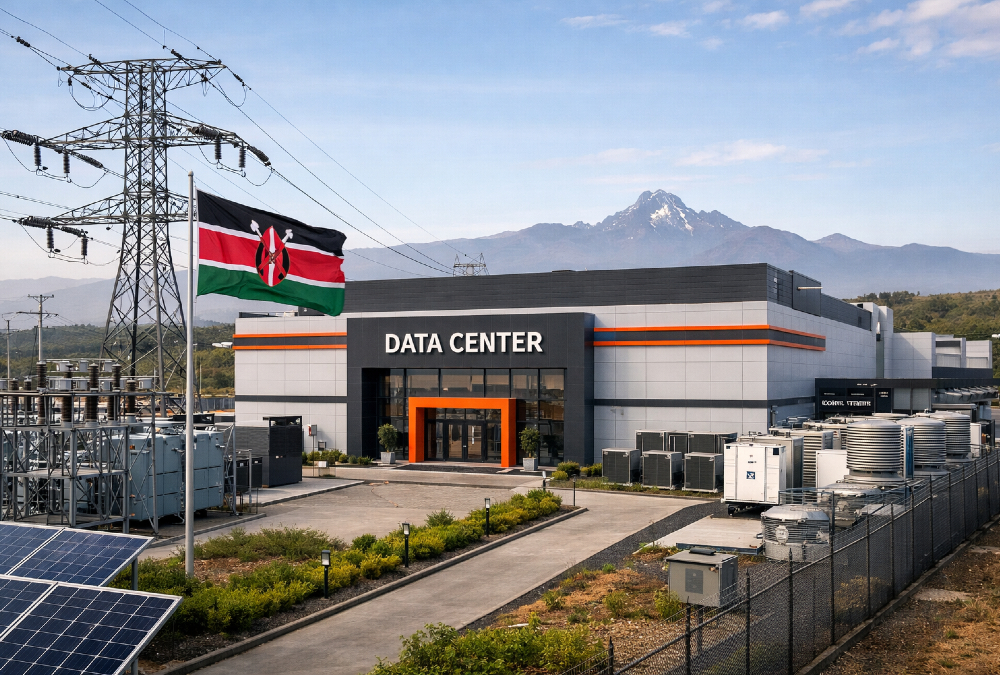
Kenya presents perhaps the most compelling renewable energy story on the continent. Its grid already derives over 60 percent of power from renewable sources, including geothermal, solar, wind, and hydroelectric generation.
The Naivasha geothermal zone, supplying nearly half the country’s electricity, will soon host a planned 100 MW green data center backed by US$1 billion in investment from Microsoft and G42. This clean, non-intermittent power gives Kenya the capacity to support data centers with both lower emissions and greater stability.
The Kenyan government sweetens the deal with substantial tax incentives for investments in special economic zones, including a 10 percent corporate tax exemption for the first decade and over 15 percent thereafter.
Smaller Players Making Strategic Bets
Even smaller nations are entering the arena. Ivory Coast, currently hosting six data centers, launched its largest solar power plant in Boundiali in June 2023, delivering 37.5 MWp of capacity toward its national goal of sourcing 45 percent of electricity from renewables by 2030.
Senegal’s Taiba N’Diaye Wind Farm represents West Africa’s largest wind project, while Gabon is actively developing hydropower and attracting investment in solar hybrid systems.
The Limits of the Model: Not Every Nation Can Compete Equally
Reality demands acknowledgment of constraints. Data centers are notoriously water-intensive due to cooling requirements for densely packed server banks.
Nations dominated by desert and savannah can ill afford competition between data centers and agriculture for scarce water resources. These countries may need to rely on regional power pools, as the African Energy Chamber suggests.
Others lacking strong renewable prospects will likely focus on conventional energy sources – oil and gas, which many possess abundantly. Even nations with robust renewable sectors would be prudent to develop conventional capacity to achieve the reliability that developed markets take for granted.
The African Energy Chamber has long advocated for natural gas as a bridge fuel, providing quick ramp-up and ramp-down capability when renewable supplies fluctuate.
The Verdict: Infrastructure Follows Demand
Electrification in Africa faces multiple obstacles on the path to modernization, but one fact remains incontrovertible: demand exists and is accelerating. Building and provisioning local data centers represents a powerful mechanism for addressing government’s most pressing challenges – improving infrastructure, stimulating economic growth, and strengthening national security.
The beauty of this approach lies in its alignment of incentives. Private capital seeks predictable returns; data centers provide them.
Nations need reliable power infrastructure; data center investment can catalyze it. Citizens require electricity for modern life; expanded grids deliver it.
For decades, Africa’s electrification challenge has resembled a chicken-and-egg problem: insufficient demand couldn’t justify infrastructure investment, yet inadequate infrastructure prevented demand from developing.
Data centers may finally break this cycle. Their arrival doesn’t just represent digital progress – it could spark the power revolution Africa has awaited for generations.
The question is no longer whether Africa needs data centers. It’s whether policymakers will seize this moment to harness private investment for public infrastructure transformation.
The digital economy is knocking at Africa’s door. How the continent answers could determine its trajectory for the next quarter-century.
NJ Ayuk is the Executive Chairman of the African Energy Chamber.
