
A Diaspora View of Africa
Ceuta’s Surge: Europe’s Fault Lines and Africa’s Displacement Crisis

By Gregory Simpkins
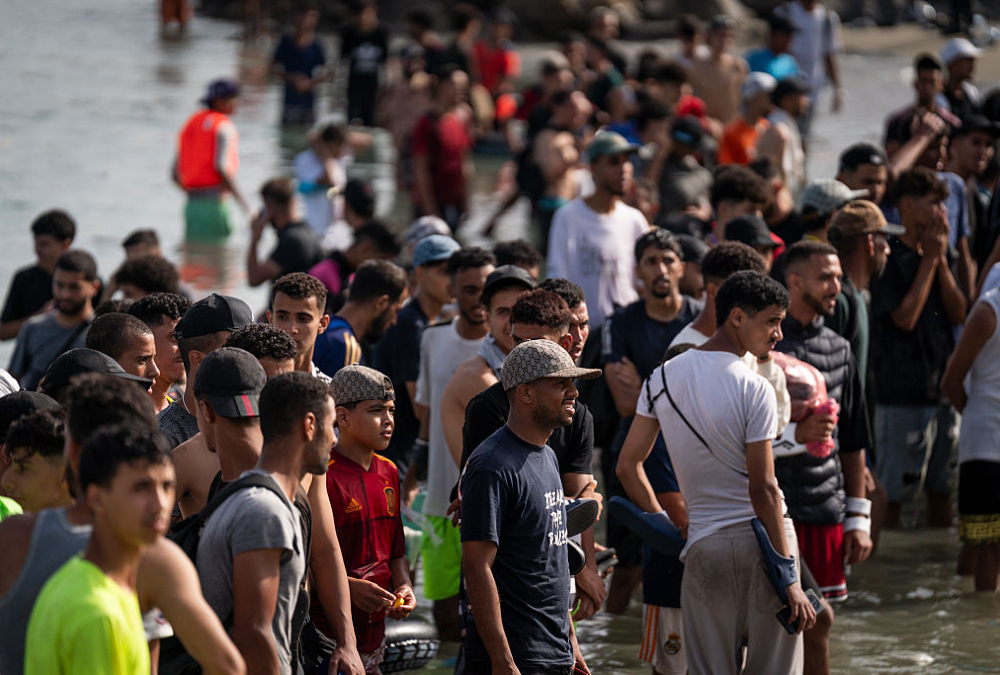
An unprecedented migrant surge into Spain’s North African enclave of Ceuta in late July 2026 – with over 60,000 people crossing from Morocco and at least 67–88 dead – has created a crisis in Spain. Nearly all of the estimated 60,000 people who swam around the sea border to reach the peninsula have been returned to Moroccan soil, most having left voluntarily within three days.
Ceuta sits on a tiny peninsula, 10 kilometers (6 miles) long and with a population of some 84,000. The massive scale of the arrivals quickly overwhelmed Spanish authorities and the streets soon filled with youths, mainly from Morocco but also from sub-Saharan Africa. The Spanish military was deployed and eventually managed to bring the situation under control, ushering the crowds back as Moroccan security forces began to impede access to the point of departure.
The incident has become a flashpoint for European Union migration policy debates. Italy’s Prime Minister Giorgia Meloni called for Spain’s suspension from the Schengen area, a system of open borders encompassing 29 European countries, and tougher travel controls.
France, Finland and Denmark backed similar measures, warning of a “failure to protect the external border”. Spain’s Prime Minister Pedro Sánchez condemned these moves as “driven by prejudice, fake news, ignorance or political interest” and defended cooperation with Morocco. The EU Commission President Ursula von der Leyen stressed the need for stronger border coordination and solidarity, while Spain’s interior ministry noted most migrants had been repatriated within hours.
Sánchez’s government faces sharp criticism from opposition parties. Far-right Vox leader Santiago Abascal accused him of inciting “an invasion” and linking the crisis to Spain’s controversial plan to grant legal status to more than 1 million irregular migrants.
Center-right People’s Party leader Alberto Núñez Feijóo also blamed “irresponsible migration policy” decisions.
US President Donald Trump labeled the event an “invasion” and used it as a political talking point ahead of the midterms. Elon Musk called it “absolutely an invasion” on social media, echoing hardline border security rhetoric.
Africa’s Migration Challenge
African migration and refugee movement is one of the largest forced displacement crises in the world. Most of it happens within Africa, not outside it. About 70 percent of all African refugees come from seven countries with Sudan and South Sudan being the largest source right now. The war in Sudan since April 2023 between the army and Rapid Support Force has created more than 12 million displaced, including about 3.5 million refugees. South Sudan’s civil war (2013-2020) displaced 4 million.
The Democratic Republic of Congo’s (DR Congo) decades of armed groups fighting in the east has caused more than 6 million IDPs and more than 1 million refugees. Somalia’s ongoing conflict with al-Shabaab since 2006, as well as recurring drought, has displaced about 3.8 million.
Eritrea is one of the largest sources for the Mediterranean migration route, caused by indefinite national military conscription, political repression and lack of exit visas. An estimated 6 million Eritreans now live abroad. In Ethiopia, the Tigray war (2020-2022), in addition to conflicts in Amhara and Oromia, have led more than 3.1 million internally displaced persons along with approximately 930,00o asylum seekers. In the Sahel, Islamist insurgency from ISIS and Al-Qaeda affiliates, coups, intercommunal violence and Boko Haram in the Lake Chad basin have led to high migration from Burkina Faso, Mali, Niger and Nigeria. UN High Commission for Refugees data shows about 45 million Africans are forcibly displaced as of 2024-2025, about 35 percent of the global total.
About 75-80 percent of refugees stay on the continent. Most refugees flee to a neighboring country. These are the largest hosts: Uganda: 1.7 million refugees (mostly South Sudanese), Chad: 1.2 million (mostly Sudanese), Kenya: Kakuma and Dadaab camps host about 700,000 Somalis and South Sudanese. Ethiopia, Egypt, Tanzania and Cameroon see large number of refugees under the principle of first asylum.
Many refugees at some point move on to Europe. The Central and Western Mediterranean routes are Libya/Tunisia to Italy/Malta/Spain, then often on to France, Germany and the United Kingdom.
In 2023-2024, about 150k-200k Africans per year arrived in Europe via sea. Eritreans, Sudanese, Somalis, Guineans, Malians and Ivorians were among the top nationalities.
Libya is a major transit hub.
Horn of Africa migrants travel across the Red Sea to Yemen and Saudi Arabia, often for labor. This Eastern route sees more than 200,000 Ethiopian and Somali migrants per year.
There are much smaller numbers going to North America but growing through the Darien Gap in Panama to the US southern border, especially from West Africa and North Africa.
Why Are Refugees Fleeing?
Most people have overlapping reasons. Legal refugee status requires persecution, but the drivers are mixed:
- Armed conflict such as civil wars, insurgencies and ethnic conflicts. This is the primary driver.
- Political persecution such as authoritarian rule, imprisonment without trial, forced conscription in Eritrea and crackdowns on opposition.
- Communal violence, such as land disputes between herders and farmers aggravated by desertification, especially in the Sahel and DR Congo.
- Climate and livelihood collapse such as droughts in the Horn of Africa, floods, locusts and desertification of Lake Chad. This often destroys farming and pastoralism, which then fuels conflict over resources.
- Economic conditions such as no livelihood, youth unemployment (more than 60 percent in many countries). Many economic migrants move alongside refugees on the same routes, which makes separation difficult.
- Governance failure, experienced through a lack of services, corruption and the inability to protect civilians from non-state groups.
The outcomes are divided into three very different tracks:
- In African host countries most live in large refugee camps or urban settlements for years. The average time in exile for an African refugee is more than 10 years. Sahrawis in refugee camps in Algeria have been there for more than 50 years. They face aid cuts, no right to work in some countries and limited education. Uganda is an exception with a more open policy allowing work and land. Many eventually return when conflict eases, often to find their land taken.
- The transit routes are the most dangerous part. There is a high risk of trafficking in persons, extortion, torture in Libya and the Sinai and drowning in the Mediterranean. The International Organization for Migration estimates that more than 28,000 are dead or missing in the Mediterranean since 2014 (the majority of them being African), detention in transit countries and kidnapping for ransom by smugglers.
- Those who reach Europe or elsewhere face an asylum process, in which acceptance rates vary hugely by nationality. Eritreans and Sudanese have high acceptance rates of 70-85 percent. West Africans often have lower rates and are classified as economic migrants. Those granted asylum face language barriers, job credential difficulties and housing issues, but over time, employment rates rise. Second-generation outcomes vary significantly by host country. Many live in legal limbo, undocumented and working in the informal economy, subject to deportation orders that are difficult to enforce.
African migrants/refugees face enormous challenges – both in their home country and outside. Many have little choice but to flee their circumstances at home, but they deserve more consideration on their outbound journeys.
However, rushing borders undermines their plight by diminishing the compassion of governments and their citizens. In addition to being more discerning and sensitive to migrants/refugees, efforts must be made by the international community to alleviate the push factors in their home countries that force them to seek new homes elsewhere.
Gregory Simpkins, a longtime specialist in African policy development, is the Principal of 21st Century Solutions. He consults with organizations on African policy issues generally, especially in relating to the U.S. Government. He further acts as a consultant to the African Merchants Association, where he advises the Association in its efforts to stimulate an increase in trade between several hundred African Diaspora small and medium enterprises and their African partners.
