
Opinion
Africa’s Trade Awakening: AfCFTA Advances by Necessity, Not by Policy

By Danilo Desiderio
Africa’s biggest trade vision, the African Continental Free Trade Area (AfCFTA), is gathering momentum – but not because policymakers willed it so. It is advancing out of sheer necessity.
The 2025 PAFTRAC Africa CEO Trade Survey Report reveals a striking reality: global economic fragmentation is forcing African businesses to look inward, and in doing so, they are accelerating continental integration from the bottom up.
At the heart of this shift lies a paradox. While U.S. protectionist tariffs, disrupted shipping routes, and uncertainty over the renewal of the African Growth and Opportunity Act (AGOA) are rattling Africa’s trade corridors, these very shocks are driving African executives to find stability within their own continent.
Faced with volatile external markets, the private sector is moving where policymakers have been slow to act – toward Africa itself.
Formed to bridge the gap between public and private sector stakeholders, the Pan-African Private Sector Trade and Investment Committee (PAFTRAC) regularly takes the pulse of the continent’s business leadership. Each year, its survey of CEOs provides a telling snapshot of sentiment and strategy across African economies.
The 2025 report, however, marks a turning point. For the first time, the AfCFTA is not primarily viewed as an opportunity for growth, but as a defensive shield – a mechanism for economic resilience.
Private Sector Drives the New Trade Reality
An overwhelming 95 percent of African CEOs now consider the AfCFTA “important” to “extremely important” for protecting Africa’s trade interests, with nearly half calling it “extremely important.” This overwhelming consensus signals a shift from optimism to realism: the AfCFTA has evolved from a continental dream into an indispensable survival tool.
The report notes that intra-African trade rebounded by 12.4 percent in 2024, reaching US$220.3 billion, according to Afreximbank. This rebound is impressive, yet policymakers should resist the temptation to overstate it as proof that the AfCFTA’s long-promised benefits are already taking hold.
Much of that growth reflects recovery from external shocks such as the COVID-19 pandemic and the Russia – Ukraine war. In truth, trade within Africa remains modest and concentrated around pilot initiatives like the AfCFTA Guided Trade Initiative.
The promise is tangible, but broad-based implementation remains shallow.
Shifting Trade Flows and New Alliances
Still, some patterns are changing decisively. About 40 percent of African firms now export within Africa, compared with 16.5 percent to Europe and 10.2 percent to North America.
The reorientation of trade flows is unmistakable: instability in Western markets is prompting firms to search for predictability and opportunity closer to home. At the same time, Gulf Cooperation Council (GCC) countries are rising as new strategic partners.
More than 30 percent already trade with GCC states, and 41.4 percent express interest in future expansion, suggesting that the Gulf is quietly becoming an influential commercial gateway for Africa.
The survey also underscores how Africa’s export mix is transforming. Services now account for 45.9 percent of exports, surpassing agriculture at 28.7 percent, confirming a shift toward a service-led economy powered by technology, logistics, and finance.
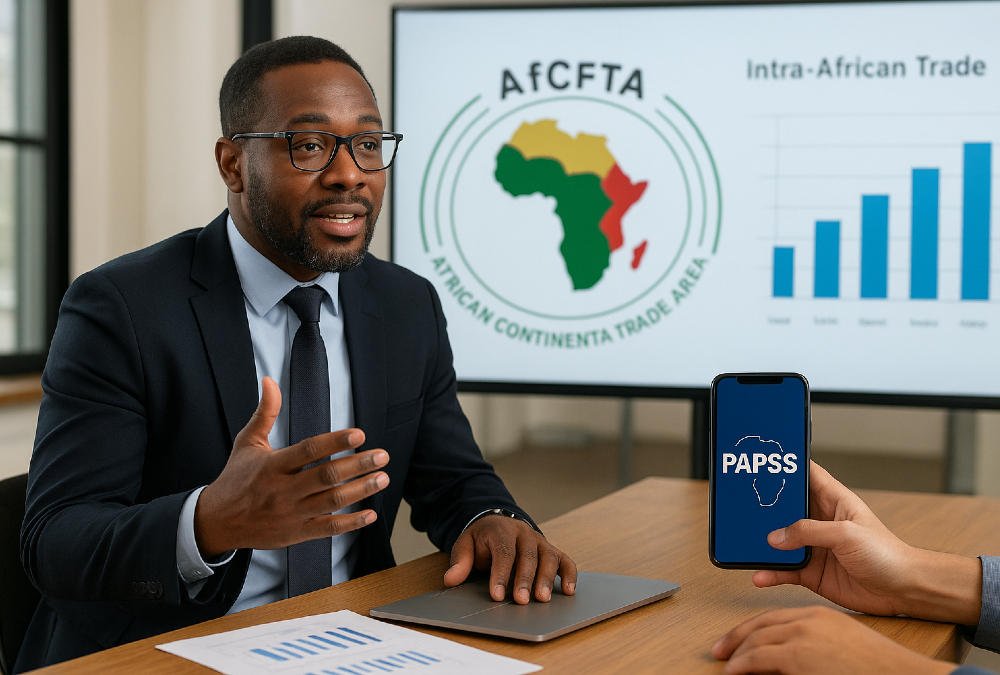
Alongside this, a new wave of digital adoption is remaking trade infrastructure. CEOs report widespread uptake of the Pan-African Payment and Settlement System (PAPSS) to facilitate faster cross-border payments and expand competitiveness. Digital connectivity is fast becoming Africa’s new trade artery.
From Policy Lag to Continental Resolve
The lesson from PAFTRAC’s 2025 findings is clear: the AfCFTA is progressing not because of formal policy implementation, but because African companies have no choice. Private enterprise is doing the heavy lifting, driving intra-continental trade to reduce exposure to external volatility.
The challenge now falls squarely on governments – to complete the unfinished architecture of the AfCFTA, finalize Rules of Origin, and fully operationalize digital integration systems.
The age of dependency on Western preference schemes is closing. What replaces it is an age of self-reliance, where Africa trades with Africa not out of aspiration, but out of necessity – and finally begins to turn that necessity into its greatest economic strength.
Danilo Desiderio serves as the CEO of Desiderio Consultants Ltd in Nairobi, Kenya, specializing in African customs, trade, and transport policies. He is a customs and trade expert at the World Bank and a senior associate to the Horn Economic and Social Policy Institute (HESPI).
