
Opinion
Africa’s Stewardship Crisis: How Elites Are Consuming Institutions and the Future
Leadership is about winning power. Stewardship is about deserving it – and that is where the continent’s ruling classes keep falling short.

By Daki Nkanyane
Africa’s troubles are usually filed under “a crisis of leadership.” That diagnosis is comforting because it is incomplete. The deeper ailment is a crisis of stewardship.
The distinction matters. Leadership is the part of politics that gets photographed: charisma, electoral mandate, command of a podium, mastery of the press conference. Stewardship is quieter and morally heavier. It asks what happens once the cameras move on. When power, office, resources and public trust are placed in someone’s hands, what do they do with them? Do they protect and strengthen those things, handing them forward in better condition than they found them? Or do they consume them – turning office into access, institutions into instruments, and the public realm into a hunting ground?
That second instinct, more than any deficiency of personality, is where much of the continent’s real crisis lies. Africa has produced no shortage of elites skilled at inheriting institutions. It has produced far too few who know how to steward them.
Beyond Corruption
It would be convenient if this were simply a story about theft, and corruption remains a devastating part of it. Transparency International’s 2025 review of sub-Saharan Africa found that graft continues to drain resources from education, health and infrastructure while eroding democratic institutions and public trust. But Africa’s stewardship problem is broader than corruption in the narrow, prosecutable sense. It includes short-termism, symbolic governance, patronage politics, elite self-insulation and a kind of institutional cannibalism in which public mediocrity is tolerated – even rewarded – so long as it is loyal. The deeper failure is not only theft. It is a broken relationship with entrusted power.
A genuine steward understands that what has been placed in their hands does not, in any ultimate sense, belong to them. It belongs to history, to the public, to generations not yet born. A bad steward sees things differently: office as reward rather than duty, public infrastructure as leverage rather than a system to protect, institutional weakness as convenient because weak systems are easier to personalize and exploit. For this kind of operator, the state is not a moral burden. It is an opportunity structure.
How Institutions Are Eaten From Within
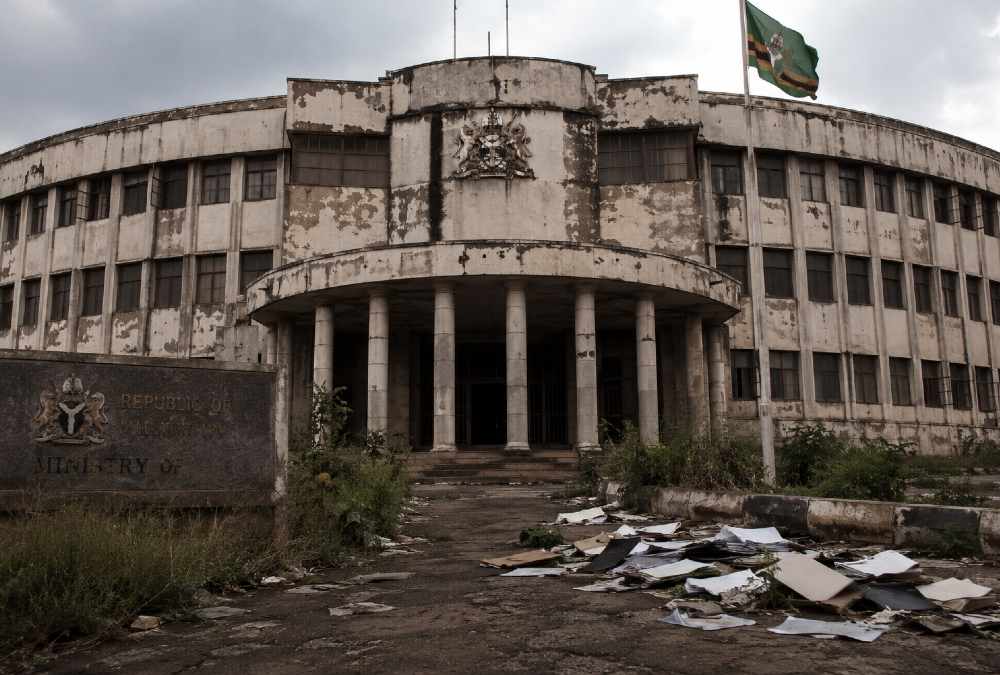
Institutions rarely collapse in a single dramatic act. More often they are eaten slowly, through habit: appointments made for loyalty rather than competence, procurement decisions made for access rather than value, policies chosen for spectacle rather than sequence, mediocrity quietly rewarded because it threatens no one. Multiply these small choices across a ministry, a municipality, a utility, a university, and the institution does not need an enemy to destroy it. It already has caretakers willing to do the job.
This helps explain why Africa so often feels caught between ambition and underperformance. The Mo Ibrahim Foundation’s latest governance index finds real gains in parts of the continent on human development and economic opportunity, even as security, the rule of law, participation and accountability have deteriorated over the past decade. That combination is telling. Africa’s central problem is not a lack of resources, ideas or aspiration. It is an inability to protect and compound what has already been built. Too much of it is wasted, hollowed out, politicized or simply allowed to decay under the people entrusted with its care.
There is a familiar arc to this. A new administration arrives promising reform. It inherits a public institution – a ministry, a regulator, a broadcaster, a development agency. The natural question ought to be: how do we strengthen this? Too often the real question becomes: how do we control this? Once control takes priority, stewardship becomes optional. Independence becomes inconvenient. Professionalism becomes negotiable. The institution weakens – not necessarily because everyone inside it is incompetent, but because the logic governing it has quietly changed.
The Evidence of Decline
This is not merely an impression; it shows up in the data. The World Bank’s most recent regional analysis, published in April 2026, warns that without stronger institutions and better-quality public investment, growth across Africa will remain too weak to reduce poverty at the pace required. That is a technical way of stating a moral problem. Where institutions are weak, where delivery systems are politicized and public resources thinly protected, even sound policy struggles to survive contact with reality. The shortfall is rarely one of intelligence. It is, again and again, one of stewardship.
And stewardship failure is contagious. When elites model extraction, others learn to copy it. When public office visibly enriches those who hold it while services fail for those who fund it, cynicism spreads outward and downward. Afrobarometer’s 2025 findings on institutional trust show that citizens across much of the continent are growing more skeptical of public institutions – an erosion that bodes ill for democratic consolidation and governance legitimacy generally.
That skepticism is not irrational. It is learned, episode by episode of lived experience: a road that crumbles soon after it is built; a school that performs below its promise; a procurement scandal followed by another anti-corruption speech. Slowly, a kind of national psychology takes hold – the sense that nothing is really held in trust, that everything is available “to eat.” In much of Africa, that phrase carries a precise meaning: to eat is not merely to consume, but to convert public access into private benefit, to treat entrusted systems as spoils.
The Cost Is More Than Money
This anti-stewardship instinct is devastating precisely because it steals more than money. A diverted contract is not only money lost; it is also infrastructure delayed, school quality weakened, business confidence dented, jobs unmade. A compromised appointment is not only one unqualified official; it is an entire chain of mediocrity flowing downstream from that one decision. A politicized institution is not only one institution weakened; it is a signal sent to an entire society that access counts for more than excellence.
This is why stewardship deserves to be treated as a civilizational question, not merely an administrative one. A society that loses its culture of stewardship begins, in effect, to consume its own future in the present tense. It struggles to think across generations, because extraction is always more immediate than patience. It struggles to build deeply, because opportunism keeps interrupting continuity. It struggles to protect public goods, because those goods are no longer felt as common property – and what belongs to no one in particular soon belongs to whoever is most organized in claiming it.
That is the hidden tragedy beneath Africa’s underdevelopment. It is not always an absence of resources or talent. More often it is a form of cannibalism – institutional, moral and public – with elites disproportionately at the center of it.
An Elite Problem, Not Only a Political One
This needs to be said plainly, because public language across the continent is often too polite about elite failure. Officials speak of “capacity gaps,” “implementation bottlenecks” and “institutional weaknesses” – all real, all true as far as they go. But the simpler truth is that too many elites have never treated the continent as something to build. They have treated it as something to navigate, leverage and harvest. One orientation builds history. The other consumes it.
Nor does the failure belong only to politicians. It runs through bureaucracies, business networks, professional classes, party loyalists, intellectual enablers and private actors who benefit quietly from public weakness while lamenting it loudly in public. The stewardship crisis is, in this sense, an elite moral problem more than a narrowly political one – which is exactly why it cannot be solved by technical reform alone.
Why Technical Fixes Fall Short
New laws, digitization, oversight bodies and transparency rules all matter, and none of them is sufficient on its own. None solves the stewardship question if the people inside institutions still relate to those institutions as opportunities for access rather than as obligations of care. The African Development Bank’s own governance strategy rightly emphasizes accountable institutions, transparency and sound public financial management – but even the best-designed reforms depend on political and moral seriousness to become more than paperwork.
What Africa needs to recover, in other words, is a language of custodianship. Power should be understood again as trusteeship. Office should be felt again as a burden rather than a reward. Institutions should be treated as inheritances, not as feeding grounds. Public goods should be regarded as sacred enough to protect, and competence should matter more than comfort, continuity more than factional appetite. Without that moral reset, most reforms will remain cosmetic – new rules layered over old habits.
Institutions are not, in the end, damaged only by their enemies. They are damaged by caretakers who never understood that care was the assignment: people who held the title but not the burden, who enjoyed the authority but not the discipline, who used the system without ever loving it enough to strengthen it. That is the sharpest indictment available, and it is the right one.
The Real Test
This is why Africa can feel simultaneously ambitious and under-kept. The continent speaks the language of destiny while too often managing itself with the habits of plunder. It dreams at continental scale while tolerating municipal decay. It speaks of renaissance while normalizing basic institutional neglect. It celebrates growth while permitting the very systems meant to sustain that growth to be hollowed out by those who should have been their first guardians.
This cannot continue indefinitely, and it need not. Africa’s future depends not only on more leaders, more policies or more investment, but on whether the continent can cultivate a different class of steward: people who understand that history has placed fragile and valuable things in their hands, and whose duty is not to consume those things gracefully but to preserve and strengthen them faithfully.
That, in the end, is the real test of leadership. Not whether one can win office, hold power or dominate a news cycle. But whether one can take what has been entrusted and hand it forward with more dignity, more competence and more trust than it arrived with. That is stewardship. Until Africa treats its absence as a central crisis rather than a footnote, the continent will keep losing its future to those who know how to inherit institutions, but never learned how to protect them.
Daki Nkanyane is a South African – born Pan-African thought leader, entrepreneur, keynote speaker, and strategist with over 25 years of experience driving innovation, identity, and development across Africa. He is the Founder & CEO of Interflex Capital, AfrisoftLive, QonnectedAfrica, and iThinkAfrica, where he focuses on youth empowerment, entrepreneurial ecosystems, and Africa’s economic and ideological renewal. His work spans technology, digital transformation, major international events, and strategic advisory for future-ready African institutions. As a contributing writer for The Habari Network, Daki covers African innovation, leadership, human capital, economics, entrepreneurship, and Africa–Caribbean relations through cultural, philosophical, and developmental perspectives. His mission is to help shape a new African consciousness rooted in pride, possibility, and self-determination for Africans on the continent and in the diaspora. He can also be reached on Facebook and X.
