
Opinion
Africa’s Entrepreneurial Paradox: Abundant Startups, Scarce Scale
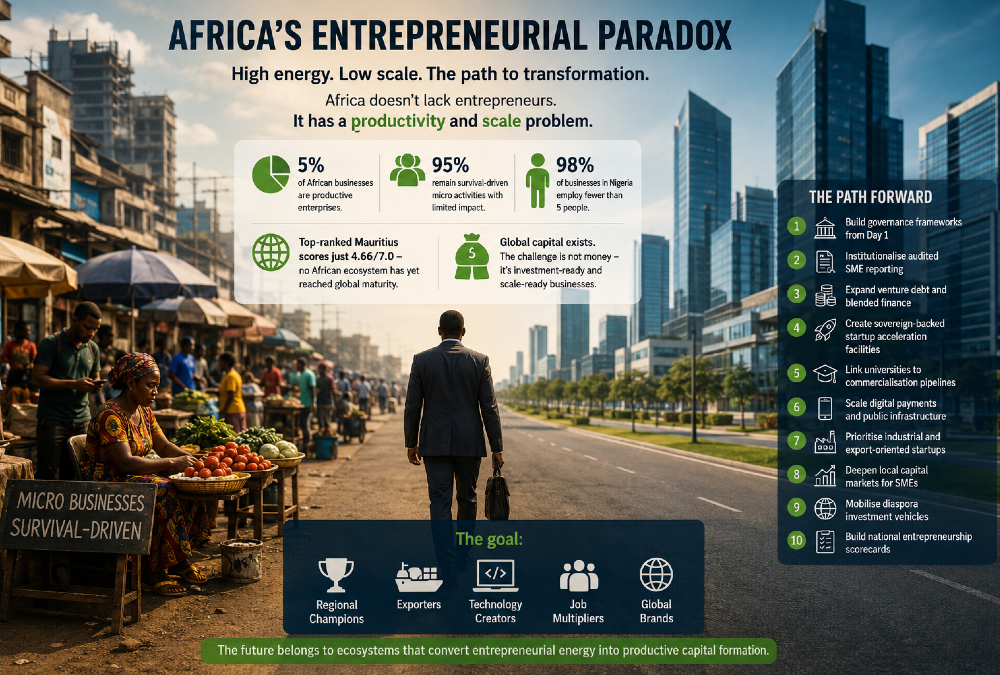
The continent teems with entrepreneurial energy, yet new evidence shows that fewer than one in twenty African businesses ever grows into a productive enterprise. The problem is not hustle – it is institutional maturity.

By Kelly Mua Kingsly
A new continental index is forcing an uncomfortable reckoning. The Africa Entrepreneurial Ecosystem Index (AEEI), which covers 27 countries and assesses 21 indicators across seven dimensions of ecosystem health, puts to rest one of the most persistent myths in development finance: that Africa’s primary entrepreneurial challenge is a shortage of founders.
It is not. Africa is, by almost every measure, overflowing with entrepreneurial activity. The deeper problem – and the harder one to solve – is that this activity overwhelmingly fails to scale.
That last figure deserves emphasis. Even Mauritius – long regarded as Africa’s most mature financial and business environment – scores only 4.66 out of a possible 7.0 on the AEEI. No African ecosystem has yet reached what the index defines as global entrepreneurial maturity. The gap is not trivial, and it is not merely about individual ambition or cultural attitudes toward risk. It is structural.
Capital does not chase ideas alone. It chases governance, structure, predictability, and scalable cash flows.
The Capital Narrative Needs Updating
For years, the dominant explanation for Africa’s constrained private sector growth was a shortage of capital. That narrative is now incomplete to the point of being misleading. Global liquidity is abundant. Pension funds, development finance institutions, climate finance vehicles, diaspora capital networks, venture capital firms, and private equity funds collectively represent hundreds of billions of dollars in search of credible opportunities. The money exists.
What remains scarce is investment-ready, scale-ready businesses to receive it. Too many African ventures still present with weak governance structures, poor financial reporting, an absence of audited accounts, unrealistic valuations, fragile business models, regulatory non-compliance, and limited pathways to export markets. These are not insurmountable deficiencies – but they are real ones, and they consistently deter the institutional capital that would otherwise be available.
It is no accident that ecosystems in Mauritius, South Africa, and parts of North Africa continue to outperform the continental average. They do so not through any special abundance of entrepreneurial talent, but through stronger institutions, deeper financial systems, and more robust capital market infrastructure. Governance, not genius, is the differentiator.
What The Next Phase Requires
Africa’s next entrepreneurial revolution will not be built on hustle culture. It will be built on institutional maturity – on the painstaking, unglamorous work of creating the conditions under which businesses can grow, attract investment, export, hire, and compound. Ten priorities stand out:
- Build governance frameworks for startups from day one, not as an afterthought.
- Institutionalize audited financial reporting for small and medium-sized enterprises.
- Expand venture debt and blended finance instruments to supplement equity-only models.
- Create sovereign-backed startup acceleration facilities to reduce early-stage risk.
- Link universities directly to commercialization pipelines to convert research into ventures.
- Scale digital payment infrastructure and public services to lower operating costs.
- Prioritize industrial and export-oriented startups over purely domestic consumer plays.
- Deepen local capital markets to give growing SMEs viable domestic financing options.
- Mobilize structured diaspora investment vehicles to channel remittance flows productively.
- Build national entrepreneurship scorecards to create accountability and track progress over time.
The Right Ambition
The goal, in short, is not to produce more informal micro-businesses. Africa already generates those in abundance. The goal is to build companies capable of becoming regional champions, exporters, technology creators, job multipliers, and, in time, global brands. The distinction matters enormously – not only for GDP growth and industrial output, but for the quality and durability of employment that a continent of 1.4 billion people urgently needs.
The AEEI provides a useful starting point for that ambition: a rigorous, comparative picture of where African ecosystems currently stand and what it would take to move them forward. The analysis is sobering, but it should not be discouraging. Institutional maturity is not a gift – it is built, deliberately and incrementally, by governments, investors, educators, and entrepreneurs working in concert.
Africa has no shortage of energy. The question now is whether it can convert that energy into the kind of productive capital formation that transforms economies. The answer depends less on how many new businesses are started than on how many existing ones are given the structural conditions to survive, scale, and compete.
Kelly Mua Kingsly brings extensive expertise in public finance and strategic leadership. He currently serves as the Head of Finance Operations at the Ministry of Finance of Cameroon, while also holding a dual role as Project Finance Manager at the Ministry of Economy, Planning, and Regional Development, and Censor at the Central Bank of Central African States (BEAC). He has previously served as Chairperson of the Board of the African Trade & Investment Development Insurance (ATIDI) and as a Director on the Board of Quantum Blockchain Capital. Driven by a strong passion for Africa’s economic transformation, he is deeply committed to advancing the continent’s path toward industrialization.
