
Opinion
Why the African Union must press ahead with a business and human rights policy
By Romola Adeola
The African Union (AU) is in the process of developing policy designed to hold companies to account by setting down guidelines on how they should conduct business on the continent.
The aim of the policy is to implement a set of guiding principles drawn up by the United Nations (UN).
The policy will provide a roadmap for AU member countries, regional economic communities and regional institutions to regulate the impact of business activities on people. It also seeks to advance guidance for firms conducting activities in Africa.
The policy has been in the making since 2016 and still has to be adopted by an AU technical committee. Because it is not a treaty it will not be subject to ratification by all AU member states.
This “soft law” approach raises questions about whether the policy will ever be implemented. But the fact that the AU has developed one is a major step forward and could help African countries deal with some major rights issues including: land grabs and environmental pollution.
Land grabs
Africa’s agricultural sector has attracted significant investment. This has resulted in massive land acquisitions by local and foreign firms which has enabled them to engage in large scale production. But local agrarian populations have been dispossessed of their land with little to no consultation or adequate compensation.
Chinese businesses have become the face of the growing concern over land grabs on the continent. A 2014 report estimated that about 10 million hectares (25 million acres) of agricultural land in Africa belonged to Chinese businesses. But the Chinese are not the only ones acquiring massive tracts of land on the continent.
In Tanzania for instance, Sweden-based Agro EcoEnergy acquired 20,000 hectares (50,000 acres) of land to establish a sugarcane plantation and an ethanol-production site. Local people in the were deeply distressed by the acquisition.
Although local communities were consulted, they were not presented with any alternatives, particularly around the issue of compensation. Nor was the community given adequate information about the impact of the project.
Environmental degradation and pollution
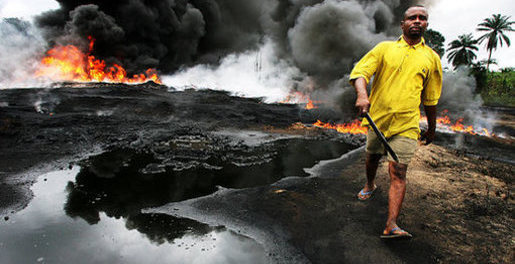
Another major business and human rights challenge has been environmental pollution, particularly in the extractive industries. In many cases foreign-owned companies have been involved.
One of the biggest concerns involve oil spillages and gas flaring from business-related activities in Nigeria. For example, over 100 million barrels of oil was spilled in the Niger-Delta between the 1960s and 1997.
In 2014 alone, Shell and ENI admitted to over 550 oil spills in the region.
The United Nations Environment Program (UNEP) estimates that a cleanup process in the Niger Delta will take between 25 – 30 years.
And some estimates suggest that the impact of gas flaring has significantly reduced life expectancy in the region, from 70 years to about 45 years.
The policy framework
All this suggests that Africa needs to regulate business activities with human rights impacts.
The policy framework builds on the 3 key pillars of the United Nations guiding principles. These are the state’s duty to protect human rights, businesses’ responsibility to respect human rights, and access to remedies.
AU member countries need to ensure that business activities do not negatively affect the livelihoods of local communities. Governments must therefore ensure agreements are drawn up with home countries of multinationals and also with businesses to protect human rights.
For their part, businesses have a responsibility to respect human rights. As such, they are required to desist from activities that will have an adverse impact on human rights. To give effect to this responsibility, businesses are expected to develop human rights policies and make a commitment to implement them.
Access to remedies talks to the issue of justice. This means that it has to be underpinned by judicial and nonjudicial, state-based and non-state-based measures to protect victims of business related human rights violations.
Businesses are also required to develop grievance procedures to ensure recourse for affected communities. But it is important that these procedures should not prejudice the rights of victims to seek justice from judicial systems.
Upholding human rights
The AU’s policy is a right step towards ensuring business upholds human rights. But it is only the start of a long journey towards deepening a culture of respect for human rights among businesses in Africa.
Only time will tell if the policy framework, once adopted, will in fact be used. But the mere fact that it is being formulated shows resolve on the part of the AU member countries to tackle key human rights issues related to business activities in Africa.
A number of key steps need to be taken if the policy is to become a reality.
– First, sufficient resources must be made available to make sure its implemented by both states and regional bodies.
– Secondly, AU member countries must drive policy implementation with the political will to regulate businesses within their territories.
– And finally institutions must be strengthened at all levels of implementation including national, regional and continental levels.
But successful implementation won’t be achieved unless there’s cooperation between state institutions, businesses, local populations as well as civil society.
Nigeria’s Romola Adeola is a Steinberg Fellow in International Migration Law and Policy at the Faculty of Law, at McGill University. She has previously served as a consultant for the African Union. The original version of this article appeared in The Conversation Africa.
