
Opinion
Africa Is Dismantling Its Own Borders – and the Continent Is Better for It
The Republic of the Congo’s decision to scrap visas for African travelers is the latest sign that the continent’s long-promised era of open borders may finally be arriving.

By Mark-Anthony Johnson
When President Denis Sassou Nguesso announced, before a gathering of finance ministers and development bankers in Brazzaville, that the Republic of the Congo would eliminate all visa requirements for African citizens starting January 1, 2027, the timing was deliberate. The African Development Bank Group’s annual meetings were underway.
Africa Day festivities filled the streets. The symbolism was unmistakable: free movement, long a rallying cry for Pan-Africanists, is quietly becoming policy.
The Congo Republic’s decision is not an isolated gesture. It joins a small but growing cohort of African nations that have concluded what economists have argued for decades – that the continent’s greatest unrealized asset is its own people, and that border friction is among the steepest taxes levied on their potential.
A Patchwork Giving Way to a Pattern
The landscape of African visa policy has, until recently, been a discouraging map of restrictions. Traveling between African capitals has often required more paperwork than crossing between European Union member states. The irony has not been lost on African policymakers, nor on the businesses and tourists who have quietly rerouted their ambitions accordingly.
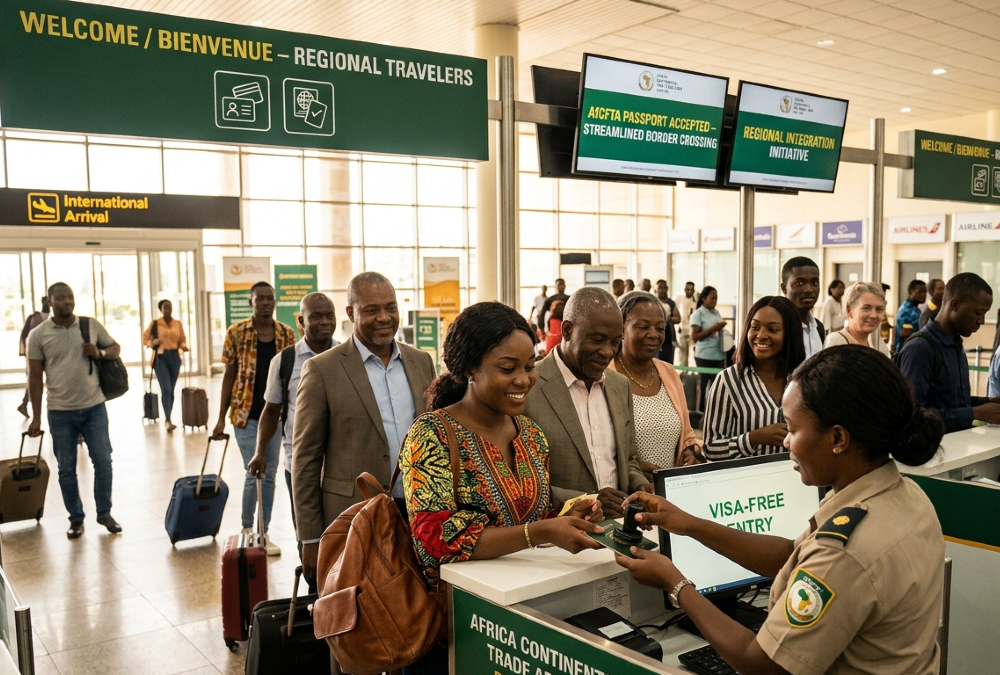
Yet a pattern of liberalization is emerging. Benin, The Gambia, Rwanda, and Seychelles have already extended full visa exemptions to all African passport holders.
Togo introduced a 30-day exemption with a simple pre-arrival declaration in May 2026. Ghana offers free electronic visas to African citizens; Kenya operates an Electronic Travel Authorization system that replaces the traditional visa stamp with a digital one.
The Congo Republic’s forthcoming policy – full visa-free access, with operational details on stay durations, health protocols, and pre-arrival declarations expected in the coming months – will bring the total of meaningfully open-border African nations to eight.
That is still a minority. Larger economies, most conspicuously South Africa and Morocco, maintain strict traditional visa requirements for fellow African travelers.
Their caution is not without logic – concerns about irregular migration, public service pressures, and bilateral reciprocity are real – but the costs of immobility are real too. Intra-African trade remains chronically underdeveloped relative to the continent’s size and demographic weight, and visa barriers are a meaningful part of the explanation.
The AfCFTA Imperative
The Congo Republic is a member of the African Continental Free Trade Area, and that membership matters. The AfCFTA’s ambition – to create the world’s largest free trade zone by the number of participating countries – depends on more than the removal of tariffs.
Goods cannot easily follow commerce if the people conducting that commerce cannot easily follow the goods. Visa liberalization and trade integration are, in this sense, complementary rather than parallel tracks. One without the other produces an incomplete architecture.
The announcement in Brazzaville should be read, then, not merely as a bilateral gesture but as an institutional signal: that the Congo Republic intends to be a serious participant in the continental economic project, not merely a signatory to its paperwork.
The Skies Are Opening Too
The ground-level policy shift is mirrored by what is happening above the clouds. Africa’s aviation connectivity is expanding at a pace that would have seemed optimistic even a few years ago.
According to analysis by the African Tourism and Travel Association, 70 non-African countries will operate direct flights to Africa in 2026, with more than 89 million inbound seats scheduled – a forecast increase of 4.4 percent in total inbound capacity.
Europe remains the continent’s dominant external aviation market, accounting for more than 50.7 million inbound seats and growing at 5.6 percent year over year. But the more telling numbers lie elsewhere: Russia is adding capacity at 23.1 percent annually; Portugal at 13.4 percent; Italy and China each at 11 percent.
India, the United Kingdom, and Türkiye are all growing Africa-bound seat capacity at roughly 8 to 9 percent per year. The Gulf Cooperation Council states continue to function as a critical global hub, connecting African cities to intercontinental networks in ways that legacy European carriers never fully managed.
Intra-African aviation, however, may be the most consequential trend of all. Continental air connectivity is forecast to exceed 112 million seats in 2026, a 6.6 percent increase over the prior year, led by Nigeria, Mauritius, Algeria, and Madagascar.
That is not a recovery story. Africa’s aviation network contracted sharply during the pandemic years, as did most of the world’s. What is now happening represents genuine, structural expansion – more routes, more carriers, more seats – built on the premise that Africans will travel to see one another if given the opportunity and the infrastructure to do so.
The Argument for Openness
Skeptics of visa liberalization often frame their concerns around security and sovereignty. These are not frivolous objections, and the practical details – maximum stay durations, health screening protocols, digital declaration systems – matter enormously to whether open-border policies succeed or breed political backlash.
The Congo Republic’s decision to finalize these frameworks before the January 2027 implementation date is prudent; the credibility of the policy will depend on its administration as much as its announcement.
But the broader direction is correct. The nations that have already moved toward open borders – Rwanda, Benin, Seychelles, The Gambia – have not collapsed under waves of unmanageable migration.
What they have gained, in varying degrees, is the economic vitality that comes with easier movement of workers, entrepreneurs, students, and tourists. Africa is a continent of 1.4 billion people across 54 countries, many of them artificially divided by colonial cartography.
The argument that Africans should need visas to visit one another has always been weak. It is becoming weaker still.
The Republic of the Congo’s announcement is one data point. But in the context of expanding air networks, a functioning continental trade framework, and a generation of African policymakers who have watched the European single market work, it begins to look less like an isolated gesture and more like the early outline of something larger.
Africa is, quietly and imperfectly, opening up. That is worth noting – and worth watching.
Mark-Anthony Johnson is the founder and CEO of JIC Holdings, a global asset and investment management firm founded in 2009. With over 30 years of experience and strong ties to Africa, his investments span mining, infrastructure, power, shipping, commodities, agriculture, and fisheries. He is currently focused on developing farms across Africa, aiming to position the continent as the world’s breadbasket.
