
Opinion
Africa Fuels the Modern World. Its Economies Capture Almost None of the Value.
The continent sits at the center of the energy transition – yet the wealth it generates flows everywhere but home.

By Gregory September
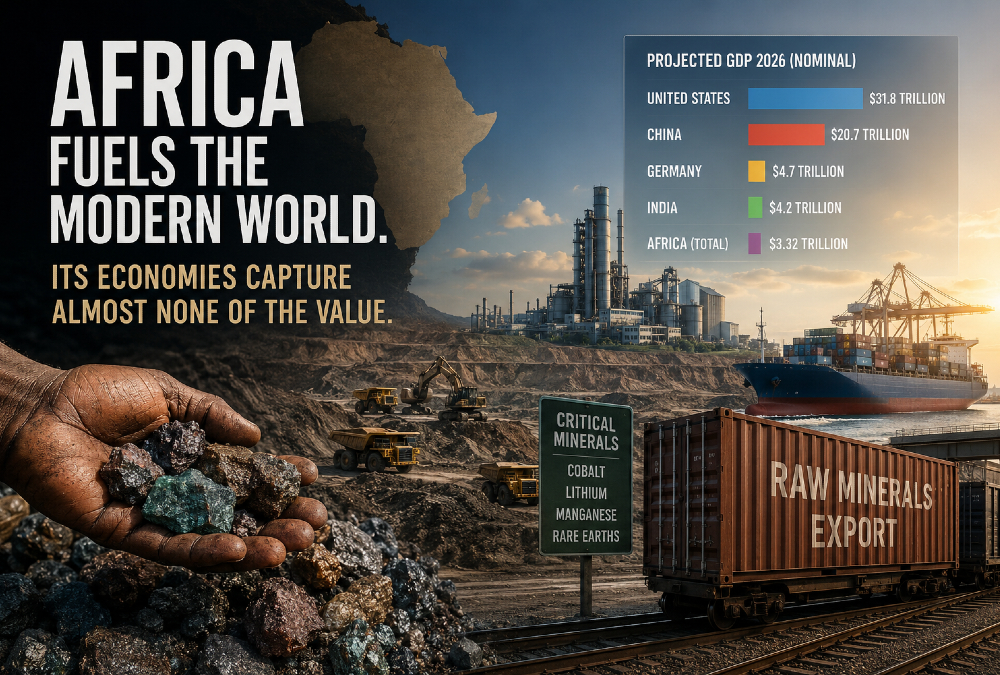
The arithmetic of the modern economy contains a glaring paradox. Africa holds a commanding share of the world’s critical mineral reserves – cobalt, lithium, manganese, and rare earth elements that are essential to electric vehicle batteries and renewable energy infrastructure.
The green revolution runs on African soil. And yet, when the economic returns from that revolution are tallied, Africa’s name appears near the bottom of the ledger.
This is not merely an injustice. It is a structural failure with consequences for the entire global economy – and one that is becoming harder to ignore as the energy transition accelerates.
The Numbers Tell the Story
To understand the scale of the problem, consider the economic context. Africa’s combined GDP is projected at approximately US$3.32 trillion in 2026. That figure sounds significant until it is placed alongside comparable data points: the United States alone is projected at US$31.8 trillion – roughly ten times Africa’s entire output – and remains the world’s largest economy, bigger than China, Germany, and India combined. China’s projected GDP stands at US$20.7 trillion; Germany’s at US$4.7 trillion; India’s at US$4.2 trillion.
These are not merely statistics about wealth. They are a map of who captures value, who processes raw materials into finished goods, and who sets the terms of global trade. Africa provides the inputs. Advanced economies build the industries.
The pattern is as old as colonialism and as current as today’s battery supply chains: raw materials leave the continent; finished products return to it at a steep markup. Africa grows. Others industrialize.
Five Structural Realities
Southern Africa’s predicament illustrates the broader continental challenge with particular clarity. The region holds some of the world’s largest deposits of the minerals that define the next industrial era, yet most processing and manufacturing activity occurs overseas.
Five structural realities explain why the gap between resource endowment and economic capture remains so wide.
- First, Africa’s population is young and expanding rapidly – a demographic dividend that, properly harnessed, could power decades of productivity growth, but that currently strains infrastructure, education systems, and labor markets.
- Second, the continent’s resource abundance is extraordinary and, in geopolitical terms, increasingly strategic. No serious pathway to global decarbonization exists without African minerals.
- Third, Africa’s current economic growth, while real, starts from a low base. Headline growth rates that look impressive in percentage terms translate into modest absolute gains when applied to a small economic foundation.
- Fourth, limited industrial capacity means that extraction and export remain the dominant mode of economic participation. Beneficiation – the transformation of raw ore into processed materials and finished products – happens largely elsewhere.
- Fifth and most fundamentally, value leaves before transformation begins. The point at which raw materials become worth multiples of their extracted price is, almost invariably, a point located outside the continent.
The numbers matter. But incentives matter more. Geography gave Africa the resources. Industrial ecosystems – built over decades through policy, investment, and institutional development – determine who captures the value. That is the real issue. Not geology. Not scarcity. Not demand.
The Strategic Question the World Is Not Asking Loudly Enough
If batteries and renewable technologies define the next industrial era – and the evidence suggests they will – then the question of where those technologies are manufactured is not merely an economic one. It is a geopolitical one. And Africa’s answer to that question will shape the continent’s trajectory for a generation.
Should Africa remain a raw material supplier, providing the essential inputs while watching the value-added work migrate to East Asia, Europe, and North America? Or should it become a value creator – processing minerals domestically, building battery supply chains, anchoring industrial parks, and capturing the economic rents that its geological endowment has long subsidized for others?
The policy levers are well understood, even if their implementation remains contested. Local processing requirements – mandating that a portion of minerals be refined domestically before export – can shift value retention upstream.
Industrial parks and special economic zones can attract manufacturers by bundling infrastructure, regulatory clarity, and proximity to raw material sources. Skills development programs can build the human capital needed to staff more sophisticated industrial operations. And thoughtfully designed public-private partnerships can mobilize the capital that African governments, burdened by debt and constrained by borrowing costs, cannot provide alone.
None of these levers is sufficient on its own. All of them require institutional capacity – the rule of law, contract enforcement, regulatory predictability – that is unevenly distributed across the continent. Minerals and institutions together determine economic outcomes. Neither alone is enough.
Geography as Destiny – and as Constraint
The resource story is only one dimension of Africa’s structural position in the global economy. Geography matters in ways that go beyond what lies beneath the ground.
Africa’s coastlines define some of the world’s most consequential maritime chokepoints. The Cape of Good Hope route, long a secondary option to the Suez Canal, has returned to strategic prominence as instability in the Red Sea has disrupted conventional shipping lanes.
Cargo that once transited Suez now rounds the Cape – adding days and fuel costs to global supply chains, but also underlining Africa’s quiet centrality to the movement of world trade. When the shortest route becomes unavailable, geography reasserts itself.
Ports, trade corridors, and infrastructure investments are not soft development priorities. They are hard strategic assets. The competition among global powers to finance African infrastructure – with all the attendant debates about debt sustainability and conditionality – reflects a recognition that these assets matter enormously to the functioning of the global economy.
Africa does not control global trade. Yet global trade cannot move without Africa. That simple contradiction ought to concentrate minds in finance ministries and corporate boardrooms from Washington to Beijing.
An Opportunity Window That Will Not Stay Open Indefinitely
The energy transition is not waiting for Africa to build the institutions and infrastructure needed to capture its benefits. Supply chains are being designed now. Investment decisions are being made now. The countries and companies shaping the architecture of the green economy are making choices today that will prove difficult to reverse tomorrow.
For African governments and their international partners, the imperative is clear: the window for positioning the continent as a value creator rather than a raw material exporter is open, but it will not remain so indefinitely. The policy frameworks, investment agreements, and industrial strategies that determine which side of the value chain Africa occupies need to be built with urgency.
This is not a matter of charity or development assistance, though both have roles to play. It is a matter of structural economic logic. A global energy transition built on African minerals, but not on African prosperity, is neither stable nor equitable – and, in the long run, it is not in the interest of the advanced economies that depend on those minerals either.
The world needs Africa’s resources. Africa needs the world to stop pretending that extraction is the same as development.
Gregory September is a South African academic, author, and geopolitical analyst with extensive experience in government and Parliament. He is the founder and CEO of SAUP (Sustainability Awareness and Upliftment Projects NPC), which focuses on sustainability education and community development. He previously served as Head of Research and Development for the Parliament of South Africa. His work centers on sustainability, African geopolitics, and economic development, and he regularly contributes to analysis of global political and economic affairs.
