
Opinion
Africa: From “Dark Continent” to Global Powerhouse

By Victory Azimih
For centuries, Africa has endured the label “the dark continent” – a phrase that speaks not to any absence of value, but to value deliberately unseen, systematically underbuilt, and relentlessly extracted. This characterization has obscured a fundamental truth: Africa is the cradle of humanity itself, the motherland that has nourished global development with its resources, labor, and raw potential while receiving little in return.
The continent’s economic condition has resembled a biblical inversion – servants riding on horses while princes walk on foot. Yet today, a transformation is unfolding that could redefine Africa’s place in the global economy and, by extension, reshape the architecture of 21st-century commerce itself.
The Infrastructure Imperative
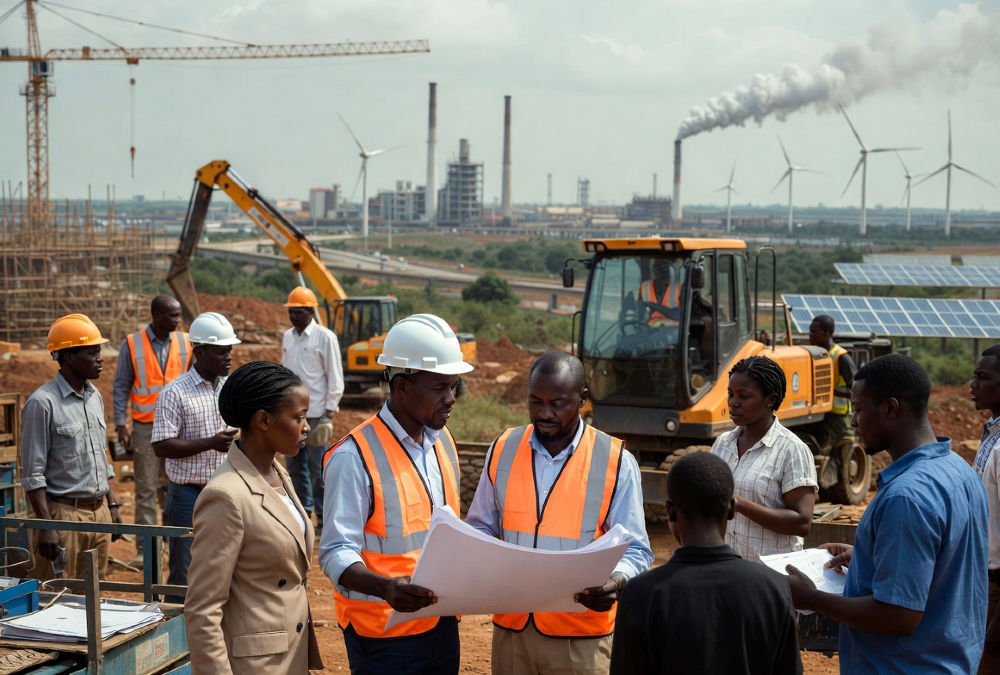
Africa stands at an inflection point, driven not by aid packages or conference declarations, but by the convergence of artificial intelligence, advanced manufacturing, agri-industrial corridors, data economies, and renewable energy infrastructure. These forces are positioning the continent as a potential global production powerhouse.
However, one principle remains non-negotiable: without infrastructure and industrial ownership, there can be no genuine independence.
No continent achieves sovereignty if it cannot feed itself, power itself, move goods efficiently, process its own resources, house its population, or employ its youth at scale. These capabilities form the bedrock of economic autonomy, yet Africa continues to grapple with deficits across each dimension.
The continent’s infrastructure gap is staggering. While Asia invested over US$1.7 trillion in infrastructure in recent years, Africa’s investment barely exceeded US$100 billion.
This disparity manifests in concrete ways: farmers watch crops rot for lack of cold storage and reliable transport; manufacturers import processed versions of raw materials they themselves exported; renewable energy potential remains largely untapped despite abundant solar and wind resources.
From Panels to Projects
Africa’s development discourse has suffered from an excess of discussion and a deficit of execution. The continent does not need more expert panels, white papers, or feasibility studies.
It needs projects – tangible, scalable, and transformative.
What does this mean in practice? It means public-private partnerships that construct assets rather than extract rents.
It means special purpose vehicles that mobilize institutional capital toward productive infrastructure. It means rail corridors linking agricultural zones to ports, refineries that retain value within national borders, and integrated ecosystems spanning power generation, data infrastructure, logistics networks, housing developments, and manufacturing capacity.
The demographic dimension adds urgency to this agenda. Africa’s population, projected to reach 2.5 billion by 2050, is frequently characterized as a liability – a source of migration pressure, political instability, and resource strain.
This framing is fundamentally mistaken. Africa’s young population represents the world’s largest untapped production engine, a human capital reservoir that could power global growth for decades.
The Ownership Question
Yet engines require fuel, and that fuel is infrastructure. More critically, sustainable development requires ownership – not merely of physical assets, but of value chains, industrial processes, and the economic destinies these represent.
The extractive model that has dominated Africa’s economic history is reaching its natural endpoint. Resource extraction without local processing, foreign ownership without technology transfer, and capital flows that enrich external actors while leaving source countries impoverished – these patterns are increasingly untenable in a world where economic power is being reconfigured.
Africa’s industrial architects – policymakers, sovereign wealth managers, diaspora investors, and the continent’s 54 heads of state – face a choice. They can continue hosting conferences about Africa’s potential, or they can build the infrastructure that converts potential into productive capacity.
A Century-Defining Moment
The confluence of technological advancement, demographic trends, and shifting global supply chains has created an unprecedented opportunity. Artificial intelligence and automation, often feared as job destroyers, could enable Africa to leapfrog traditional industrial development stages.
Renewable energy abundance positions the continent to build clean manufacturing ecosystems from the ground up. Digital infrastructure can connect dispersed populations and markets with unprecedented efficiency.
Those who recognize this moment will not merely invest in Africa – they will help define the architecture of global economics for the next century. The question is not whether Africa will industrialize, but whether it will do so on terms that generate broadly shared prosperity or reproduce the extractive patterns of previous eras.
The age of viewing Africa as a source of raw materials and cheap labor is ending. The age of African industrial development is beginning.
Whether this transformation fulfills its promise depends on choices being made today – in capital allocation decisions, policy frameworks, and the political will to prioritize productive infrastructure over short-term consumption.
Africa’s restoration moment has arrived. The only question is whether the continent’s leaders and global investors possess the vision to seize it.
Victory Azimih is a visionary entrepreneur and global investment consultant specializing in Africa’s economic growth and industrial transformation. As the CEO and founder of Azeemi Global, he leads a pioneering firm dedicated to accelerating the continent’s development through cutting-edge technology and infrastructure solutions. Under his leadership, Azeemi Global focuses on harnessing the potential of artificial intelligence, blockchain, and smart infrastructure to unlock sustainable investment opportunities across Africa. Based in Lagos, Nigeria, Azimih is at the forefront of driving Africa’s future as a hub of innovation and industrialization.
