
Opinion
Africa’s Middle-Class Mirage
What looks like rising prosperity is often fragile aspiration – and the continent cannot afford to confuse the two.

By Daki Nkanyane
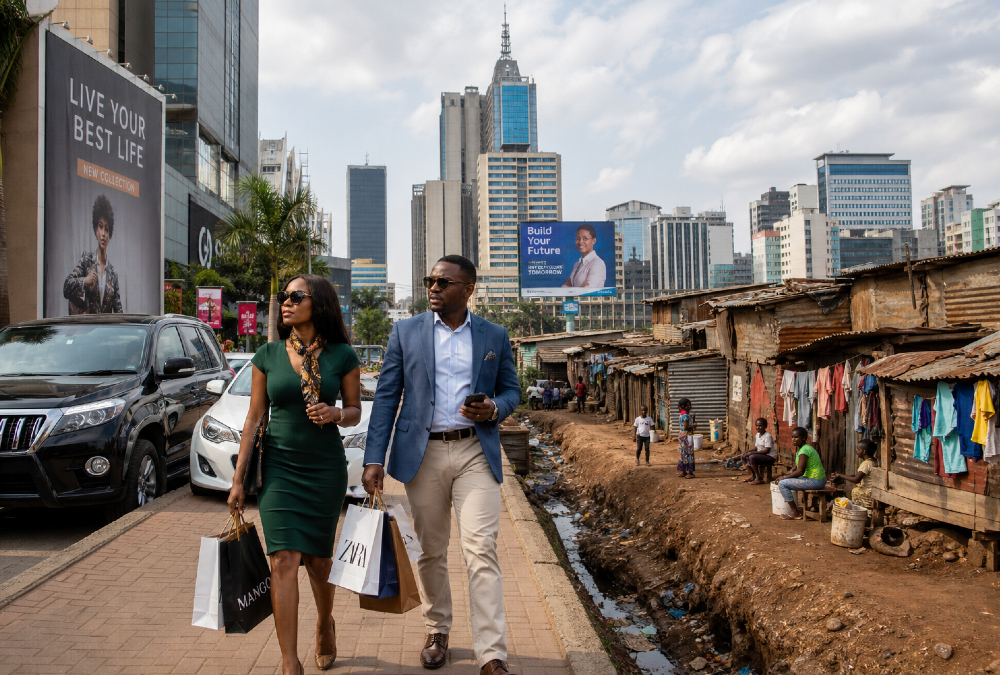
There is a version of Africa’s success story that is visually persuasive and economically deceptive. It lives in the gleaming new shopping mall, the gated residential estate, the smartphone upgrade, the imported car, the private school tuition, the airport lounge, the rooftop lifestyle district, and the soaring urban skyline.
It is the story of a continent that appears to be moving upward because parts of it are consuming more visibly – a story whose central protagonist is the so-called rising African middle class. For years, this narrative has offered reassurance to investors, policymakers, marketers, and governing elites alike.
It has implied that structural transformation is already underway, and that conspicuous consumption is itself proof of arrival. But a society can learn to look richer before it becomes stronger.
That is the central problem – and it is one that Africa can no longer afford to ignore.
Visibility Is Not the Same as Durability
The African middle class, as commonly imagined, has too often been treated as evidence of deep prosperity when, in many cases, it is evidence of shallow transition, fragile security, and uneven inclusion. This is not a denial that real gains in income, urbanization, access, and opportunity have occurred across the continent.
It is a demand that we distinguish between visibility and durability.
The World Bank’s latest regional outlook for Sub-Saharan Africa offers a sobering corrective: poverty reduction remains modest, with the share of people living on US$2.15 per day projected to decline only slightly after peaking in 2025, held back by weak investment in income-generating sectors, lingering inflationary pressures, and anticipated cuts in donor aid.
That is not the profile of a continent securely entering broad middle-class consolidation. It is the profile of a continent still suspended between promise and precarity.
This matters because the idea of a middle class is not merely statistical – it carries philosophical weight. A genuine middle class is not simply a cohort of people who can consume a little more than before.
It is a stabilizing social formation, occupying the space between mass vulnerability and elite insulation. It broadens the tax base, deepens domestic demand, supports institutional accountability, and generates the social expectations around competence, public goods, and long-horizon stability that underpin durable national development.
When it is fragile, it becomes a mirage: vivid from a distance, incapable of bearing weight when shocks arrive. That is where much of Africa still stands.
Aspiration Without Protection
Earlier analyses by the African Development Bank helped build an optimistic continental narrative around middle-class expansion – but even those frameworks distinguished carefully between a stable middle class and a far more precarious “floating class” living only marginally above the poverty line. That distinction is more urgent today than ever.
Across much of the continent, what is labeled middle class is more accurately described as shock-sensitive aspiration: households with sufficient income to participate in consumption, but without the structural protection to withstand inflation, job loss, illness, currency depreciation, school fee increases, fuel price spikes, or housing shocks for any meaningful period.
The World Bank’s 2025 social protection report makes the wider point starkly: across low- and middle-income countries, two billion people remain inadequately covered by social protection, with coverage particularly weak in the most vulnerable settings. Africa sits disproportionately within that gap.
This is why Africa’s middle class can expand in image while remaining unstable in substance. The shopping basket is not the same as security.
Lifestyle is not the same as resilience. Upgraded consumption is not the same as structural prosperity.
The Labor Market Problem No One Wants to Name
No middle class can be built sustainably on an economy where too much work remains informal, insecure, underproductive, and weakly protected. Yet labor fragility remains one of the great unspoken constraints on Africa’s social ascent.
The International Labour Organization’s 2025 employment outlook identifies youth unemployment and underemployment as critical global challenges, especially in low-income contexts, while its Africa-specific data continue to underscore the enormous weight of informality across the continent.
A society does not become broadly middle class simply because more of its population lives in cities. It becomes broadly middle class when productive, formalizing, income-deepening work expands fast enough to support predictable household progression.
That is a far higher bar than urbanization alone can clear.
Africa’s challenge, then, is not only that too many people remain poor. It is that too many who appear to have escaped poverty remain dangerously close to falling back into it.
Inflation, household debt stress, weak state capacity, uneven public services, and fragile job markets all conspire to make upward mobility thinner than it appears. The World Bank’s repeated emphasis on broad-based growth – tied explicitly to jobs, infrastructure, healthcare, education, and social protection – reflects a recognition that aggregate growth alone cannot fix distributional weakness.
When the Market Segment Precedes the Social Formation
For too long, Africa’s middle class has been discussed as a market segment before it was understood as a developmental formation. Banks wanted to lend to it. Retailers wanted to sell to it. Developers wanted to build for it. Politicians wanted to invoke it. International investors wanted to celebrate it.
What often emerged instead was a social category more financially exposed than institutionally secured – households that entered the language of progress without fully entering the infrastructure of stability.
That is precisely why the mirage is dangerous. It allows governments to confuse pockets of urban consumption with broad structural transformation.
It tempts elites to believe that because a visible consumer class has emerged in major cities, the deeper national development challenge is solving itself. It encourages prioritizing symbolic modernity over productive depth – imported goods, property bubbles, and debt-financed lifestyle aspirations packaged as evidence of advancement.
But a consumption class is not automatically a productive class. A country that imports most of what its aspirational households consume is not building prosperity – it may simply be widening dependence at a higher aesthetic level.
UNCTAD’s current research on inequality, poverty, and trade in Africa reinforces that distributional outcomes are tied to structural economic patterns, not income snapshots alone. If wages remain weak, manufacturing shallow, agriculture underperforming, logistics inefficient, energy unreliable, and local enterprise unable to scale, then visible urban consumption rests on a dangerously narrow productive base.
The Middle-Class Question Is an Industrial Question
At its core, the question of whether Africa can build a genuine, durable middle class is an industrial policy question. The more the continent builds productive sectors with real multiplier effects, the more it creates the conditions for stable household advancement.
The more it deepens local value chains, the more it reduces imported inflation and external vulnerability. The more it invests in decent work, accessible public transport, quality education, healthcare, affordable housing, and social protection, the more upward mobility becomes durable rather than cosmetic.
Middle-class expansion that is not tied to productive transformation remains acutely vulnerable to reversal – and reversals are already part of the contemporary African story. The African Development Bank’s 2025 outlook presents the continent as resilient but still exposed to significant global and domestic headwinds, with reform quality and domestic resource mobilization central to stronger long-term outcomes.
Resilience, however, is not the same as security. A household can be resilient because it has learned to survive instability. That survival does not constitute prosperity.
The Time Horizon Test
The clearest test of whether a middle class is real or illusory is time horizon. A fragile middle class lives quarter to quarter, preoccupied by school fees, rent, transport costs, grocery prices, power interruptions, and the ever-present threat of financial emergency.
Its members are trapped in a short psychology of existence even if they appear, by surface measures, to have advanced. A durable middle class lives year to year, generation to generation – planning for education, home ownership, enterprise development, retirement, healthcare, and the intergenerational transfer of opportunity with enough confidence to change how those plans are made.
A genuine middle class should signal that citizens can increasingly rely on earned income rather than survival improvisation; on institutions rather than private workarounds; on public-order rather than private insulation; on competence rather than connections. It should reflect a society where growth is not only occurring but settling into people’s lives with enough predictability to alter their planning horizon.
Africa needs far more of the latter and far less celebration of the former.
The Institutional Work That Markets Cannot Do Alone
A middle class is not built by market enthusiasm alone. It is built by a state and an economy that systematically reduce vulnerability at scale – through policy choices that support production, employment, affordable services, urban order, and household resilience.
It is built when financial systems do more than extract fees from aspiration. It is built when growth reaches beyond elite enclaves and informal struggle into an expanding zone of broadly shared stability. That is not romantic idealism. It is institutional realism.
Until Africa does more of that institutional work, the image of middle-class rise will continue to outpace the reality of middle-class security. The continent must therefore become more discriminating in what it celebrates – because premature celebration stops the demand for what is still missing.
If visibility is mistaken for victory, fragility is allowed to dress itself as progress. If advancement is measured by malls, consumer goods, and urban aesthetics rather than by productive depth, household resilience, and broad-based opportunity, the result is societies that look more modern than they are secure.
The Foundation Always Tells the Truth
The real African middle class will not be built by aspiration alone, nor by imported goods filling local shelves, nor by debt-funded lifestyles perched atop weak economic systems. It will be built by productive economies, decent and formalized work, stronger institutions, and a social contract that makes upward mobility less reversible.
It will be built when prosperity is thick enough to survive shocks – not merely visible enough to photograph.
What many African cities display today is not yet the settled confidence of a broad middle-class civilization. It is, more often, the choreography of advancement performed on top of an unfinished foundation. And foundations, unlike appearances, eventually tell the truth.
Daki Nkanyane is a South African – born Pan-African thought leader, entrepreneur, keynote speaker, and strategist with over 25 years of experience driving innovation, identity, and development across Africa. He is the Founder & CEO of Interflex Capital, AfrisoftLive, QonnectedAfrica, and iThinkAfrica, where he focuses on youth empowerment, entrepreneurial ecosystems, and Africa’s economic and ideological renewal. His work spans technology, digital transformation, major international events, and strategic advisory for future-ready African institutions. As a contributing writer for The Habari Network, Daki covers African innovation, leadership, human capital, economics, entrepreneurship, and Africa–Caribbean relations through cultural, philosophical, and developmental perspectives. His mission is to help shape a new African consciousness rooted in pride, possibility, and self-determination for Africans on the continent and in the diaspora. He can also be reached on Facebook and X.
