
Opinion
West Africa’s Efficiency Trap: Fix Corridors, Not Electrification
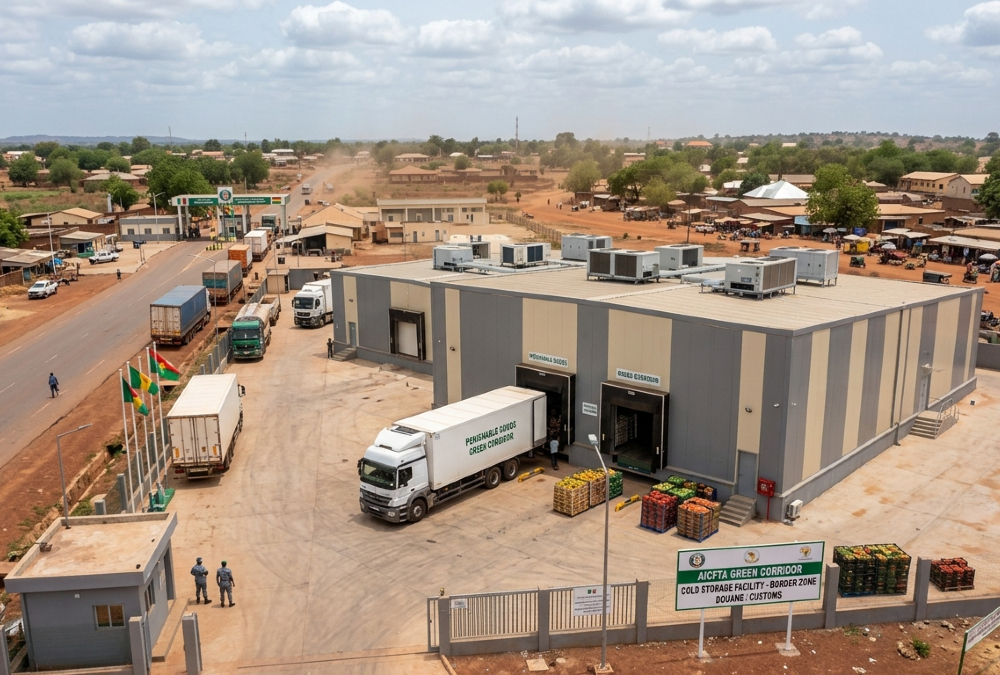
Rotting mangoes, idle trucks, and the compounding price of inaction.

By Ziad Hamoui
Every mango that spoils at Tema Port is more than a lost sale. It is a forest that may yet be cleared, a farmer pushed deeper into poverty, and a truck that burned diesel for three days going nowhere.
West Africa loses between 30 and 40 percent of its agricultural produce to post-harvest spoilage – a figure so familiar it has lost the power to shock. It should not have.
The economic toll is severe. The environmental cost is arguably worse, and far less discussed.
Every truck idling for 72 hours at a border crossing consumes the fuel, land, water, and energy that went into producing the goods rotting in its trailer. Spoiled produce does not simply represent lost income – it represents squandered natural capital: degraded soils, overdrawn aquifers, and mounting pressure to expand agricultural frontiers into what remains of the region’s forests.
Along the Ghana–Côte d’Ivoire (Ivory Coast) cocoa belt, those expanding frontiers are already threatening vital forest corridors and the biodiversity they sustain.
These are not isolated failures. They are the predictable output of a system in which cold-chain gaps, border bottlenecks, and bureaucratic inertia compound one another.
The result is waste on an industrial scale – environmental as much as economic.
Green Corridors Must Mean More Than Green Trucks
The growing conversation around “green corridors” within the African Continental Free Trade Area (AfCFTA) framework is welcome. But it risks fetishizing technology at the expense of fundamentals.
Electrifying trucking fleets matters; reducing the time those trucks spend stationary matters more. Real sustainability in West African trade logistics means shorter dwell times, fewer redundant journeys, and produce that reaches markets intact.
That is operational efficiency – and it is also, directly and measurably, climate action.
The African Development Bank’s Green Investment Program offers a critical opening. Trade facilitation infrastructure – streamlined border crossings, digitized customs procedures, expanded cold-storage capacity – should be recognized and funded as bankable green investments.
The case is straightforward: faster movement of goods means less fuel burned, less food wasted, and less pressure on already-stressed ecosystems. The link between environmental science and logistics may be underappreciated, but it is real.
The Checkpoint Paradox: When Security Theater Breeds Insecurity
West Africa’s trade corridors are among the most checkpoint-dense in the world, and defenders of the status quo routinely invoke security to justify them. The evidence, however, tells a different story – and a deeply troubling one.
Consider the Abidjan-Lagos Corridor, a 1,028-kilometer (639-mile) artery connecting five countries and one of the continent’s most commercially significant routes. Operators face multiple checkpoints every 100 kilometers (62 miles), each adding between 30 and 90 minutes of delay.
A journey that should take two days routinely stretches beyond 72 hours. The ripple effects are systemic.
Those delays do not make the corridor safer. Trucks stranded at predictable chokepoints become targets for theft and banditry. Prolonged holdups normalize informal payments, entrenching corruption across the supply chain.
When compliance with formal processes demands so much time and money that it becomes commercially unviable, traders route around the system entirely – blurring, in practice, the line between legitimate commerce and smuggling. That economic pressure, in turn, feeds the youth unemployment and accumulated grievance that extremist groups in the Sahel and beyond have proved adept at exploiting.
This is the checkpoint paradox: the apparatus built in the name of security actively undermines it.
Smarter Controls, Not Simply Fewer
The solution is not to abolish checkpoints but to make them intelligent. Risk-based targeting – expediting compliant operators and concentrating enforcement resources on genuine threats – is the logical starting point.
Intelligence-led operations, backed by shared databases and real-time coordination between national agencies, can transform static checkpoints from friction generators into functional security infrastructure.
Technology is not a luxury here; it is the mechanism. Internet-of-Things cargo tracking, digital customs platforms, and automated risk-assessment tools are already deployed elsewhere to considerable effect.
The East African Single Customs Territory and the Northern Corridor have demonstrated that smarter controls can sharply reduce transit times while simultaneously improving security outcomes. West Africa has no principled reason it cannot do the same.
As ECOWAS reflects on 50 years of regional integration – the achievements, the unfinished business, and the cost of delayed ambition – the moment is well-suited to pilot “smart corridor” initiatives across the region’s major routes. Rethinking checkpoint management is not a technical adjustment. It is a political choice about what kind of economic community West Africa intends to be.
The Imperative Is Now
The integration of trade facilitation into ECOWAS and AfCFTA climate strategies is not merely desirable – it is logically necessary. Every dollar invested in faster, cleaner, more secure corridors delivers returns across multiple ledgers simultaneously: economic competitiveness, environmental sustainability, and regional stability.
The concrete question for policymakers and private-sector leaders is what steps can be taken in the near term, rather than deferred to the next summit or the next strategy cycle. Pilot programs on the Abidjan-Lagos and Trans-West African Coastal corridors, funded through green investment mechanisms and designed around smart-control principles, would generate both results and replicable models.
West Africa’s infrastructure challenge is real, but it is also solvable. The continent has the institutional frameworks, the investment programs, and the analytical clarity to act. What it requires now is the political will to move goods – and move fast.
Ziad Hamoui is the Co-Founder and Past President of the Borderless Alliance, a leading private-sector advocacy group promoting economic integration and removing trade and transport barriers in West Africa. With extensive experience in Ghana’s road transport, logistics, and shipping sectors, he currently serves as Executive Director of Tarzan Enterprise Ltd., a long-established family business. He is a former Co-Chair of the Africa Food Trade Coalition, Co-Founder of the Trade Facilitation Coalition for Ghana, and serves on multiple high-level advisory committees on trade, transport, agriculture, and security. A Chartered Fellow of the Chartered Institute of Logistics and Transport (CILT) Ghana, he is also a former member of its Governing Council.
