
Opinion
The Nile’s New Calculus: How Ethiopia Built a Dam – and a Doctrine
When the world said no, Ethiopia said: watch us.

By Lance Chisue
In April 2011, on the parched banks of the Blue Nile in the remote Benishangul-Gumuz region, Ethiopia broke ground on the most audacious infrastructure project in African history. No international lender had agreed to finance it. No downstream neighbor had consented to it. No foreign power had blessed it.
The Grand Ethiopian Renaissance Dam – the GERD – was born entirely of sovereign will, and the world was skeptical. Fourteen years later, that skepticism looks embarrassingly misplaced.
A Funding Model the World Had Never Seen
The conventional wisdom in development finance holds that megaprojects require multilateral backing. The World Bank, the IMF, major bilateral lenders – these are the institutions that build dams.
Ethiopia, facing geopolitical headwinds and downstream opposition from Egypt and Sudan, was effectively shut out of that system. So it built a different one.
The government turned inward. Civil servants pledged months of salary. Farmers and university students contributed their savings. Ethiopians in the diaspora wired millions home from Washington, London, and Riyadh.
Through bond issuances and a sustained national fundraising campaign, the country mobilized an estimated US$5 billion domestically – making the GERD arguably the largest infrastructure project ever financed primarily by the citizens it was built to serve.
This was not charity. It was a calculated bet on national destiny.
Defying Geopolitical Gravity
The pressures arrayed against the project were considerable. Egypt, which relies on the Nile for over 90 percent of its fresh water, viewed the dam as an existential threat and lobbied aggressively – including at the United Nations Security Council – to halt construction.
The United States suspended aid to Ethiopia in 2020, partly in response to the dam dispute. Colonial-era treaties, signed without Ethiopian consent, were invoked to argue that Addis Ababa had no legal right to build at all.
Ethiopia’s response was consistent and unmoved: the Blue Nile originates within its borders, and no nation requires foreign permission to develop its own natural resources. That sovereign stance, maintained across multiple governments and years of external pressure, proved more durable than the opposition.
Engineering at the Edge of the Possible
The site itself was hostile. Temperatures regularly exceed 40 degrees Celsius (104 degrees Fahrenheit).
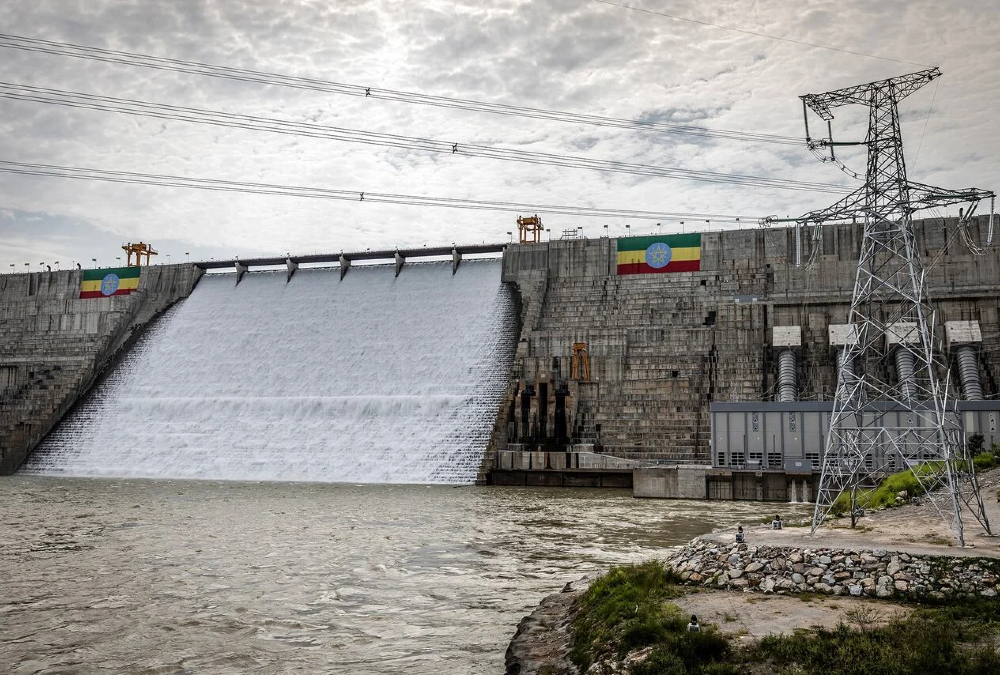
The terrain is remote, the logistics punishing. And yet thousands of Ethiopian engineers – working alongside Italy’s Webuild, the project’s primary contractor – poured 11 million cubic meters of concrete into a structure that now stands 145 meters (476 feet) tall and stretches nearly 1.8 kilometers (1.12 miles) across the river.
The reservoir behind it holds 74 billion cubic meters of water, enough to sustain a century of power generation.
The dam’s 13 turbines are now fully operational, producing 5,150 megawatts of electricity – roughly doubling Ethiopia’s previous national capacity and positioning the country to become a major exporter of clean energy across the Horn of Africa and beyond.
What It Means
The numbers are striking on their own terms: millions of homes now electrified, potential annual revenue of more than US$1 billion from power exports, and a reservoir that also promises to improve irrigation across the region. But the significance of the GERD exceeds its specifications.
For decades, the dominant narrative around African development has centered on dependency – on aid, on foreign investment, on external validation. The GERD disrupts that narrative in a way that statistics alone cannot capture.
It represents a model in which a low-income country identifies a strategic national priority, finances it through collective sacrifice, withstands sustained international pressure, and delivers. That is not a small thing.
A Blueprint, Not Just a Dam
The GERD’s inauguration in September 2025 marks not just the completion of a construction project but the maturation of an argument. The argument is this: African nations need not wait for permission – from lenders, from colonial-era treaties, or from more powerful neighbors – to build the infrastructure their populations require.
Whether that argument spreads beyond Ethiopia’s borders will depend on factors well outside Addis Ababa’s control. Financing constraints, institutional capacity, and geopolitical contexts vary enormously across the continent.
The GERD was not achieved without cost – the dam has strained regional relationships that will take years to repair, and the downstream water-sharing questions it raises remain unresolved.
But as a proof of concept, it is difficult to argue with a 145-meter (476-foot) wall of concrete on the Blue Nile.
Ethiopia did not wait for a seat at the table. It built one.
Lance Chisue is the Founder and CMO of Sales Connect Africa, a Pretoria-based firm specializing in helping manufacturers enter and grow in Southern African markets. He leverages sales expertise and strategic visibility to connect products with buyers, supporting manufacturers in navigating complex regional market dynamics and distribution channels. Lance is dedicated to empowering manufacturers to succeed by bridging gaps between products and customers in emerging African markets
